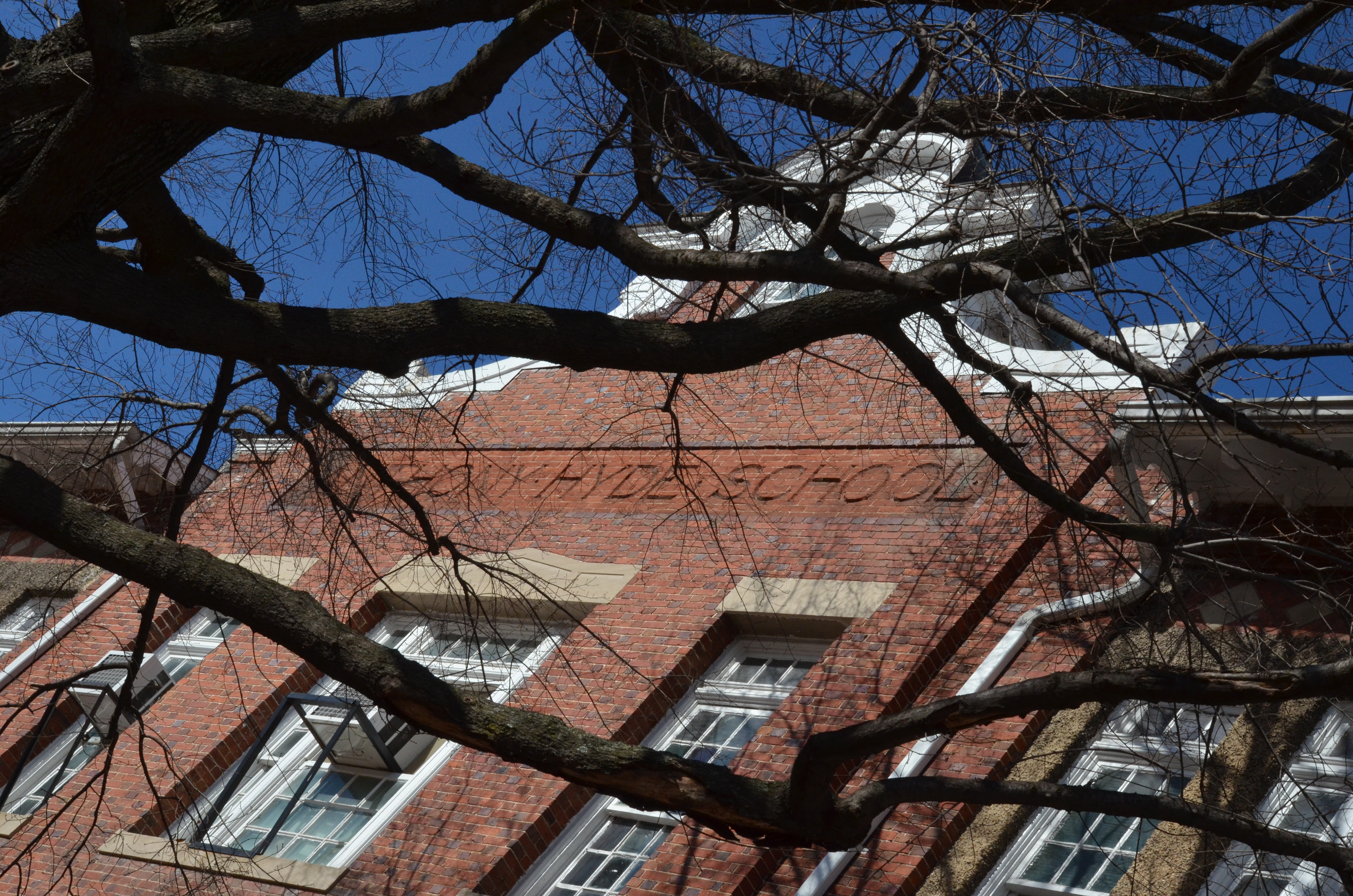
As discussed yesterday, the city is currently conducting a comprehensive evaluation of school boundaries and assignment policies. And GM specifically discussed how the initial proposals called for an expansion of the boundary for Georgetown’s elementary school, Hyde-Addison.
Today GM discusses the far more radical portions of the initial proposals. As announced by the Deputy Mayor of Education, Abigail Smith, the proposal is organized into three potential policies. GM will discuss each separately and how it would impact Georgetown below:
Policy Example A
This first proposal is by far the most radical and would, frankly, by far be the worse outcome for Georgetown. First of all, Georgetown kids would lose the guaranteed right to attend Hyde-Addison. That’s because under this scenarios, no one in the city would have the right to attend their local elementary school. Every elementary school would be grouped into a “choice set” of 3-4 schools. All children would enter a lottery that would assign them to one of the schools in the choice set.
Hyde would be placed in a choice set with Ross Elementary in Dupont and Francis-Stevens in the West End. Thus when a Georgetown family decides to send their child to elementary school they would enter a lottery and be assigned one of the three schools, even if you live across the street from Hyde.
Regardless of what elementary school the Georgetown child attends under this scenario, the student would have rights to attend one of the two closest middle schools based upon his or her home address. In Georgetown that would likely mean Hardy Middle School and Francis-Stevens (which goes from K-8). DCPS would allow the student to state a preference between the two, but wouldn’t guarantee a seat at the preferred school.
For high school, all students would enter a citywide lottery. The policy refers vaguely to giving preferences to proximity, but it doesn’t detail what that actually means. For what it’s worth, the closest comprehensive high school to Georgetown is Dunbar in Truxton Circle. So, Georgetowners would probably lose much hope of attending Wilson High under this scenario.
Basically under this scenario, Georgetowners would be denied guarantees to attend every school they now currently have a right to attend. Whatever success DCPS has achieved attracting Georgetown families to Hyde (as well as whatever nascent revival of local interest in Hardy there is) would likely be squashed. So, yes, this is the worst scenario for Georgetown.
Policy Example B
The second scenario basically keeps the existing feeder patterns. So for Georgetown that would mean the continued right to attend Hyde, Hardy and Wilson.
The most significant difference from the current system is that at every school, there would be a certain percentage of seats set-aside for children who live in a zone with a “low performing school”. At the elementary school level, that would be 10%. For the middle school level that rises to 15%. And for high school, that rises to 20%. It’s not clear what makes a school qualify at “low performing school”. (The set asides would apply the same in all three scenarios).
Also, with this scenario, all children have a right to continue on to the designated school at the next level. So, for example, a child from outside Georgetown who obtains a seat at Hyde would have a right to continue on to Hardy and Wilson. What’s not clear is if the set-asides are cumulative. In other words, does a middle school need to set aside 15% of its seats on top of the seats taken by children who enrolled through one of the elementary schools? Probably not, but so far it’s just not clear.
This feature of this scenario is unlikely to have much impact on Georgetown. Currently about half the seats at Hyde and a wide majority of the seats at Hardy are taken by out of boundary students. The set aside would merely make sure that a certain portion of those children come from zones with particularly bad schools. Also, part of the justification for expanding Hyde’s boundaries is to free up space at Glover Park’s Stoddert and the Palisades Key. Children in Burleith and Foxhall Village would now go to Hyde. So for Hyde, the implementation of set asides would ironically lead to fewer seats available for out of boundary kids.
This scenario is mostly fine for Georgetown in that it minimizes the changes.
Oh, there is one possible significant change for Georgetowners. This policy refers vaguely to the construction of a new high school to relieve crowding at Wilson. This would likely mean a high school where children who feed to Hardy would be assigned. This would be similar to the long discussed plan to restore Western High School. (Placing a restored Western High School in its old building is unlikely at this point because the Duke Ellington School, which occupies the building, is about to undergo significant renovations.)
Policy Example C
The final scenario is somewhere between the first and the second.
For elementary school, all children would continue to have rights to attend their local school. So Georgetowners would continue to have rights to Hyde.
For middle school, however, all children would have to enter a lottery (no feeder rights for out of boundary students). The lottery would be similar to the choice sets under Example A. For Georgetowners the middle school choice set would be Hardy and Deal. Deal is widely viewed as the best middle school in the city, so it goes without saying that Georgetowners’ middle school options would improve under this scenario.
However, at the high school level the city-wide lottery concept returns. And in this case there would be no preference given for proximity at all. Then again, as mentioned above, the closest comprehensive high school to Georgetown is Dunbar, which is unlikely to attract any Georgetown students anytime soon. So for all intents and purposes, under this scenario Georgetowners would likely be considering charters or a specialized high school (like Schools Without Walls in Foggy Bottom).
As mentioned above, the set asides would apply the same to this scenario as in the other two.
What’s Actually Going to Be Adopted?
Who knows. These scenarios are being put forward by a deputy mayor to a mayor who has just been kicked out. Neither of the two primary candidates, Muriel Bowser and David Catania, have made any statements yet.
But as controversial as the proposals are, a lot of work went into generating them. And the next mayor probably doesn’t want to start from scratch. Moreover, Gray is going to be mayor for the next nine months regardless, and can push the ball forward enough that the next mayor may be reluctant to stop the changes. And not for nothing, but the situation probably allows the next mayor a lot of political cover to enact large changes without having to take credit (or blame) for it.
That said, here’s GM’s educated guess (rim shot) of what will make it through to the final plan:
- Most of the elementary school boundary changes will be enacted, although not all of them. Some organized efforts from dramatically affected blocks will be successful.
- The set-asides for children from neighborhoods with poorly performing schools will be enacted. They are in all three scenarios. And more importantly, they represent a reasonable compromise between allowing schools in wealthy neighborhoods become overwhelmingly attended by wealthy children, and keeping access to these high performing schools to children not born into the same privilege.
- Because these set asides will maintain access to “west of the park” schools for a significant, if not exactly huge, number of children from poorer neighborhoods, the core of the current system will be kept. In other words, some version of Scenario B is likely to be adopted.
If you want to weigh in, go to engagedc.org to submit comments. GM highly encourages you to do so!






 The Georgetown Metropolitan
You must be logged in to post a comment.