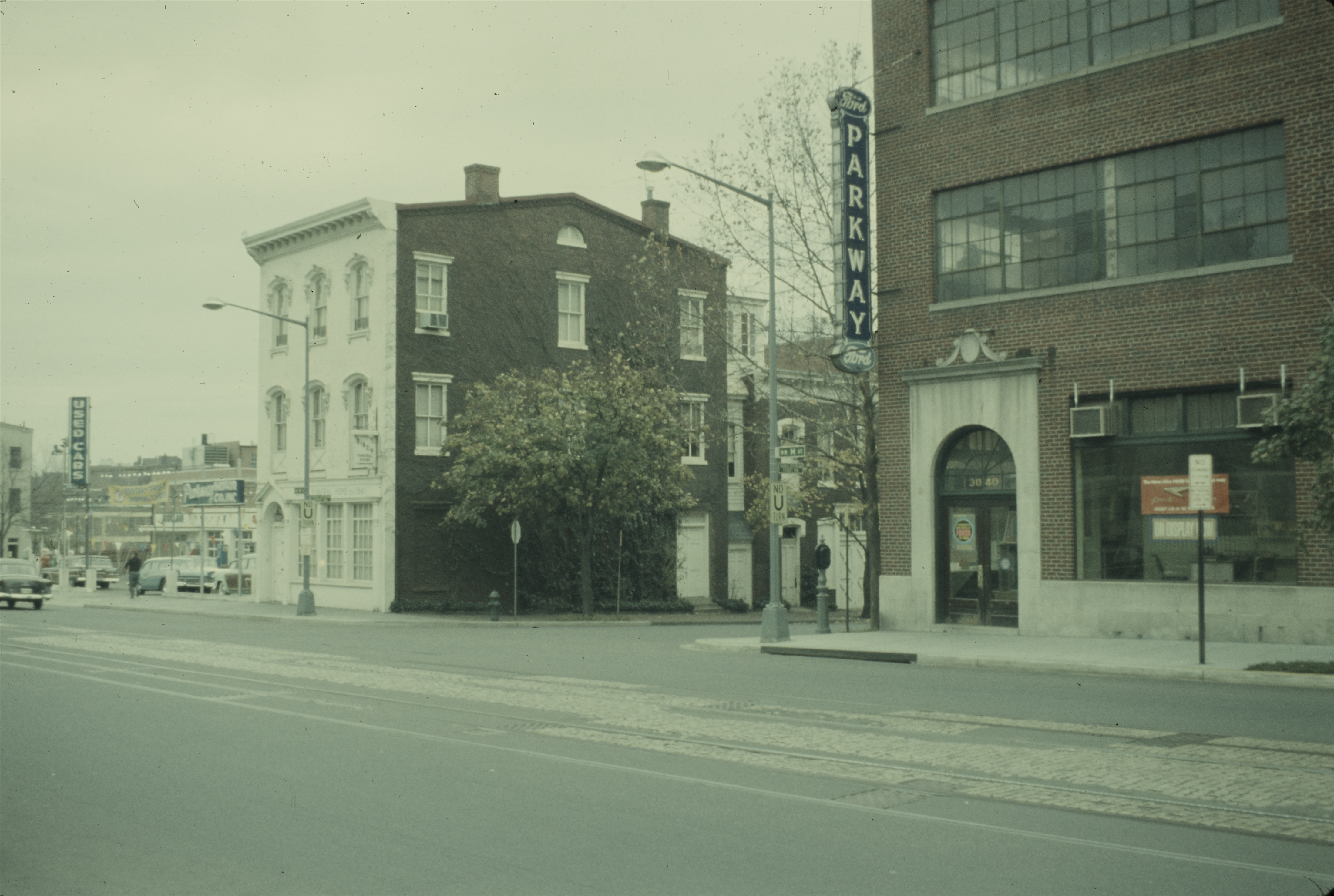
This week for Georgetown Time Machine, I’m again flipping through the Emil. A. Press collection at the DC Historical Society. This one comes from 1965 and shows the legendary Crazy Horse bar at 3261 M St.
Crazy Horse was a rowdy bar that was open for decades until finally closing in the late 90s. Excerpts from the Post article from the 80s gives a good sense of the place:
THE CRAZY HORSE has gone upscale? Thankfully, not really. A few changes have been made by management to weed out the rowdies and defuse antagonism in the surrounding Georgetown area, but it’s basically the same beer-and-boogie bar that opened its doors on M Street almost 20 years ago. The Crazy Horse still fits one man’s definition of a good rock’n’roll club: a place in which most of the patrons have never opened an IRA.
Rodzilowski says that along M Street, only the nearby Paul Mall also offers live music, and that club attracts more of a suit-and-tie crowd. That’s something you haven’t seen much of at the Crazy Horse, which for years had the reputation of the bad boy of genteel Georgetown. Hard rock and wet T-shirt nights were among the elements that at times made the Crazy Horse a pretty rowdy spot.
“There’s no question about that,” Rodzilowski says. “When I came here 16 months ago, it attracted a much rougher crowd. You had a lot of fights, a lot of bums and guys with leather jackets. I remember when I first started here, I’d be working the door and I’d see some young women looking inside, like they’d like to come in. I’d say, ‘Why don’t you come inside?’ And they’d look at me like I was nuts.”
This sort of rowdy behavior was what eventually inspired the liquor license moratorium, which began the long slow death knell of these sort of bars.
After hosting the Coach for many years, this building now holds an Everlane, which is not nearly as much fun as Crazy Horse was:
At least somebody has faith that Gen Z is going to finally start dating each other settle down: a DTC diamond shop is opening up in Georgetown. The shop, Blue Nile, is apparently going to take over the James Allen space at 3109 M St.
But when I looked a little more into it, it turns out that Blue Nile is owned by the same holding company that also owns James Allen. So this is more like a repositioning of a brand strategy than one shop moving in to replace another.
This week on the podcast, I’m talking about the French Market coming this weekend, a French music festival later in June and finally the story of how a legendary American tune about a mountainous rural state was actually written here in urban Georgetown on 31st St.
This week for Georgetown Time Machine, I’m checking out another photo from the Emil Press Collection at the DC Historical Society. It shows the southest corner of 35th and O St. in January 1969.
What you see now, of course, is the psychedelia-by-way-of-Miami otherwise known as Call Your Mother:
But in 1969 the building hosted Feldman’s Market. This was one of the many small (often Jewish-owned) grocery stores that once dotted Georgetown (and the rest of DC) before the age of the supermarkets. I wrote a bit about the history of this market and the building itself a few years ago:
Let’s start way back in the 1850s. (I wasn’t kidding about it being a long story). Sometime around 1859, a building was constructed at the southeast corner of Fayette and Second Streets. It was constructed to have a grocery store on the first floor, with a residence on the second floor. This was a common sight in Georgetown in the century before supermarkets were invented. Back then most people bought their food from small corner grocery stores, which themselves obtained their supplies wholesale from the large city markets, like Central or Eastern Markets.
A grocery store stood at this location well into the 20th century. For a long time it was a location of the chain of small grocery stores operating under the name “Sanitary Grocery Co.” Here’s an ad from 1926 listing the address (by then Fayette Street had become 35th and Second Street became O St., and so the address was, and is, 3428 O St.):
But the arrival of the supermarket model in the mid-20th century brought the days of the ubiquitous corner grocery store in DC to an end. For this location that end was in 1970, when a health foods store opened up in its place. It only lasted about a year and was then replaced with an antiques store. This lasted for many years and was ultimately replaced by a flower shop. The flower shop closed in 2019 at which point Call Your Mother signed its lease to operate here.
So this photo was actually taken nearly at the end of the grocery store’s operations. In fact there’s a for rent sign by the door. Maybe that’s for the apartment upstairs, but more likely it’s for the store itself (moreover, often store space like this were rented along with the apartment upstairs where the shop owner would live.)
I’m not sure when it ceased being a Sanitary Grocery Store. That chain was actually bought up by Safeway in the 20s, but most of the small grocery stores kept operating under the original name until about 1940. In fact, if you look closer, the window has a sign saying it was part of the District Grocery Store chain. DGS, as it was called, was more of a cooperative among independently owned and run stores than a proper chain. It was a major part of DC’s landscape until their decline, especially after the 1968 riots. It ceased operations in 1972, just a few years after this particular location stopped operating as a grocery store.
The former DGS Deli on Connecticut Ave. in Dupont was named in honor of the DGS coop. Sadly it closed in 2018.
Lastly, I’ll point out that the building that is just south of Call Your Mother, which sure looks like it was also once a commercial building, was in fact a commercial building. In 1969 it appears to have been a real estate agent’s office.
The time is here! Start watering those street trees!
It hasn’t been an especially wet spring so far, so newly leafing trees will already be a bit thirsty. You especially need to make sure every week that young trees have actually received at least 25 gallons of water a week. Heavy but brief rain showers don’t actually drop that much water on us. So it’s good to supplement it with water from a hose.
If it’s a new tree, hopefully it has an ooze tube, those large bags around the base of the tree that can be filled from a hole on the top. Fill them up once a week and you’re all set. If you don’t have one, you can just leave a hose dribbling out water for about 20-30 minutes, and that will suffice.
It is rewarding to see trees that were once meek become giants. I’ve lived on my current block for 11 years and I’ve already seen several trees make that transition. I’ve also seen several older trees cut down. It’s the inevitable end, but an end that can be softened by the presence of young and thriving trees. And keeping on top of watering them will ensure their future for many more years.
Don’t miss this unique opportunity to interact with prominent New York commercial and fine art photographer, Matthew Klein.
Welcome to Art and Not Art, in which notable New York photographer Matthew Klein embarks on a thought-provoking discussion about the blurred boundaries between what is and what is not art! The event will leave you questioning what you thought you knew about art!
Background:
Matthew Klein is an award winning New York commercial photographer known for iconic images which have appeared on many magazine covers, including Time, Psychology Today and the New York Magazine.
Klein collaborated intensely with Milton Glaser, who was among the most celebrated graphic designers in the United States. Today, Matthew Klein’s practice encompasses intense explorations in personal image-making.
Facilitating the discussion is David Levy, who brings to the conversation his long-time experience as former President and Director of the Corcoran Gallery of Art and Corcoran College of Art and Design, Chancellor of The New School for Social Research in New York City, Executive Dean and CEO of Parsons School of Design, and President of Sotheby’s Institute of Art.
2. May 17
Jackson Art Center Spring Open Studios
Sunday, May 17, 2026 12:00 PM 4:00 PM 3050 R St, NW Washington, DC 20007
Free
Twice a year, the 40 resident artists of Georgetown’s Jackson Art Center open their studios to the public, showcasing painting, sculpture, photography and ceramics. Come view the studios, chat with the artists, enjoy light refreshments and pick up some fresh art.
This week for Georgetown Time Machine, I’m exploring a story that at first glance seemed to be a story about whether preservation rules are too strict but actually turned into a wild history of police chiefs getting bitten and WWII era latin jazz.
But lets start with the seemingly innocuous photo. It comes from the DC Historical society. It’s from the Emil Press collection and was taken around March of 1964. It shows 3213 O St. which at the time was a former coffeehouse named Gallery. It operated here (with “red jacket waiters sedately serving cappuccino and darjeeling” according to the Washington Post) for seven years.
The owner, Amanda Goudie, decided in 1964 to pick up sticks and open a new coffee shop a block away at 3210 N St. You can see the announcement in the window of the coffeeshop intentionally(?) misspelled:
cum and see are new garden coffeehouse at 3210 N St. It looks like this-> (with a drawing of the new location).
That new location, however, would turn out to be a big headache for Ms. Goudie. According to a Washington Post article from a couple months later, she got into some serious trouble with the preservationists:
Apparently she needed to do some work on the new location, including fixing the door. According to the article, the plans she got approved by the CFA included one design for the door, but she installed a different one. This lead to a summons from the DC government. She was nonplussed:
She was due to appear before the DC government and account for her actions two days after this article appeared, but at the last minute the CFA came to her rescue:
Sadly for Ms. Goudie, this small victory did not save her from being savaged by the Post a few years later when her shop chased the fondue craze:
I’m not sure when the shop closed, but Ms. Goudie eventually made her way to Harpers Ferry, WV where she opened another coffeehouse. She also appears to have become a bit of a local gadfly. After a violent run in with the police chief in which she apparently bit him, she stood trial and acted as her own lawyer. It was, as it always is, a mistake:
She was fined $500 and then promptly announced she was running for mayor. She got seven votes.
Another source states that before all this, she sung under the name Amanda Lane with the Desi Arnez Band. Here she is singing East Street in 1946:
It’s pretty incredible sometimes what stories you uncover when you start digging around a completely innocuous photo of a closed coffee shop…
For the record, 3210 N St. still has a window with 8 rows and a square-topped door.
This week on the podcast I’m talking about some major changes that are coming to the western end of Water St. and how once significant flaw will remain until we come up with a solution.
You must be logged in to post a comment.