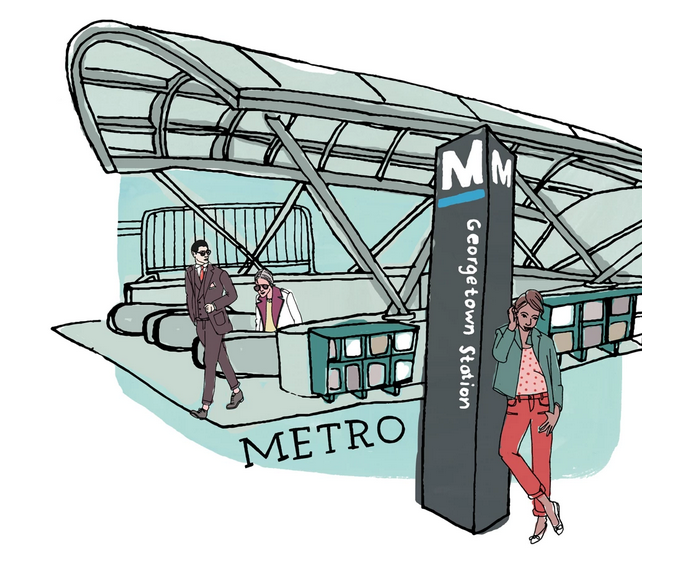
Last year the Georgetown Business Improvement District issued a dramatic plan charting out what Georgetown will need to look like in fifteen years if it will remain a viable commercial district. It was full of eye-catching details-like two new Metro stations and, yes, aerial gondolas-as well a more mundane improvements, like signage and repair to the canal. (Catch all disclaimer: GM was on the steering committee of the plan representing the Citizens Association of Georgetown.)
Coinciding with the first year anniversary of the plan Lavanya Ramanathan of the Washington Post reviewed the plan anew, and came away with a distinct case of cognitive dissonance:
One year after the plan’s splashy launch, the first palpable elements of Future Georgetown are coming after a series of government approvals: a dock on the C&O Canal could be installed by this summer. Micro leisure areas, known as “parklets,” are slated to open as soon as this summer.
So, why is it that we can’t quite square the European-style courtyards and contemporary light installations of Future Georgetown with Current Georgetown, a strange mosaic of wealth, history and buttercream-hungry tourists?
…
A gondola in Logan Circle or Shaw or on H Street NE, sure…This almost never happens in Georgetown, where the houses still go to buyers of a certain stratosphere and the sidewalks are still brick, never mind that it’s hell on the stilettos of today’s well-heeled Georgetowner. It’s a quarter that, depending on your vantage point, is either admirably quaint or kind of oblivious.
Perhaps expecting to find Nimby resistance to the radical ideas, Ramanathan reached out to various likely suspects. But she didn’t find it. The Citizens Association backs the effort. The University backs the effort. Even the stodgy Old Georgetown Board is open to ideas such as the aforementioned gondolas or the idea to use dramatic LED lights to illuminate the Key Bridge or the underside of the Whitehurst:
“You try to preserve what you can, how you can, of its character, but it has to be a living place,” says Thomas Luebke, secretary of the [Old Georgetown Board].
Ramanathan’s skepticism finally falters a bit at the end:
That won’t necessarily make it less challenging for [BID CEO Joe] Sternlieb and his team. But, he says, “if it was as easy to do a development in Georgetown as it is to put up a strip center on Route 29, Georgetown would look like Route 29.
“If it was easy, I’m not sure it would be better,” Sternlieb adds. “But just because it’s hard doesn’t mean it won’t happen.”
Not every radical idea in the report will come to fruition. And some of that will be because of the inherent conservatism that Ramanathan is getting at. But the challenges are much more likely to come from the outside of Georgetown than from inside. Will the city and the region back a new Metro line? Maybe, but Georgetown will be all for it. Will the city back aerial gondolas? Who knows, but Georgetown is going to ask. And so on.
If a new Georgetown that recognizes is strengths while also acknowledging its shortcomings creates cognitive dissonance, then so be it. At least they’re talking about us again, instead of writing us off with the tourists and the cupcakes.







 The Georgetown Metropolitan
You must be logged in to post a comment.