

At the turn of the 20th century, a smelling, decrepit and shameful scene lingered in Georgetown: the old Presbyterian Burying Ground. And for Georgetown Time Machine, GM will take a closer look at it by way of an article from 1902 in the Washington Times.
Rather than try to tell the whole story of the old cemetery, GM will mostly direct you to the surprisingly extensive Wikipedia article about it instead. But in short: the burying ground was built in 1802 by the Georgetown Presbyterian Church on the site of the current Volta Park. At the time the church was located at what is now 30th and M, which had its own graveyard, but that soon filled up:

As described in Wikipedia:
Presbyterian Burying Ground was laid out simply, similar to most cemeteries of the day. The cemetery had two gravel paths, lined with fir trees, one which bisected the grounds east–west and another which extended from 4th Street north to the center of the block.[14][15][16] The main entrance was in the east on Market Street.[17]Black locust trees were planted about the grounds.[17] A winding, somewhat circular path occupied the intersection of the two fir-lined gravel walkways.[14] No other footpaths were laid out, however, and access to most graves, vaults, and mausoleums were via informal dirt ruts in the lawn. Vandals and children were kept out by a high wooden fence.
The land was donated by the wealthy Beatty family on the condition it always be used as a cemetery (that became an issue later). A chapel was constructed on Market St. on the east side of the grounds in 1855:
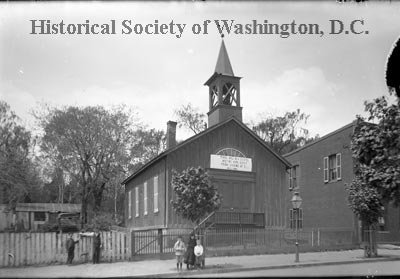
But by second half of the 19th century, the burying ground was in steep decline. It accepted its last burying in 1887, and then, lacking the income from new burials, its finances spiraled. In 1891 the cemetery was closed. Descendants of loved ones were asked to remove the remains by the end of the year. Any remaining bodies would be interred in a mass grave elsewhere. Notwithstanding this deadline, most of the bodies remained and disinterments occurred spottily throughout the 1890s.
In the meantime what was left was a field of smelling, open graves, toppled gravestones and crumbling vaults. By 1900 it also became a dump for Georgetown residents.
Continue reading











 The Georgetown Metropolitan
You must be logged in to post a comment.