Today on Georgetown Time Machine, I’m exploring another photo from the DC Historical Society. The file indicates that it is from 1925 and shows “View to east from Wisconsin Avenue NW down M Street; laying of Belgian block pavement.” But what’s the story?
The location appears correctly described. I believe this is basically the intersection of Wisconsin and M St., with the former Riggs Bank on the left and the old Heon Pharmacy (later Nathans and later still Capital One Cafe) on the right.
But what are they doing in the photo? I searched through local newspapers for items describing this event around 1925 and did not find anything. However I found a couple clues that might suggest what’s actually happening.
The photo record indicates that it includes Isaac Nordlinger. Nordlinger was the President of the Citizens Association around this time, so it suggests that this event may have been organized by the group. But newspaper articles from around that time call into question the description that they are laying Belgian blocks. If anything, they may be removing them.
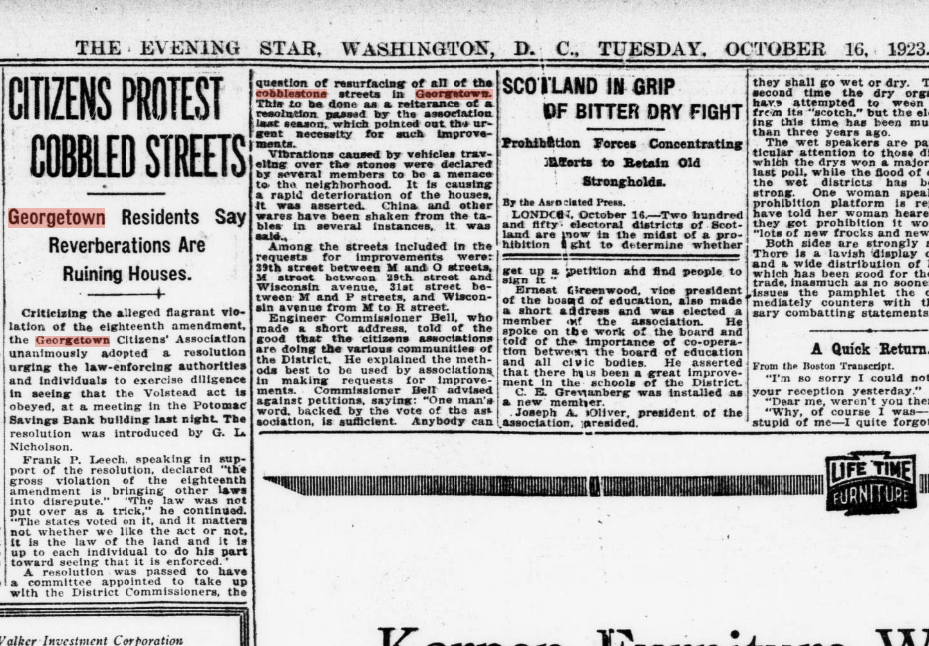
Belgian blocks (sometimes mistakenly called cobblestones, which are technically something different) got frequently mentioned in newspapers of the day. But it was normally in the context of groups complaining about them. The complaints related to how they affected car traffic. And in Georgetown specifically the Citizens Association was complaining about the vibrations from the paving (which is really a complaint about the cars, of course, but the pavement got the blame instead) In classic Georgetown fashion, the worries center on broken china:
Read that last article to the bottom: It describes the proposal to shrink the M St. sidewalk width (it says Wisconsin Ave., but they’re clearly talking about M St.) in order to allow more car traffic through based on the evergreen illusion that by merely widening a road you’ll finally solve traffic congestion. At least a century ago they could be forgiven for falling into this logic trap since cars had not been around that long; plenty of modern day people do it without such an excuse.
So instead of 15 foot wide sidewalks on M St., we were left with 10 foot sidewalks, which is what we’ve still got. The irony of this is that some opponents to the widened sidewalks and streateries cite history as a reason to oppose the very idea of wider sidewalks in Georgetown. As with a lot of arguments about history in Georgetown, a fake or otherwise mistaken understanding of history is doing a lot of work justifying positions that are really more about modern day aesthetic preferences than anything related to the actual history.
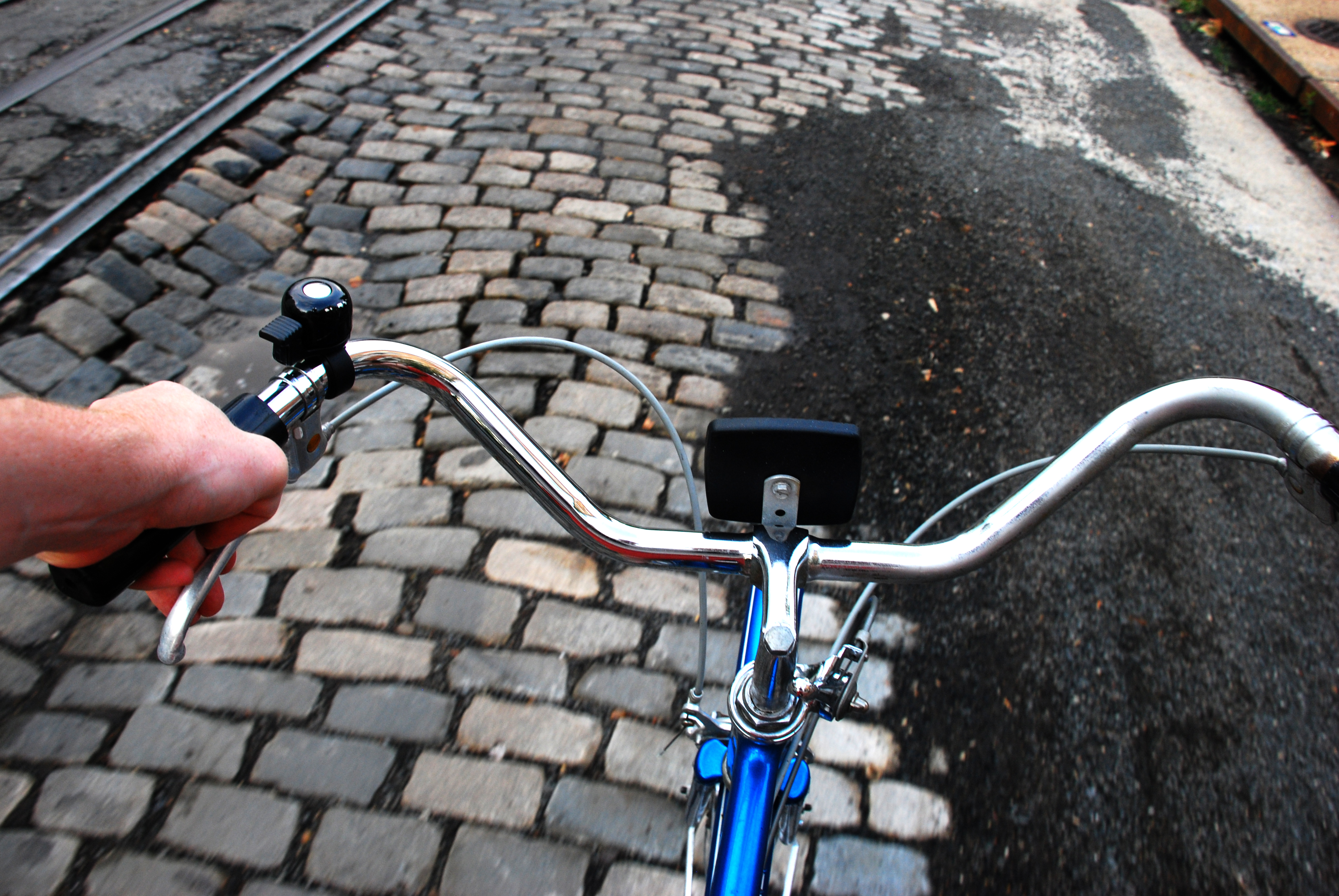
As for our friends posing for the camera in 1925, I can’t really say for sure whether they’re installing Belgian blocks or removing them. Belgian blocks remained on M St. for decades after this photo in connection with the streetcar lines. Here’s what M St. further east looked like in the 1950s:
It seems unlikely to me that they were installing new Belgian blocks on M St. in 1925, just a few years after they were asking the city to pave them over. But who knows.
Interestingly, a lot of those Belgian blocks are still there under the pavement. I’ve long wished the city would consider bringing them back the surface on some streets, china tea service be damned.
Next Thursday is Bike to Work Day. As usual, the Georgetown BID will be sponsoring a pit stop in the Georgetown Waterfront Park from 7 am to 9 am. Stop by to get a bunch of tasty neighborhood treats and bike-related schwag.
Register here! (It’s not required to register in order to partake, but it helps them plan and track).
If you are one of the many being mandated to return to the office, now is a great time to get into (or back into) the biking to work habit. It’s one of the best ways to improve your mental health!
Hello and welcome to the May Northwest Georgetown ANC update!
Spring is here and with it some helpful reminders:
Trees:
Our wonderful street trees need our help to get growing. If there’s a relatively newly planted tree on your block (i.e. planted within the last 3 years) it will need regular watering to thrive.
The basic goal you should have is to water young trees at least once a week with a good 20-25 gallons of water, from now until the trees drop their leaves in the fall . If you can’t water the new trees, try to find a neighbor who can.
The preferred watering device is the ooze tube (the bags that go around the bottom of the trees). You can differentiate them from the not-preferred gator bags because the gator bags have zippers. (They’re not preferred because they can create an unhealthy environment around the trunk and you have to remove them after each use.) With the ooze tube you can just fill it up and let it go.
If you don’t have an ooze tube, you can just leave a hose trickling into the tree box for 30 minutes to an hour.
Once a tree is mature, you can stop watering it. By then the roots are so spread out under the sidewalk that it doesn’t need your help anymore (although during any particularly dry periods, it can’t hurt to water it).
Garden Waste:
If you’re a gardener, this time of year means lots of garden waste from pollen and fallen blossoms, etc. In order for the city to take this away, you need to put the waste in paper bags (like the ones that hardware stores sell). Garden waste left out in plastic bags won’t get picked up.
As for the picking up part, you need to file a 311 request to schedule it. (The exact title of the service you need to request is “Scheduled Yard Waste”). Frustratingly, the reservations are typically several weeks away. So you can be stuck with the bags for that time. One strategy I recommend is to organize with a neighbor or two who also have yard waste and schedule out several staggered appointments that you all can share.
Bulk Waste:
Spring cleaning also often includes wanting to get rid of bulk items, like couches and other furniture. You can schedule that pick up through 311, but you have a better option this time of year. As part of the wonderfully successful Georgetown Community Partnership, the university offers its students free bulk trash pick up. This helps avoid situations of students leaving town with trash and other items sitting on the sidewalk. The good news is that non-student residents can take advantage of the same service!
The entire WMATA bus system is about to undergo a complete overhaul. Starting June 29th, every single bus line will receive a new name. And in most cases it will also receive a new route.
I’ve described the changes in detail here, but here is a handy thumbnail description of how the existing Georgetown lines will appear starting June 29th:
D2: This will now be called the D96 and it will now travel from Bethesda all the way to Foggy Bottom. The Georgetown to Dupont section will largely remain the same.
G2: This will now be called the C91. It will still travel from Georgetown University to Howard University. But instead of traveling along O, P, and Dumbarton through Georgetown, it will travel on Q St.
D6: This will now be called the D94. It will still travel to Sibley, but no longer will it go eastward to RFK. It will now terminate in Chinatown.
38B: This will now be called the A58. It will still travel from Farragut out to Balston, by way of Georgetown, but now it will continue onward all the way to Seven Corners.
30 Series: The 30 series will be replaced with the D80 and the D82. Through Georgetown it will mostly be the same (although with an unfortunate number of eliminated bus stops). The D80 will travel to Union Station (like the current 33) and the D82 will go to Foggy Bottom (like the current 31).
Finally there will be a novel new route called the C85. It will travel from Foggy Bottom, along M St. through Georgetown. It will then head out to MacArthur Blvd. in the Palisades in order to reach the new MacArthur High School. Then it will wind its way back through Glover Park and up through Ward 3.
Hopefully the transition will be smooth and riders will be able to adjust. Please reach out if you are having difficulty or have questions.
Volta Park
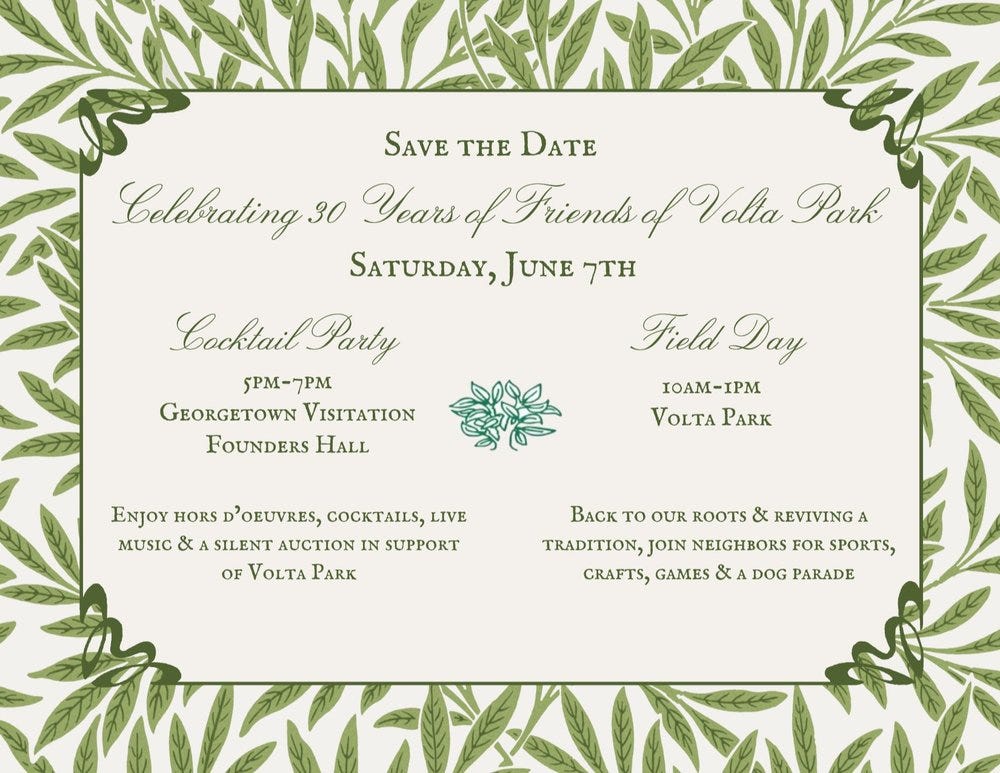
Volta Park’s annual fundraiser cocktail party is returning June 7th, back at Visitation. Tickets are available here. Moreover, there will be a field day in the park from 10am to 1pm on the same day. Should be a great time!
For this week’s news roundup published earlier, I included a mention tying the former City Tavern Club to a Politico article about a new VIP club. I failed to confirm this connection with building’s owners, who deny it entirely, and I must retract and correct this information. It was merely an unconfirmed rumor, and I should not have passed it along as fact. I apologize wholeheartedly.
As part of Georgetown University’s effort to keep the neighborhood tidy during student move out, the school hauls all the bulk trash that the students need to get rid of. And if you have bulk trash you need to dispose of as well, they’ll take that too!
This is just one of the many fruits of the cooperation that the Georgetown Community Partnership produces for the neighborhood. So rather than students facing the daunting challenge of getting rid of couches and whatever, giving up, and leaving it to the frustration of the neighbors, the trash gets cleared and the neighbors get a bonus service for free. And the school gets massive brownie points and avoids angry missives. Win-Win-Win.
The Friends of Volta Park are celebrating their 30th year with their spring cocktail party on June 7th at Visitation. The celebration will be kicked off with a field day in the park that morning from 10 am to 1 pm. Come and celebrate with your neighbors!













 The Georgetown Metropolitan
You must be logged in to post a comment.