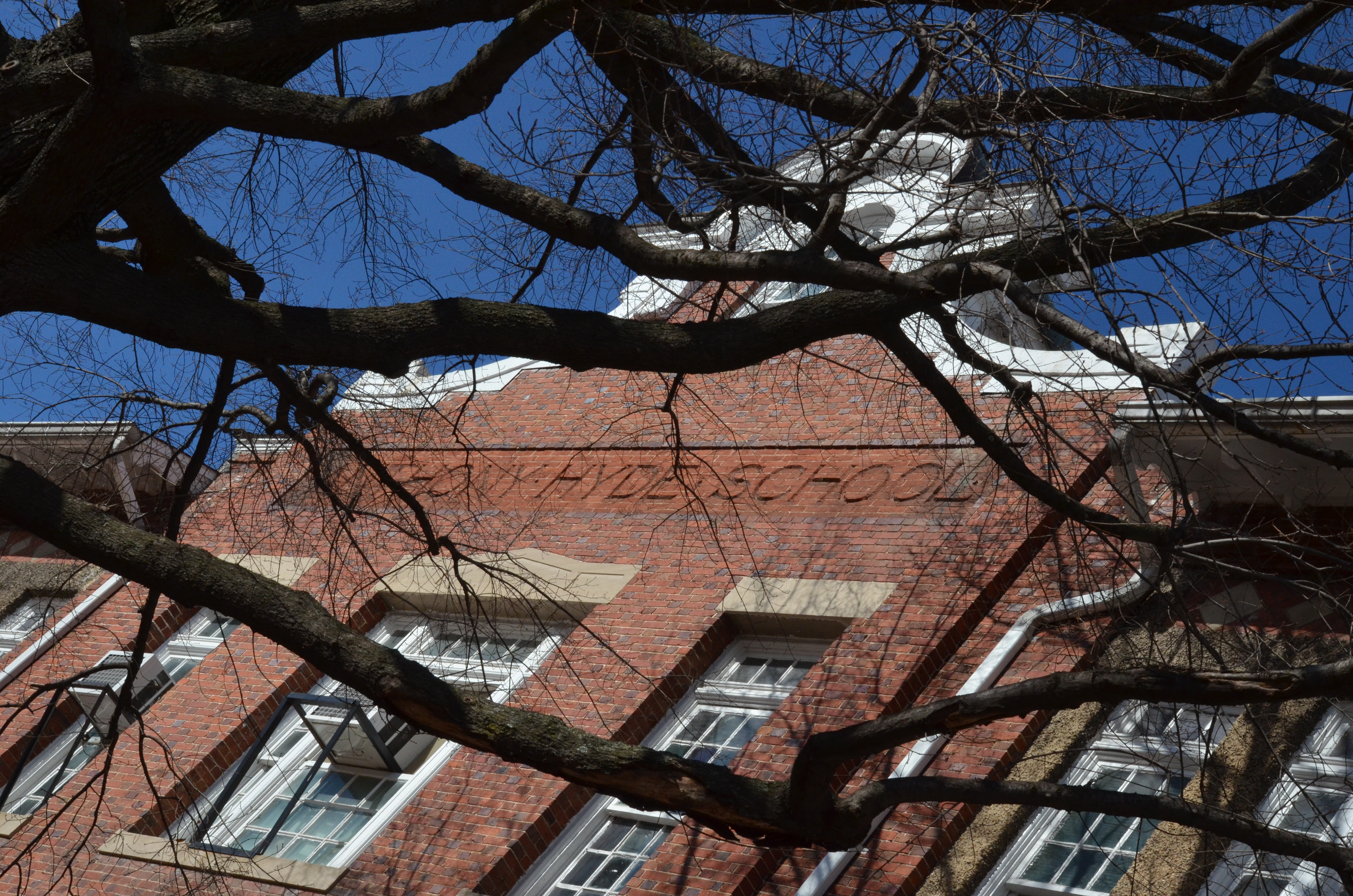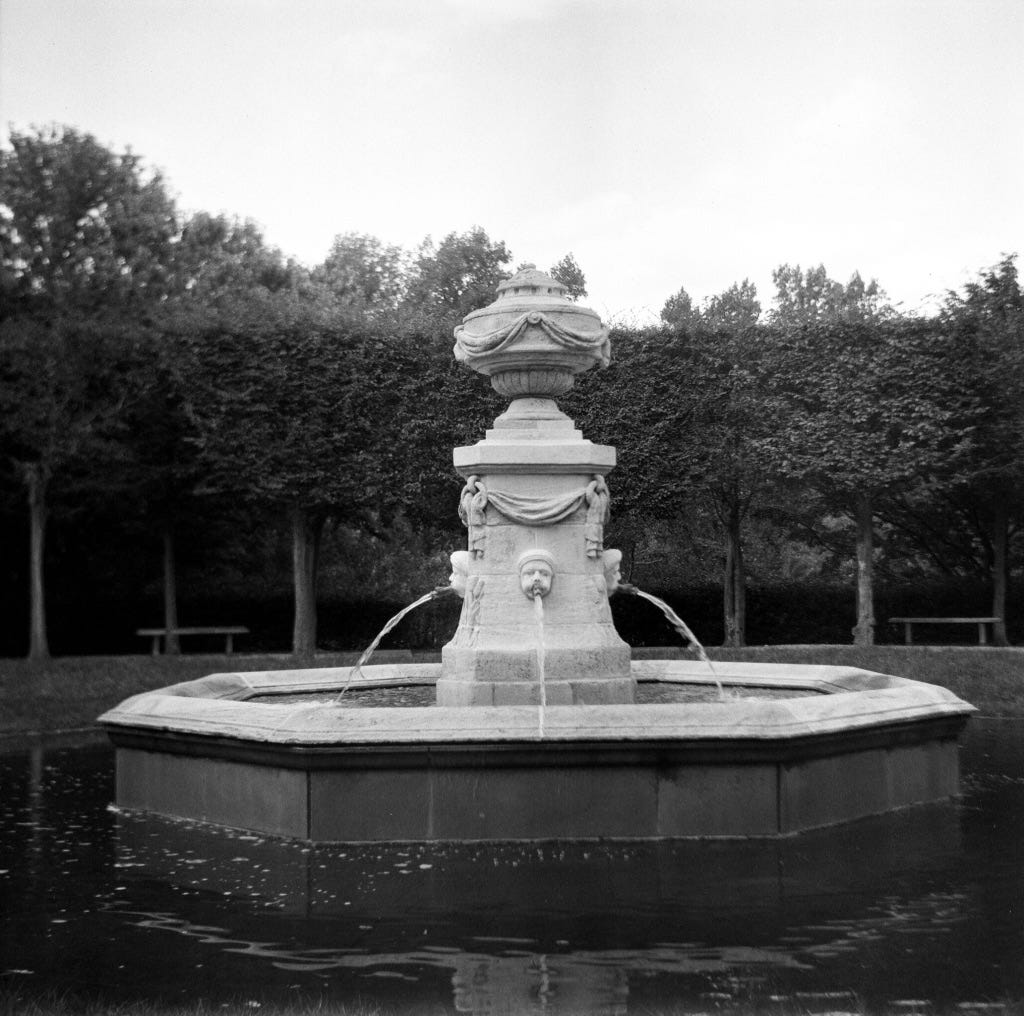
Photo by M.V. Jantzen.
Good morning Georgetown, here’s the latest:
- Alexander Graham Bell’s house is for sale.
- Georgetown Library celebrates turning 90 years old this Sunday.
- The Argentinian bar/restaurant in the old Papparazzi’s space is now open.
Photo by M.V. Jantzen.
Good morning Georgetown, here’s the latest:
Filed under Uncategorized

Several years ago, the city set aside money to renovate Book Hill Park. As is often the case, it has taken a while to see any evidence of that money actually getting spent. But the day is finally here. On October 8th at 6 pm at the library, DPR will host a community meeting to discuss its planned improvements to the park. I think the bulk of the money is mostly going towards restoration of the wall and steps, but new design elements might be included as well. We’ll see.
The initial budget allocation for this project grouped potential improvements to Book Hill Park with improvements to the triangle park across the street (at 33rd and Wisconsin). But that park is administered by DDOT, not DPR, so whatever improvements it might receive will be handled through a different process, I believe.
If you are interested in what improvements Book Hill Park could receive, come on out to the meeting!
Filed under Uncategorized
Photo by M.V. Jantzen.
Good morning, here’s you weekly news round-up:
Filed under Uncategorized
We’re holding our October ANC meeting next Monday night at Visitation at 6:30 pm. The agenda is above. Should be another long one!
Filed under Uncategorized

As I reported earlier this month, the city is moving forward with a new regulatory regime for the streateries. Rather than having the BID be the single permitee for the vast majority of the streateries around Georgetown, each restaurant will obtain its own permit and be responsible for maintaining their allotment.
The first batch of applicants is now working through the process. They are:
The only applicant that I foresee having some issues might by Martin’s, as the regulations state a streatery can’t be located within 10 feet of a marked cross-walk. Their streatery along Wisconsin is within that 10 foot restriction. The Public Space Committee is empowered to make exceptions, and Martin’s is probably a strong candidate for receiving one. But we’ll have to see.
Filed under Uncategorized

A lot of people know that Dumbarton Oaks is beautiful in the spring. But I like to to issue this annual reminder that it’s also quite lovely in the fall:
Dumbarton Oaks is well known for its spring displays of incredible seasonal bounties. But people often overlook how spectacular the acres of gardens are in the fall. Hurry up and catch it now before it’s gone.
But here’s just a taste. The wildflowers of the Herbaceous Border are breathtaking:

The rest of the garden is at that magical moment when the gardeners loosen their grips and the plants give off one more explosion before the winter:


Of course the rest of Dumbarton Oaks is also looking great:


Filed under Uncategorized
Photo by M.V. Jantzen.
Good morning Georgetown, here’s your weekly news round-up:
Filed under Uncategorized

Yesterday I used the saga of Call Your Mother to explore the capabilities of AI to do my job for me. But I didn’t mention that the Call Your Mother saga just took a significant step forward last week. Specifically, the Board of Zoning Adjustment only just finally issued its order approving the zoning relief sought by the store.
As you may or may not recall, this saga began way back in 2019. The store announced it was coming to 35th and O St. and sought the relief it thought it needed to operate at this location. The Board voted in their favor in January 2020, but it took another six months before the actual zoning order effectuating that decision was issued. The store then took several more months to finally open that August.
As explained in my long piece last year, after the store finally opened some neighbors appealed the zoning order to the DC Court of Appeals. The court partially agreed with some of their arguments and it was sent back to the BZA last year. We went through months more of marathon hearings and then last November the BZA voted once again to approve the store’s zoning request.
But it didn’t issue the order effectuating that decision right away. And it continued to not issue the order for months and months. It took about ten months after the BZA’s vote for the board to issue the written order. (Since the initial zoning relief from 2020 was vacated by the court, theoretically the shop could have been forced to close until it was actually granted the relief order, but early on the city decided to allow the store to stay open pending it’s renewed application. This may be a routine accommodation, I really don’t know to be honest.)
There are at least two significant consequences to this order finally being issued. The first is that the decision of the board was to limit the zoning relief to ten years. But it’s not ten years from the date of the BZA’s vote. It’s ten years from the date of the order. So the store got almost a whole extra year of relief.
Secondly, the neighbors objecting to the store have had to wait for the order to be actually issued before they can be permitted to appeal it again. During the hearings, they made it clear that they intended to do so and expressed confidence that they would win again. I don’t know for certain that they will follow through (no case shows up on the docket yet), and I definitely have no idea how the court will decide it. (I’ll merely point out that the store altered its second application to address the reasons that the court gave for its initial decision, so it’s not simply a case of having the same exact issues and facts presented to the court all over again.)
So the saga goes on…
Also, the delay in issuing the order is not unusual, I’m sorry to report. There is a major backlog in the Office of Zoning for the issuance of the written orders these days. A 9 month to one year-delay is pretty typical. While written orders are not necessary for all BZA decisions, they are required for any case involving party opposition. And unlike the Call Your Mother situation, most applicants can’t just go ahead after a favorable BZA vote. They need to wait for the order. This sometimes can color negotiations between applicants and neighbors. If the neighbors agree not to oppose, the project may get completed up to a year earlier. Conversely, applicants are sometimes in situations whereby they can trim back their plans (and perhaps not in the ways asked for by the neighbors) and then the whole project becomes by-right with no zoning relief needed at all.
The Office of Zoning is supposedly trying to bring that time lag down, but clearly they still have their work cut out for them.
Filed under Uncategorized

Kids using AI to do their homework is a hot topic of debate amongst teachers and parents these days. But nobody is looking into the much bigger question: Can a lazy neighborhood blogger slough off his work to a robot? On three previous occasions, I’ve explored this question and decided: No. Not yet, at least. But this technology is moving fast, and the last time I checked was last year. Maybe it’s up to snuff now?
Let’s see! For instance, here is a lengthy piece I wrote last year on the intersection of history, zoning and popular bagels around the Call Your Mother saga. It’s probably the best thing I wrote last year. But it took me a couple hours to write, time I could have spent doing nothing instead. So could AI do it for me?
Here’s what I came up with after asking ChatGPT to write an article in the style of the Georgetown Metropolitan about the history of zoning, how it impacted 3428 O St., and why it was being debated at the BZA today. This is what it produced (with notes and corrections from me in bold):
In the mode of the Georgetown Metropolitan
On a narrow triangular lot (It’s not triangular) where O Street meets 35th, a small, candy-colored corner building has become a civics classroom for the neighborhood. To some it is a morning-line generator, to others a source of spilled coffee and stoop litter; to lawyers and planners, it is an object lesson in how zoning — an invisible, centuries-old regulatory architecture — governs the mundane question of whether you can butter a bagel and sell it to your neighbor. That building’s address is 3428 O Street NW, and the shop inside (Call Your Mother) has done what businesses in Georgetown have long done: it has exposed the seams between how the city used to operate on the ground and how modern zoning reads the map. The result is an odd, instructive fight about law, history, and what it means for small business to exist in one of the country’s oldest protected neighborhoods. The Washington Post+4DC Planning+4The Georgetown Metropolitan+4
Georgetown is not simply a neighborhood; it is one of the nation’s earliest cases of America deciding to treat a place as a patrimony. The Old Georgetown Act of 1950 created, in effect, a special historic enclave on the Potomac with federal oversight of exterior changes through the Old Georgetown Board — a legal wall put up to preserve streetscapes and cornices, and, by extension, an entire way of living in close-grained houses and tiny shops. That act sits on top of an even older municipal practice: Washington’s zoning law, first adopted in 1920, which began the long business of mapping what goes where. The two strands — preservation and zoning — entwine in Georgetown in sometimes harmonious, sometimes mischievous ways. DC Planning+1 (Honestly the Old Georgetown Act has nothing to do with this fracas. It is strictly a zoning question.)
Zoning is a deceptively simple bureaucratic instrument: a map with letters and numbers. Those letters (R-1, R-3, MU, etc.) stand for permitted uses and dimensional rules. But overlays, exceptions, grandfathered uses, and a patchwork of ad hoc decisions make the map read like a palimpsest. In Georgetown, the “GT” overlay — a small, neighborhood-specific set of rules — sits over the underlying R zones to impose stricter controls intended to keep commercial spillover from swallowing the rowhouse blocks. In practice that means that whether a tiny corner shop may sell refrigerated cream cheese or toast a bagel depends on a stack of code citations, the history of what preceded it in that building, and the tolerance of immediate neighbors. maps.dcoz.dc.gov+1
A key change in the District’s zoning came with the Zoning Regulations of 2016, which for the first time created an explicit category for “corner stores” in certain residential zones (see Subtitle U §254). The reform was intended to revive the idea of small neighborhood retail while preventing wholesale commercialization of rowhouse blocks. The code says, bluntly: corner stores are allowed in specified rowhouse zones only under certain limits — maximum square footage, ground-floor location (cellars excepted), proximity limits to existing commercial zones, and, crucially, constraints on the kinds of activities permitted. The line in the law that matters most in Georgetown is the GT overlay’s proximity restriction: some corner stores may not be sited within 750 feet of lots zoned MU or NMU — an effort to prevent residential corners from becoming satellites of main thoroughfare commerce. DC Rules+1
But the code also embeds a paradox. “Corner store” as an enumerated use allows small retail, a deli counter, or packaged groceries. Prepared food — that is, food that requires more than reheating or simple assembly (toasting, full sandwich preparation, on-site warming) — is not a matter-of-right activity in many of these residentially zoned corners. To do that, an applicant must seek relief: a special exception (to allow prepared food under controlled conditions) and sometimes an area variance (if the property fails the numeric or proximity tests). Those are discretionary remedies; they require a hearing before the Board of Zoning Adjustment (BZA), public notice, and, often, sustained neighbor testimony. The result is that a kitchen that would be unremarkable on M Street becomes an object of law as soon as it eclipses the line the code draws between “retail” and “restaurant.” DC Rules
To understand why this specific building became a legal contested object, it helps to read its biography. The narrow two-story structure — the pink building that now delights Instagram feeds — is a classic Georgetown small commercial parcel: ground floor storefront, upstairs living space. Its use over the decades reads like a microcosm of neighborhood evolution. In the late 20th century the corner hosted an antiques shop and then a florist; a health-food experiment appeared briefly around 1970; most recently a flower store occupied the ground floor until 2019. When Call Your Mother signed a lease in 2019 and sought to open in 2020, it did so in a space that had an evident commercial ancestry — a fact that would matter in BZA filings and neighbor petitions. The Georgetown Metropolitan+1 (This is largely correct, but as you can see, it’s correct because it took the information from my own website. Fair play, I guess…)
The property’s public records show a mixed-use classification and modest square footage — under the 1,200-square-foot ceiling the code sets for corner stores — and its lot lines place it within the R-3/GT envelope that governs many of Georgetown’s residential blocks. But the GT overlay’s proximity rules and the question of whether on-site food preparation would be “objectionable” to adjacent rowhouses made the case anything but routine. The building, in other words, is legally small but politically large. Long & Foster+1
When Call Your Mother moved in and began drawing long lines, the predictable civic machinery whirred into motion. Some neighbors testified about morning queues, people eating on stoops, and an increase in litter; others spoke about the delight a lively corner brings to a neighborhood. The local ANC weighed in with mixed recommendations; the Office of Planning’s memos examined the code and the precedents; eventually the matter landed at the BZA, where the operators sought both a special exception (to allow prepared food service) and an area variance (to accommodate the particular geography and prior uses). The Georgetown Metropolitan+1 (This is an entirely jumbled timeline of events. For instance, the first BZA hearings took place in 2019, before the store opened.)
Those hearings are necessarily granular. The BZA has to weigh whether the proposed use “will not be likely to become objectionable to neighboring property” by reason of noise, traffic, deliveries, or other conditions. The board considers mitigation measures — indoor trash storage, a queue management plan, signage asking patrons to leave the neighborhood when finished, capped hours, deliveries at certain times — and it conditions approvals accordingly. In November 2024 the Board issued a decision that, in practical effect, allowed the shop to continue operating after finding that the applicants had made adequate concessions and changes to reduce objectionable impacts. The vote was not unanimous; the decision acknowledged both the amenity and the nuisance. The ruling offers a template: Georgetown’s code can accommodate a small prepared-food operator, but only if the operator accepts operational constraints and the board is persuaded that neighbors’ concerns are addressed. The Washington Post+1
If you want to understand Georgetown zoning, stare at the map until it becomes legible. The Office of Zoning’s interactive viewer is the canonical source: it overlays the zoning parcels, the GT overlay, historic district boundaries, and even older zoning layers if you care to dig. Until you place 3428 O Street into that viewer and see the R-3/GT shading, the 750-foot rule that sits invisibly between residential corners and commercial corridors feels abstract. The map does a simple job: it shows where the law applies and where the exceptions must be sought. If you want to see the parcel, the Official Zoning Map is the place to start; for historic context, the Old Georgetown Act’s map defines the district whose fabric the Old Georgetown Board protects. maps.dcoz.dc.gov+1 (What?)
(If you are following along at home: open maps.dcoz.dc.gov, type “3428 O Street NW” in the address bar, and toggle the zoning layers. You will see the GT overlay and the adjacency to MU/NMU zones on M Street. That adjacency is functionally the line that was litigated.) maps.dcoz.dc.gov
The immediate (practical) lesson from the BZA’s ruling is simple: you can open a bagel shop in Georgetown’s residential corners, but you very often will need formal zoning relief and you will very likely have to accept operational constraints. The code’s tidy categories — corner store vs. eating establishment — are volumetric and behavioral. If your operation involves toasting, chopping, frying, or otherwise producing odor or grease on site, you’ll face the prepared-food threshold. If your corner is within the GT overlay’s 750-foot buffer to MU/NMU parcels you may need a variance. If your customers tend to gather outside, you’ll need a persuasive management plan. In short, the law is not designed to stop small commerce; it is designed to make it behave like a neighbor. DC Rules+1
There is another lesson, and it is a political one: zoning is porous to those who can marshal time, money, and public testimony. A well-represented applicant with good counsel and a nimble operations plan can secure relief; a less-resourced owner or a tilting public mood can doom the same proposal. That reality means that what gets to be a community amenity is partly a function of procedural access. This has always been true in zoning, but the Georgetown drama makes the inequity visible: in neighborhoods where property is expensive and neighbors are politically organized, approvals often come with conditions rather than outright prohibition — a small-town compromise enacted by bureaucrats and boards. Greater Greater Washington
Two things shaped Georgetown’s regulatory ecosystem. First, its designation as an Old Georgetown district and the establishment of the Old Georgetown Board (FWIW, among the first uses of federal preservation authority) froze an aesthetic and regulatory regime that privileges preservation over change. Second, decades of incremental zoning and ad hoc grandfathering created islands of commercial activity in otherwise residential fabric. Post–World War II patterns — the rise of supermarkets and the decline of corner groceries — removed many small operators, but the zoning map preserved the legal memory of some corners as commercial. The 2016 ZR16 updates attempted to reconcile neighborhood needs with modern retail patterns by carving out explicit rules for corner stores, but those rules were intentionally conservative. The idea was to let neighborhood retail exist without allowing M-Street-style commercialization to seep into the blocks. DC Planning+1
That conservative impulse is visible in the GT overlay’s distance requirement: the neighborhood wanted a safety valve that would keep residential corners from becoming annexes of the commercial spine. It is an eminently Georgetown solution to an eminently Georgetown problem. But policy always meets practice in the person who wants to make a living; hence the BZA’s role as a pragmatic arbitrator. The board is the place where the map’s abstract lines encounter the messy facts of customers, deliveries, and trash pickup schedules. dcoz.dc.gov
The controversy at 3428 O Street is not, at bottom, about bagels. It is about how a city decides what a neighborhood should be, and who gets to make that decision. It’s about the collision of preservation and commerce, of hard legal lines and softer community norms. The regulatory code provides structure; the community provides texture. When the two are in tension, the outcomes are necessarily compromise: limited hours, indoor trash receptacles, managed queues, conditional approvals.
For small business owners the moral of the story is to plan as if the zoning map were a gatekeeper — because it is. For neighbors, it is to recognize that businesses bring both disruptions and intangible benefits: vibrancy, morning ritual, livelihoods. For the city, the tale suggests that zoning will always be an instrument for balancing competing claims — not a neutral record of what already exists but a set of choices about what should persist.
And for anyone who wants a bagel on O Street: yes, you probably can buy a toasted everything in Georgetown; but the price of that convenience will be the compromises the board and the owner carved out in public record. The pink building at the corner will remain a small civic theater — where law, design, and appetite performatively meet each morning. The Washington Post+1
Honestly, it’s not terrible, but it’s still mostly words for the sake of words (probably because I asked it to write 3000 words). I don’t think a reader would come away with a genuine understanding of the issues at play, but only a vague understanding. I’ll give it some style points for the regular references to the pink building and bagels generally, but it still does not feel human to me. Or, at least, not written by a human that actually understands the story. But then again, that describes a lot of the humans that have written about the Call Your Mother saga.
So, alas, I can’t (and won’t) start relying on a robot butler to do this. But it is quite startling how much better this is from the initial attempts a few years ago.
Filed under Uncategorized

Two new establishments on the way according to new OGB filings. The first is Monos, coming to 3124 M St. Monos is a luggage store offering wares similar to Away, another M St. shop. This address has hosted sneaker shops for a while. Before that it was the location of the fondly remembered Bristro Francais for may years.

Speaking of world cuisine, the other addition contained in the OGB filings is Cottage House, coming to 1529 Wisconsin, which most recently hosted City Sliders. The sign states that it will be an Ethiopian restaurant. DC has a long tradition of great Ethiopian restaurants, including Georgetown’s own Das; hopefully this spot will join their ranks.
Filed under Uncategorized
You must be logged in to post a comment.