
Last Friday, GM posted a particularly breathless report on the huge jump in the population count for Georgetown in last year’s census. The overall increase was 1,791, a 21.01% increase. Moreover, He found that the biggest gains in population were concentrated on the lower west side where there was an increase of 1,351 residents from 2000 to 2010.
GM cautioned that it would take a look at the block-by-block numbers before we could be certain where the growth specifically was. Well, he did just that, and the only conclusion he can reach is that the boom was primarily a product of increased reporting from students living outside the gates in GU residences.
Below is a map showing the blocks where there was a net gain of more than 50 residents from 2000 to 2010:
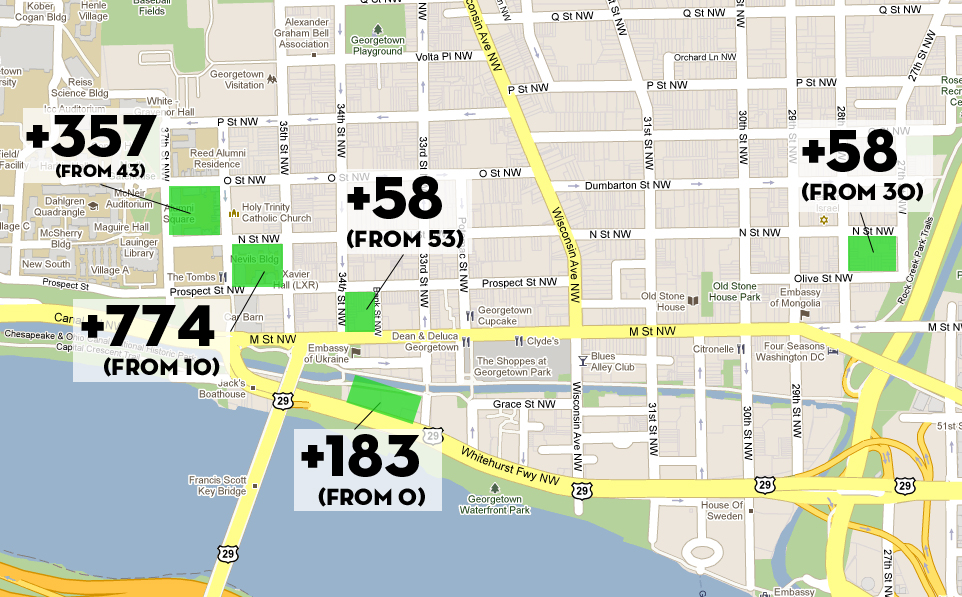
Over 1,100 of the net boost came from just two blocks: the block bound by 36th, 27th, O and P and the block bound by 35th, 36th, Prospect and O. Both those blocks contain GU residences. GM’s not entirely familiar with all the history of GU residence halls, but he’s fairly certain that most if not all the residences on those two blocks were housing students ten years ago. Yet ten years ago these blocks reported a grand total of 53 residents.
So it appears that all that happened was that these residents started getting counted where they actually live, as opposed to behind the gates (which is a different census tract). GM’s not sure if that was a change in policy from the university or the census, or whether it might be something as simple as students getting their mail in a different location.
The behind-the-gates campus population actually reported a drop from 2000 to 2010 of 551 residents (to 3,916). And that actually sounds about right. After factoring out the 1,100 or so students that shouldn’t have been counted as living behind-the-gates in 2000, there would be a modest increase of about 400 residents behind-the-gates. The Southwest Quad was built after the 2000 census, which added about 800 beds. So maybe those beds aren’t all full, or maybe there was a slight under count this year.
Either way, it was a bit of a shell game. The fact that GM didn’t consider the behind-the-gates numbers last Friday increased the effect.
But not all the increase was a shell game. There were about 183 new residents added due to the new 3303 Water St. condo. And over on the east side, there were about 58 new residents added with the Phillips School condo conversion, which happened early last decade (there were still school kids attending the school as late as 1998 when it was owned by the Washington International School).
There were another 58 residents added to the block bounded by Bank, M, Prospect and 34th. This one is less clear to GM. There were only three new housing units added to this block since 2000, but this block also reported 3 empty units in 2010. Yet it somehow went from 53 residents to 111. GM knows this block added that new building that now houses North Face (and GM can remember Bank St. caving in during the construction) but GM doesn’t think that building has residential units (and besides, it obviously didn’t produce much of a net gain in terms of housing unit numbers).
This one probably comes down to an increase in student rentals. This conclusion is supported by the fact that this block has 3.8 residents per unit, while Georgetown’s overall average is closer to 1.8 residents per unit (which is exactly what this block was in 2000). But it’s probably notable that this is the only block that jumped out at GM for having an such an increase.
If you like this sort of stuff, stay tuned.







 The Georgetown Metropolitan
Great stuff. Glad to see solid research demonstrate assumptions discussed in the last comment thread. I’m going to attempt to figure out what happened in 2000 that led to so few students registering in Nevils / LXR.
Pingback: Morning Links: Taken Into Account - Housing Complex - Washington City Paper
I find the 53-to-111 number to be puzzling. As a GU undergrad when the 2000 census was taken, I remember those blocks being pretty full (and in fact, almost moreso, as a few of the houses had basement units that may have come off-line after the Dan Rigby tragedy).
Is there any chance that differences in the timing of the census could have played a role? I’m thinking particularly about end-of-spring timing, which could have had differential effects on academic year-end reporting.
Another possibility could be due to changes in study-abroad behavior (this is a bit in the weeds, but could be the real explanation, so bear with me).
— GU students are more likely to study abroad in the spring than the fall.
— On-campus housing availability was tighter in 2000 ( pre-SWQuad), therefore, juniors who were studying abroad for one semester would have been more likely to live off-campus for the semester (fall) that they were in DC, leaving empty spaces in those houses during the spring semester, when census forms came in.
— In 2010, the supply of on-campus housing is higher, leading to a higher likelihood of students living on campus for the one semester they were in DC. This would mean less variability through the year, and higher body counts for the spring, in the off-campus block in question.
Just a theory, but it might get to at least part of the truth.
As someone who has lived in the Prospect, 34th, Bank, M Street block and now filled out my third census form here (1990 as a student)…the block has ebbed and flowed a great deal. Since back in 2000, I can count at least four residences on the Prospect side that were owner occupied that have now gone rental. That should give you an additional 2o heads. If you were to cross Prospect Street to the north side there are two more houses that have gone rental in that decade. Add in a more concerted effort by students to actually fill out and return census forms or to choose to be counted in DC as opposed to a parents home…and getting a bump up of 58 is really quite easy. Keep in mind that due to the politically partisan atmosphere the census was highly limited this year, just a few questions. Which made responding very easy. Compare that to past years where there could be many pages of questions used to collect far more relevant and useful information about our countries makeup than just a head count…but which may have discouraged response from some people who were not motivated.
RNM: What you’re describing with the pages and pages of questions actually was the long-form census form. That wasn’t sent to all residents, just a sampling (one in six). It’s been replaced with the American Community Survey program that still asks all those questions on a sample basis, but they do it all the time not just every ten years. Most people that received the deceniel census in 2000 and earlier received a form a lot like the one they used last year.
Jacques: Those sound like plausible explanations to me. Tough to know for sure though.
Pingback: Where Georgetown Lost Population | The Georgetown Metropolitan