
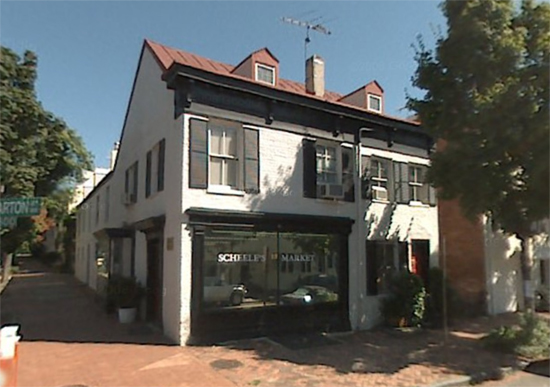
After a long and tortured process, the Zoning Commission is on the verge of adopting the final changes to the zoning code as part of the dramatic zoning rewrite. There is one final opportunity to chime in. Assuming the plan goes forward as it stands, it will mean some significant changes for Georgetown. Here are two of them:
Corner Stores
Corner stores like Scheele’s and Sara’s are a critical part of the appeal of living in Georgetown. But the thing is, they only exist where they are due to grandfathering. The current zoning code would consider them illegal if they hadn’t existed for as long as they have. And consequently, if any of them closed, unless a new store were opened there shortly after, the grandfathering would expire and no new store would be allowed.
This potentially has real consequences. When the future of Scheele’s was in doubt due to the Scheele family putting the building up for sale, it was never an option for the store to simply pick up and move across the street. The grandfathering isn’t portable. So if a store loses its lease, it cannot simply move to another building unless that building is already zoned commercial. There are only a few small pockets in the side streets of Georgetown that are zoned commercial.
The new rules would loosen the general prohibition on commercial activity in residential zones. You could open a corner store in any property literally on a corner. Some conditions apply, but the main one is that there cannot be more than three other corner stores within 500 feet and it cannot be within 750 feet of M and Wisconsin.
That last condition is a little odd, but the idea is that corner stores are supposed to be neighborhood serving and not simply be an extension of the existing commercial areas.
Admittedly, these rules would not allow for many new stores popping up in the side streets of Georgetown. But the idea isn’t necessarily to add more corner stores (the demand probably couldn’t support it anyway) as it is to make it easier for new stores to open should the existing ones ever close.
Accessory Dwellings
Right now throughout Georgetown there are scores of “English Basement” apartments, and the like. They provide extra income for the homeowners and provide more affordable housing for the tenants.
But most of them are illegal.
In Georgetown, the only way to have a legal basement apartment is to have had the apartment continuously since the 50s. Few qualify. Technically you could get a variance to get an apartment approved, but variances are nearly impossible to obtain. So most don’t bother and just rent out illegally.
This is bad for several reasons. Most of all it means tenants living in apartments that have not necessarily been brought up to code. They could be living in death traps.
By providing an avenue for landlords to come in to compliance and still keep the apartment, the new rules would hopefully result in more apartments being inspected and improved.
There are some conditions to obtaining the approval. The most important one from Georgetown’s perspective is that the homeowner needs to live in the house. This is designed to prevent houses from getting turned into mini apartment buildings, which some fear would bring unwanted noise and disruption. The idea is that a homeowner living in the house will not tolerate a noisy tenant, so the neighbors won’t have to tolerate it either.
Some object to these conditions. Some think any of these liberalizations are too much. That’s why the end result is truly a compromise designed to address the strongest concerns of the various viewpoints.
Those are just two of the more significant ways that the zoning code will change for Georgetown. Read here if you want to learn more.






 The Georgetown Metropolitan
You must be logged in to post a comment.