

Monday night, the ANC met for our last public meeting in 2023. While it (thankfully) lacked some of the discord of some of our recent meetings, it nonetheless covered a lot of ground. Here are the top take aways:
Update from the US Attorneys Office
Perhaps the most substantive item on the agenda for the night was a visit from Wendy Polhaus of the US Attorney’s Office for DC. For those not familiar with our unique structure, in DC we do not have a District Attorney to prosecute criminal actions. All cases (against adults) are brought by the federal US Attorney’s Office for DC, no matter whether the actions are brought in local DC Superior Court or federal District Court. Thus unlike any other city in the country, DC is dependent upon a arm of the Justice Department to enforce most serious laws. (The DC Attorney General’s office handles juvenile cases and certain lower level misdemeanors.)
So in effect, our “district attorney” is an unelected official chosen by the President and approved by a Senate in which we have no vote.
Which is all just background to the topic we discussed Monday night: how many cases initiated by local DC police result in actual charges being brought by the US Attorney’s Office. In other words, is there a disconnect between what MPD is arresting folks for and what our primary prosecutor is actually bringing to court? And the answer to that is sadly yes.
Ms. Polhaus present a great deal of statistics, but the overall story is this: During Covid the disconnect mentioned above grew to truly unacceptable levels. Only about a third of all arrests by MPD were resulting in any sort of charges brought by the US Attorney’s office. Ms. Polhaus offered several factors that contributed to that, but the largest is the fact that DC continues to not have an accredited crime lab. In order to charge someone for possession of cocaine, for instance, you need an accredited lab to certify that the bag of white stuff is cocaine, not powdered sugar. Polhaus explained that while this problem persists, her office was successful in using other labs, such as the DEA’s, to make a dent in the number of dismissed charges. Between this, and other factors, her office has been able to increase the percentage of “papered” cases (i.e. arrests that actually result in charges) to nearly 60%.
As for the remaining 40% of cases, Polhaus identified many possible causes. These include cases that were shifted to the Attorney General’s office to bring misdemeanors, cases of insufficient evidence, affirmative defenses (i.e. self-defense), or cases where the victim in unavailable (i.e. the victim doesn’t want to press charges). Finally, some cases are dismissed at the DC Superior Court because the prosecutors want to bring it in federal court, which carries with it much more serious consequences for the defendant.
In short, Ms. Polhaus argued that her office is aware of the problem and taking steps to address it, but that we should not read too much in the top-line numbers, as many complicating factors contribute. Additionally, Ms. Polhaus is planning to return to the ANC early next year to discuss another topic related to the recent crime spike: student truancy. I certainly look forward to that discussion.
Update from State Board of Education
The question of struggling students came up shortly after Ms. Polhaus’s discussion. Ward Two rep to the State Board of Education, Allister Chang spoke. He addressed two critical problems in DC’s school population: illiteracy and absenteeism.
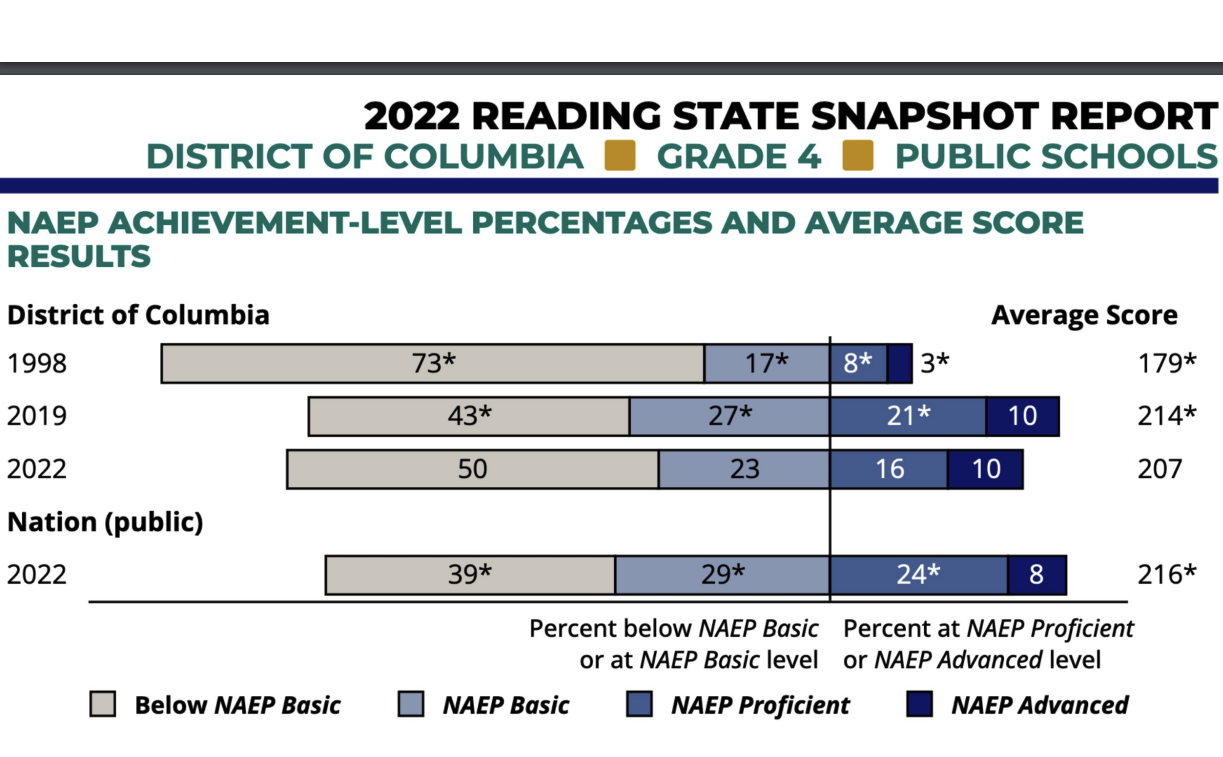
On the first topic, Chang showed the sobering chart above, which reports that only 26% of DCPS fourth graders are reading at at least a proficient level. This is a big drop from before the pandemic, when the rates were significantly closer to national results. In 2022 half of DCPS fourth graders were reading below even basic standards. That is unacceptable and Chang discussed some initiatives to turn the tide, such as an early learning literacy task force.
On the question of absenteeism, the news was similarly grave. Change reported that the levels of chronic absenteeism has skyrocketed since Covid and not reversed for the vast majority of DCPS schools. He highlighted two schools that had achieved success in reducing absenteeism in at-risk populations and how he hoped their models could be replicated across schools serving a similar population.
On the happy side, at least, Chang reported that Georgetown’s Hyde-Addison’s report card was strong, even for at-risk students and English language learners. But that only underscored the challenge facing the vast majority of schools that don’t have as happy a story to tell.
Additional Items
Despite the lack of rancor, the meeting sure was long anyway! Here are some of the other topics we discussed:
- I gave an update on the Volta Park renovations (read this for more)
- There’s a new Christmas Tree at Book Hill park, but it was crazy expensive, so please consider chipping in to defray the costs!
- Neighbors to the east of the proposed new Tatte Bakery are concerned about impacts of the business and are hoping to work with the owners to come up with a plan to reduce excessive noise and vermin. The owners expressed a willingness to meet and take steps to address their concerns.
And that’s it! We only had a single audience member who was not there just to speak on a particular topic. It sure makes it lonely. Please come out if you can. We’ve got cookies!







 The Georgetown Metropolitan
Her is a copy of my comment, which could not be sent as I am not a member of the two choices offered.
Why don’t we plant an evergreen tree on Book Hill? One that will grow into a beautiful annual Christmas tree? And, whatever tree is used, why not have community members bring Christmas lights and decorations (we all have accumulated excess) and have a community tree decorating event?
Thank you for the notes.
Carole Lewis Anderson Washington, DC
>