Hello and welcome to your November Northwest Georgetown ANC update! Daylight savings time is finally over for the year, so if you’re another early-riser like me you will join me in welcoming the brighter mornings. Now on to the updates!:
Leaves
We are entering the fall leaf collection season again. After years of truly unmitigated disasters, I think last year was perhaps a slight improvement. A mitigated disaster perhaps?
The big issue going into last year was whether the city would take bagged leafs. From my observations they appear to have taken them last year. So residents should go ahead and use them again this year.
In terms of timing, Georgetown is unfortunately once again in the back half of the city’s collection schedule. East Georgetown is in the third round and west Georgetown is in the fourth (of four) rounds. The city is only starting round one this week, so don’t expect them to come to Georgetown until late November, at the earliest.
One thing going for the city is the weather. It’s been so gorgeous and dry for weeks, and if that continues they may actually move from mitigated disaster to mitigated success. We’ll see!
In the meantime, I would bag leafs and call 311 for collection. Either they’ll collect them pursuant to your request, or they’ll get picked up later. Belts and suspenders.
Cannabis Store on 33rd St.
As I described in more detail several months ago, a retail cannabis shop is attempting to open at 1658 33rd St. (next to the Lobby Bar). The ANC’s approach generally with these shops has been to welcome the introduction of legally registered and regulated shops as a means to get rid of all the illegal shops that used to dot the neighborhood. We usually negotiate a settlement agreement that establishes acceptable rules for the road and so far the ones that have opened have not caused any significant problems.
But this one was problematic because it was seeking to open within 400 feet of another licensed cannabis shop on Wisconsin Ave. The law is clear that no retail cannabis shop can open within 400 feet of another. After we pointed this out to the city (via ABCA, the regulatory body) the permit application was pulled. But then it was later put back into effect after the applicant submitted a questionable report that claimed to show that the two buildings were actually 400.4 feet apart.
The report was questionable on several grounds. The first was that it was so wildly off from measures using Google Maps or the city’s own geographic software, both of which showed the distance to be about 375 feet. That’s a 7% difference. To put that in a context that many should be able to grasp: that’s like a 5’8” man claiming to be 6’1” on his dating profile.
Additionally, the report—a report, which by the way, alleged that the two buildings were exactly the distance apart that the applicant needed them to be—was created not by a licensed surveyor but rather an architect. It appears to be against the law1 for people who are not licensed surveyors to perform surveying work in the District, particularly when said survey is intended to be used for a government filing.
Frustratingly, the ABC Board allowed the application to go forward despite its obvious flaws. So in order to prove that 400 feet really means 400 feet, the ANC spent its own funds to hire an actually licensed surveyor to establish once and for all how far apart these two buildings are. Unsurprisingly, they found that they’re 376 feet apart, just like the initial maps showed.
We submitted this new survey directly to the ABC Board for reconsideration. We hope to get a decision from it within weeks. Ideally it would revoke the application once more. If, instead, it decides to still defer the decision to the full protest hearing in January, we will be prepared to present then that this application is clearly prohibited by law.
As I said before, the ANC is not against the introduction of licensed cannabis stores, and in fact it has welcomed well-run establishments. But what we do object to are applicants who attempt to skirt the regulations. Any store that would submit a facially flawed report like this to open is one that is unlikely to live up the rules of any settlement agreement or basic DC law. Those types of stores we do not welcome.
BID Modernization Bill
Over the past couple weeks there has been a bit of an uproar in Georgetown about the introduction of the BID Modernization Act of 2026 bill by Councilmember Wendell Felder. The concern is certainly understandable given the limited information initially available about the scope and intent of the proposed law. But having digested the bill and reviewed the hearing transcript, I’m here to clear up some of the confusion and alarm.
Read on for a longer discussion, but if you want just the highlights of the bill, here they are:
- The vast, vast majority of Georgetown homeowners would continue to not be subject to the BID tax
- If you happen to own a home in the BID zone, you may become subject to a $120 annual tax, but only if you willingly decide to join the BID. Nobody would be forced to join.
First of all, the main alarm about the initial reports over the bill stemmed from the belief that the bill would enable BIDs (including Georgetown’s BID) to tax all the residents. Let me be clear: that is not in the bill and it is not going to happen.
It would be probably helpful to briefly describe how the Georgetown BID gets its funding in the first place. It gets its funding by way of a supplemental tax that the city levies on commercial properties located in the BID zone. Roughly that includes all the commercial buildings along M and Wisconsin, and most of the commercial buildings south of M. Here is a map:
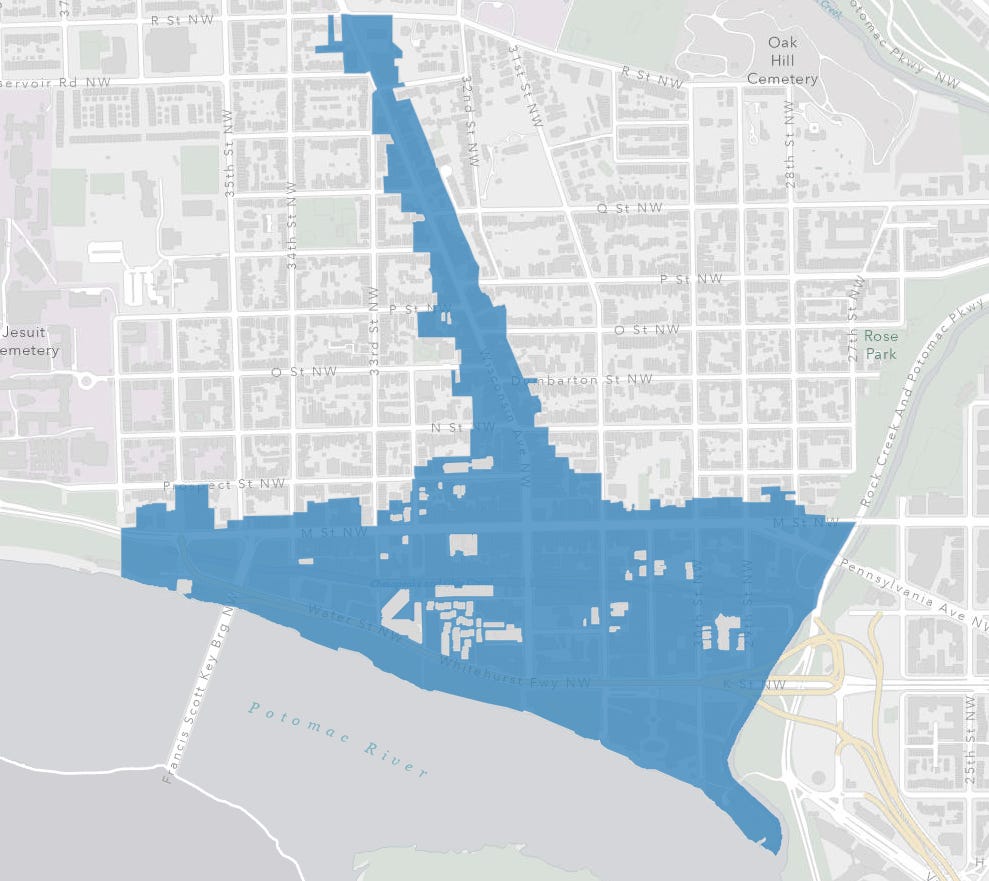
Commercial buildings located in the blue shape above get taxed an additional 0.1622% on their assessed value every year. (That’s on top of the approximately 1.7% they pay for normal real estate taxes). This generated about $5 million for the BID’s operations last year.
So to be crystal clear on this: if you don’t live in the blue shape above, you will not pay a BID tax under any circumstance. There is no plan or proposal to increase the BID zone.
But what if you do live in a building inside the blue zone? If it has a commercial presence (i.e. a store on the first floor) you probably already pay a BID tax (or your landlord does). If, however, you live in a purely residential building in the zone, you probably don’t pay the tax.
Occasionally an ostensibly residential building in the zone has been levied the BID tax over the years. For example, over the past eight years, 19 properties in the BID zone that are labeled “residential” were at least temporarily levied the BID tax. In most, if not all, of those cases it was in situations where the property did in fact have some commercial presence or, alternatively, were vacant. Let me put it this way: if you own a building in the BID zone, you probably already know if you’ve paid the BID tax or not.
What appears to have alarmed people is that the new bill contains a provision enabling BID’s to tax residential units inside their respective zones. The levy would be significantly smaller than the normal BID tax. It would be just $120 per unit (i.e. per single family home, or per condo unit, etc.). Critically, the bill would not levy the tax on these homes unless the homeowner or condo board agrees to it. In other words, it would allow homeowners or condo boards to join the BID as members if they wanted to, but not against their wishes.2
Additional terms that seem to have troubled people include a provision that authorizes BID’s to increase the BID levy by 5% a year and an extension of the BID renewal terms from 5 years to 10. On the first, the Georgetown BID already has the authority to increase its levy by 5%, so the bill’s language has no effect here. On the second, it would be a change to extend the BID renewal terms to 10 years.
Personally I can see arguments for and against this change. For instance, following the incredible improvement in town-gown relations with Georgetown University, the parties agreed to allow the school to shift from a 10-year campus plan term to a 20-year plan. Having a longer term enables the school to take a much longer view on things like major construction and enrollment figures. But I can also see how not having a more frequent check-in could cause issues, like those that existed with the school before the creation of the Georgetown Community Partnership.
It’s unclear whether this bill will even become law. The Council period ends in two months, and any bills not adopted by January expire. So there’s a good chance this will have been much ado about nothing in the end.
DC Code § 47–2853.111, which states that “For the purposes of this part, the term “practice of land surveying” means providing professional services including consultation, investigation, testimony evaluation, expert technical testimony, planning, mapping, assembling and interpreting reliable scientific measurements and information relative to the location, size, shape or physical features of the earth, improvements on the earth, the space above the earth, or any part of the earth, and utilization and development of these facts and interpretation into an orderly survey map, plan, report, description, or project.” Further, DCMR 17-1519.1 establishes that “A person must be licensed pursuant to this chapter and the Act to practice or offer to practice engineering or land surveying in the District of Columbia”.
I guess if you own a condo and the board votes to join against your wishes, then in that case I suppose you’ve been forced into it. But that seems like an issue between you and your condo board.