Category Archives: History

Field Guide to Georgetown Homes: the Colonial and Federal Period

GM is off to Europe this week, so in the meantime enjoy a rerun of his Field Guide to Georgetown Homes:

If there’s one constant in Georgetown real estate listings, it’s that every house, no matter its shape and style, is described as “Federal”. The problem is that only a small percentage of homes in Georgetown could fairly be described as “Federal”.

As GM described during his ten favorite things countdown, Georgetown represents a cross section of 19th century architecture. It has buildings of just about every major style from that time period. To help his readers better appreciate the wealth of architectural styles in Georgetown, GM is going to take a shot at writing a field guide to Georgetown homes.

First up: Colonial and Federal Homes

Continue reading

Leave a comment

Filed under History

Old Georgetown in Color: the Great Flood

flood color


This week in Old Georgetown in Color, GM returns to another old photo he’s shown before. It’s a photo of the Potomac waterfront after a flood. The photo at the Library of Congress merely says “Potomac flood, Georgetown, D.C.” [created between 1909 and 1923].

GM thinks, however, that this flood was from Feb. 1918. Check out this excerpt from a Washington Post article from 2/19/1918: Continue reading

3 Comments

Filed under History

Old Georgetown in Color

observatory color


This week on Old Georgetown in Color, GM returns to a photo he features a long time ago. It’s from August 21, 1924 and it features Father F.H. Tondorf, Prof. David Todd, and Father John S. Gipprish at the Georgetown University Observatory.

Although as GM noted previously, by the way they’re posed, it almost looks like a publicity shot from some community theater. It’s like “F.H. Tondorf, David Todd, and John Gipprish star this weekend in Ralph J. Simonsen’s ‘Catch a Rising Comet’ at the Davistown Country Playhouse.”

GM is still struggling to get the coloring just right. Particularly of things that are black or white. Nothing’s truly black, white, or even gray. There’s always a slight shade of some color, and figuring our how to add that color while keeping it still black, white or gray is tricky.

Leave a comment

Filed under History

Old Georgetown in Color

8a00145u


Today GM is going to try out a possible new feature for the Georgetown Metropolitan: Old Georgetown in Color.

Inspired by other websites that take old black and white photos and colorize them (most notable for local interests being Old Time DC) GM decided to take a shot. His first attempt is of one of his favorite photos from old Georgetown, that of two adorable girls that Carl Mydans came across one day.

Here’s the original from the Library of Congress:


Not a bad first try, eh?

Leave a comment

Filed under History

Chance to Watch Bayou Documentary this Friday (Maybe)

As mentioned here last year, a labor of love by local film maker Dave Lilling has produced a documentary on the late great Bayou night club that once graced Georgetown’s K St. (Watch the trailer above). This Friday, the full documentary will be offered to PBS stations to play at 2:00 pm.

The film’s website indicates that 20 stations have committed to showing the documentary. Unfortunately it doesn’t say if any in the DC-area are among that. If GM finds out before Friday (or if he finds out an alternative way of watching it) he’ll let you know.

Leave a comment

Filed under History

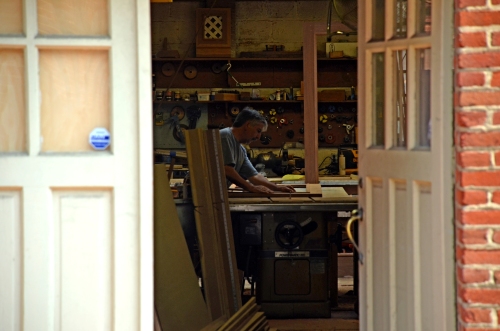
Historic Woodworking Shop Looking for Tenant

G Morris Steinbraker Building


The G. Morris Steinbraker and Sons Co. was started by Georgetown-native century to provide construction services. The first generation Steinbraker, G. Morris, built a workshop for his company on Grace St. in 1944. Ever since, his son and his grandson have used the shop for the family-business (the Georgetowner has a nice piece on the family here):

Continue reading

2 Comments

Filed under History

When Georgetown Found Itself on the Wrong Side of the Creek

Map from Library of Congress, courtesy of Ghosts of DC.

The fantastic Ghosts of DC blog found a great map from the Library of Congress archives. It shows the property values of each block in DC in 1879. Slate blogger Matt Yglesias noticed and pointed out that it shows a time when Logan and Shaw were more expensive than Georgetown.

Actually, the blocks around Logan and the Shaw blocks to the east don’t appear to have that much more of an concentration of darker blocks than Georgetown. But it is true that this map likely captures the moment when Georgetown slowly started to slip behind the rest of the city in terms of economic status.

This is a point GM has discussed many times before. Starting in the late 19th century Georgetown became somewhat of an Irish and African-American slum (although sometimes this is a bit overstated). It’s reputation grew as a rougher part of town through the early 20th century. In the 1930s, Georgetown became one of the first “gentrified” neighborhoods in DC when New Dealers swooped in and bought up the old houses. The rest is history. Continue reading

Leave a comment

Filed under History

Don Rockwell Does North Georgetown

Photo by Biberfan.

Restaurant-scene “power player” Don Rockwell recently took on that nebulous section of Wisconsin Ave often referred to as north Georgetown. (Actually it wasn’t that recently. It was back in November, but it was recently tweeted).

Rockwell walks the reader through the stretch:

We have to define what, exactly, “North Georgetown” is.

It can be loosely defined as the area between Glover Park and Georgetown, but what does that mean?

The easiest way to “understand” the notion of North Georgetown is to begin at the southern edge of Glover Park, near the Holiday Inn. There is a natural geographical division here, bisecting Wisconsin Avenue with parkland: the Dumbarton Oaks / Naval Observatory area is on the east, and the Whitehaven / Holy Rood Cemetery area is on the west. There is very much of a “gap” here in terms of Wisconsin Avenue development, and this is where “North Georgetown” begins.

He then walks down through the restaurants giving brief mentions to each. Bistrot Lepic and Cafe Divan stand out for praise. GM thinks Rockwell is a little hard on Los Cuates, which is a perfectly good neighborhood Mexican restaurant. Continue reading

2 Comments

Filed under History

What’s Your First Georgetown Memory?

GM recently took part in a focus group being run by the BID designed to find out what Georgetowners like or dislike about the neighborhood and what could be done to improve it. At the beginning of the session, the participants introduced themselves and stated, among other things, what their first memory of Georgetown was. It was an interesting way to kick off a discussion of what people think of the neighborhood.

While GM moved to Georgetown ten years ago, his first memory is much older than that. In the mid 80s, his family came down to DC from Connecticut for something or another (it was either part of a visiting fife and drum corps or the time GM’s brother won the Sea Breeze Award for “teenager of the year” and got to meet Nancy Reagan and Ms. America). Either way, GM remembers bunking up with his family in one room at the Hotel Harrington.

The Georgetown memory is of waiting forever to get a table at the legendary Geppetto’s Pizza, which once occupied the space currently housing Unum. Growing up the in northeast, GM had never experienced pizza that thick. Through the compound interest of memory, that pizza is still the best pizza GM ever ate. Continue reading

20 Comments

Filed under History

More About that Lincoln Seance

GM wrote last week about the curious connection between Abraham Lincoln and 3226 N St. Well, GM wanted to share a bit more about the seances that Lincoln took part in there:

…lt Was at this seance that Mrs. Belle Miller gave an example of her power as a “moving medium,” and highly amused and interested us  by causing the piano to “Waltz around the room,” as was facetiously  remarked in several recent newspaper articles. The true statement is  as follows: Mrs. Miller played upon the piano (a three-corner grand),  and under her influence it “rose and fell,” keeping time to her touch in  a perfectly regular manner. Mr. Laurie suggested that, as an added  “test” of the invisible power that moved the piano, Mrs. Miller (his  daughter) should place her hand on the instrument, standing at arm’s  length from it, to show that she Was in no Wise connected with its  movement other than as agent. Mr. Lincoln then placed his hand  underneath the piano, at the end nearest Mrs. Miller, Who placed her  left hand upon his to demonstrate that neither strength nor pressure  Was used. In this position the piano rose and fell a number of times at  her bidding. At Mr. Laurie’s desire the President changed his position  to another side, meeting With the same result. Continue reading

Leave a comment

Filed under History