Category Archives: History

Lincoln and Georgetown

Next Monday is Presidents Day. And for the occassion, GM would like to discuss one of the weirder (and sadder) stories of Abraham Lincoln, one that ties him to Georgetown.

While he had already nurtured a growing interest in the then trendy spiritualist movement, Lincoln grew more convinced of the veracity of spiritualism following the death of his son Willie in 1862. (To be fair, accounts of his spiritualism vary. Some historians believe his participation was merely intended to humor his wife.) Continue reading

8 Comments

Filed under History

Great Historical Photos of West Heating Plant

West Heating Plant


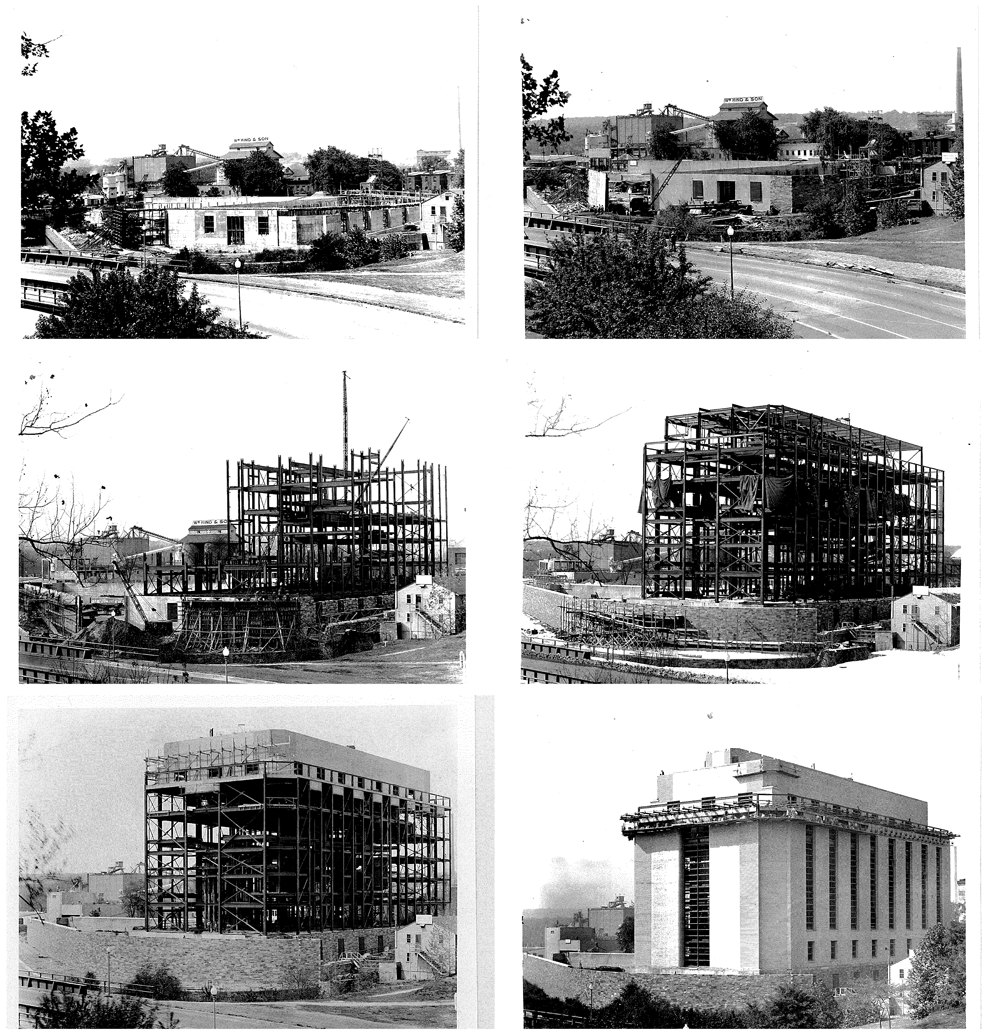
GM was recently browsing the website the GSA created in anticipation of the auction of the monumental West Heating Plant in Georgetown when he came across some fascinating historical photos on the site.

They even have what would now be described as “construction cam” photos. GM gif’d them:

West-Heating-Plant


It’s too bad that small building just north of the West Heating Plant was torn down at some point.

There’s more great stuff. Like here’s a photo of the empty lot before construction began: Continue reading

3 Comments

Filed under History

More Archaeological Treasure

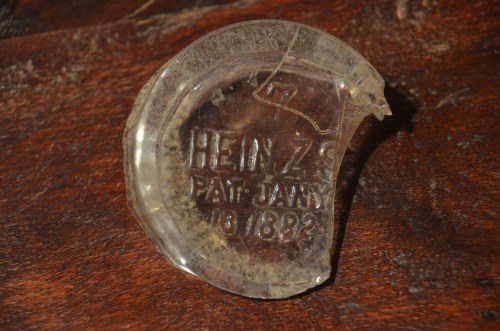
DSC_0612

A couple weeks ago, GM reported on the archaeological finds in his garden. While some prep work was being done for a new tree, some pottery shards, oysters, and coal turned up. Well, last week when the tree itself was planted, another cool piece of history popped up.

You can see above that it’s the bottom of a glass bottle. In this case, the bottle bears the familiar name of Heinz’s. Specifically it says: “7/Heinz’s/Pat Jany/13 1882”. Continue reading

Leave a comment

Filed under History

GM’s Archaeological Dig

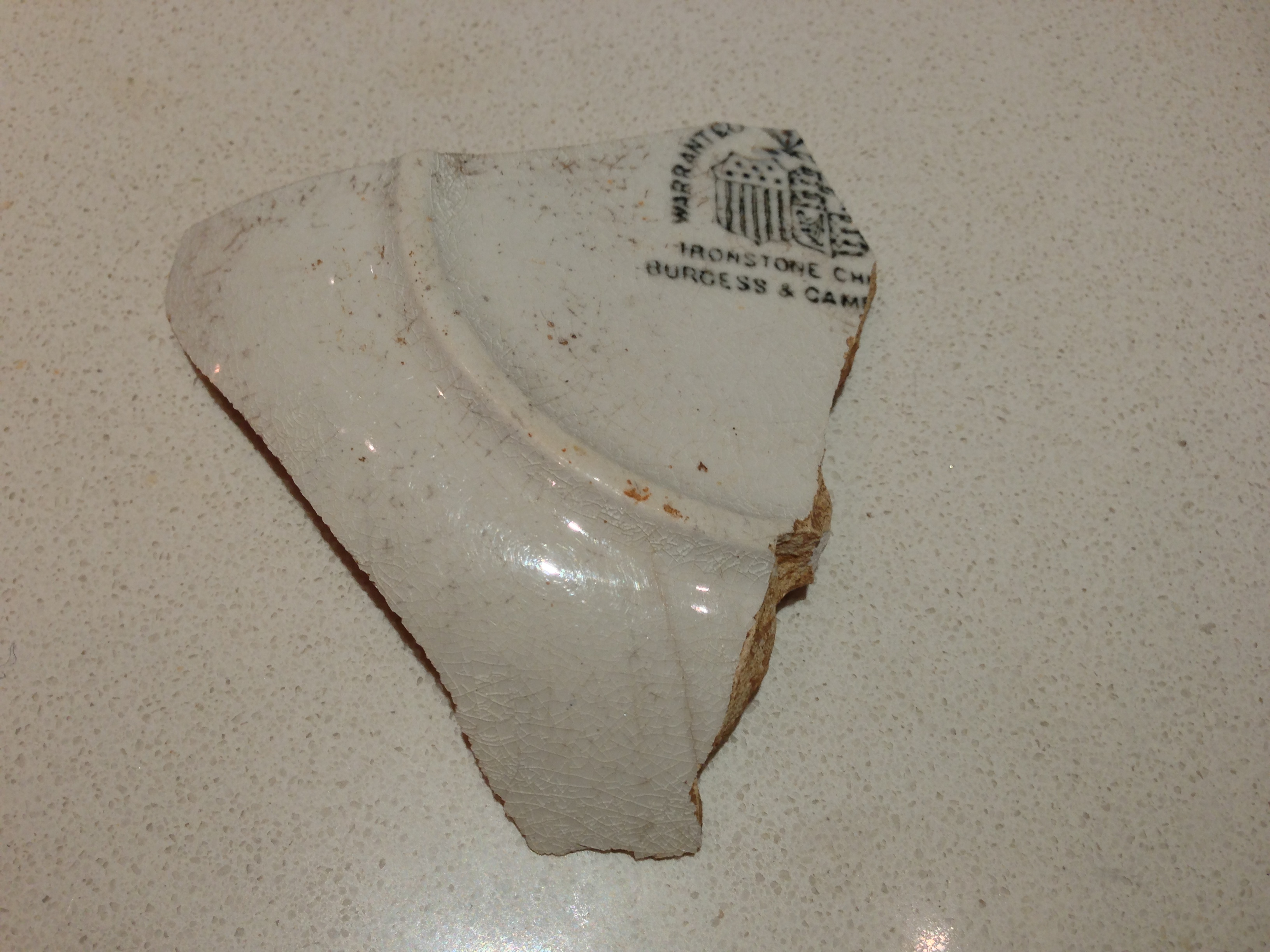
Over the weekend, GM having some work done in his small garden. Specifically, one corner of the garden was being prepped for the planting of a new tree. To accomplish this, the soil needed to be cleared of several feet of sand and clay that sat just below the topsoil. In doing so, several interesting artifacts were found.


The most interesting find was this chard of china. It appears to be from a small plate. The makers mark is from a company called the International Pottery Company of Trenton, New Jersey (“Trenton makes, the world takes!”). According to this site, this particular mark (with the name Burgess and Campbell appearing on the bottom) started being used sometime around 1879. Continue reading

5 Comments

Filed under History

Before it Was a Board, it Was a Brew


Courtesy of The Beer Can Guide.

Whenever you hear the phrase “Old Georgetown”, it’s often followed by the word board. But in the middle part of the last century, the phrase was used to describe a much more enjoyable item: beer.

The shores of the Potomac just south of Georgetown once housed DC’s greatest brewery: the Christian Heurich Brewery. Started by its namesake, a German who immigrated here in 1866, it was built in 1894. Huerich ran the brewery both before and after Prohibition, gaining a reputation as the best beer in town. He passed away on the job at the age of 102 in 1942.

The brewery produced a series of different beers, mostly under the Senate Beer logo. But in 1950, the brewery introduced the new Old Georgetown label. It wasn’t until later in the year that Congress passed the Old Georgetown Act, which established the strong historical protections for the neighborhood’s architecture. Both were probably inspired in anticipation of the 1951 centennial of the neighborhood (the “Old Georgetown” signs at M and Pennsylvania that you see in GM’s header were also erected around then). Continue reading

6 Comments

Filed under History

The Library’s Useful Tools


Yesterday, GM ran an article about the history of the Corcoran School on 28th St. GM relied heavily on a free asset that he’s not sure many people are aware of: the entire Washington Post archives. And he got them with an assist from the DC public library.

Here’s the page full of the online newspaper and magazine articles that the library offers free for any library card holder (not a card holder? Sign up online here.) Of particular interest to GM are the Post archives, which go back to 1877, but there are other more limited archives for other newspapers like the New York Times or the Wall Street Journal.

GM’s of the position that any randomly selected newspaper from the past is going to be fascinating. But luckily for those looking for a particular piece of information, the archives have a strong search function. Continue reading

1 Comment

Filed under History

West Georgetown Was Once “Obsolete”

Photo courtesy of GGW.

Greater Greater Washington published a great article the other day that delved into the sad story of mid-century urban renewal. It focused on the conclusion that the National Capital Park and Planning Commission (NCPPC) reached when it labeled huge swaths of central DC to be “obsolete” neighborhoods. And more interesting for GM, a large chunk of west Georgetown fell into that category.

The Commission identified neighborhoods as obsolete when over 50% of the dwellings needed major repairs and/or had no internal plumbing. And in its judgment, as of 1940 all the blocks west of 36th St. in Georgetown fell into that category (i.e. from P all the way down to Prospect between 36th and 37th).

This is a part of town whose poverty GM has discussed in the past. The scene was well captured by the photographer Carl Mydans:  Continue reading

4 Comments

Filed under History

Ghosts of Buildings Past

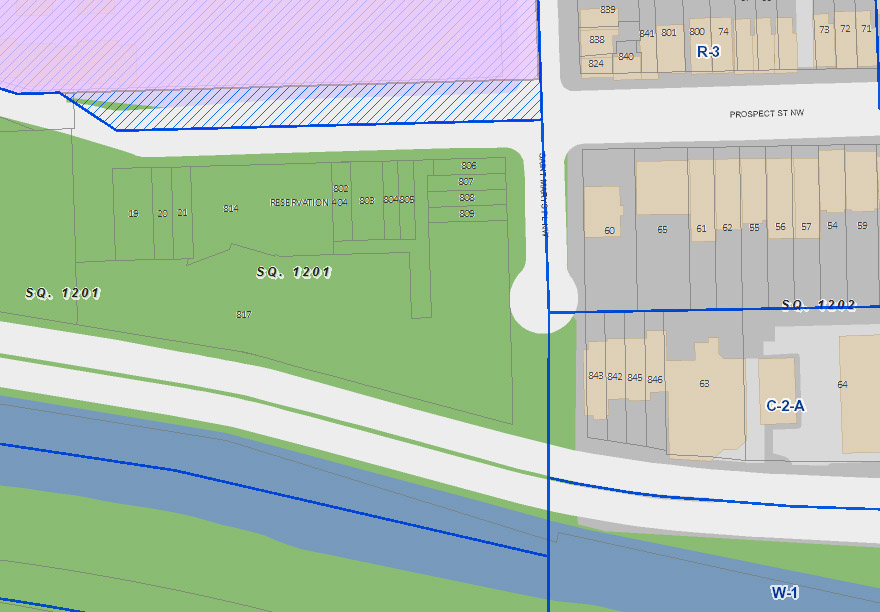
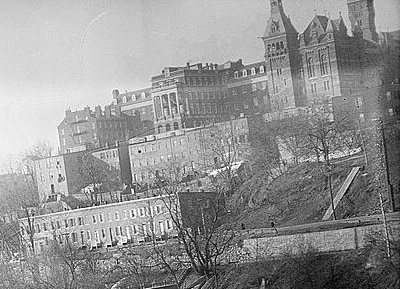
On Monday, GM posted an article showing how the waterfront has changed since 1918. One element of the old photo that GM found particularly interesting was the line of buildings along Canal Rd. and Prospect St. south of GU:

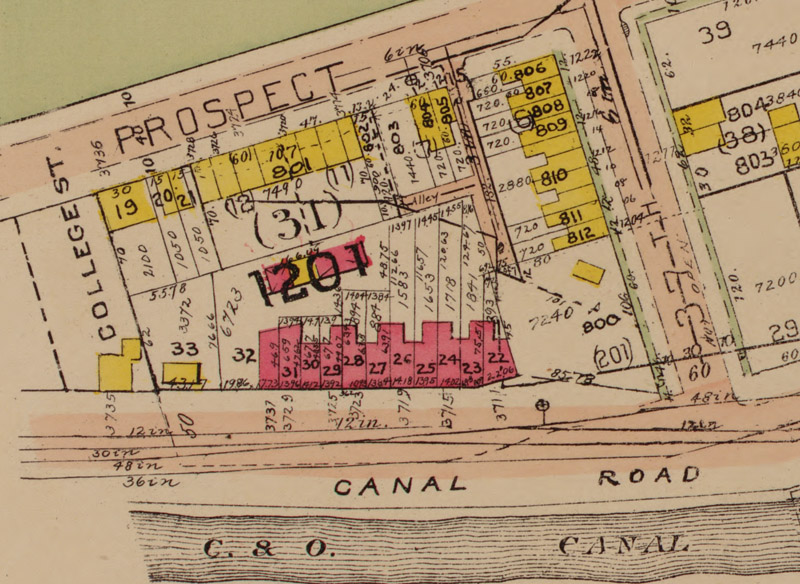
From another old GM post, you can trace back through the Library of Congress to find the survey records from 1920, which show these properties:

Continue reading

1 Comment

Filed under History

Now and a Long Time Ago: The Georgetown Waterfront

This week on Now and a Long Time Ago, GM heads down to the Georgetown waterfront. Nowadays there is a beautiful and very popular public park. But during much of the 20th century, the waterfront was an industrial sector. And sitting prominently in the middle of that nest of activity was the stately Capital Traction Company Powerhouse.

GM has delved into this building in the past:

When it was fully operational, the powerhouse contained twelve boilers that powered five turbo generators. This provided 18,500 kilowatts of electricity, which was distributed out through four substations to the streetcar system…Despite the grandness of this building, it was only used for 23 years. In 1933 it was shut down as part of the Capital Traction Company’s merger with Washington Railway and Electric Company to form the Capital Transit Company. By 1944, the powerhouse was decommission. By 1968 it was demolished.

One of the final challenges that faced those trying to complete the Georgetown waterfront park was that the original foundation of the powerhouse were still there undetected until they started digging. They had to be removed at an expensive cost.

GM loves the waterfront park, but he wishes that the old Capital Traction building were saved. It could have been a great space. Continue reading

1 Comment

Filed under History

Georgetown Historic Alley Dwellings

In the early part of the 20th century, DC was dotted with dozens and dozens of alleys with small houses lining them. Occupied primarily by the city’s poorest residents, the alleys attracted the attention of Congress which viewed the alleys as breeding grounds of crime and disease. It passed the Alley Dwelling Elimination Act of 1934 to “clear” the alleys. The residents were moved and most of the houses torn down.

Georgetown had about twenty of these alleys at the beginning of the 20th century. GM was recently directed to a nice map by Matthew Steenhoek showing all the alleys that existed in 1912:

The blue flags mean the alley is still there, green means the alley has been completely redeveloped, and red means that commercial uses exist on the alley today.

Continue reading

Leave a comment

Filed under History