
 Photo by Mike Maguire.
Good morning Georgetown, here’s the latest:
- GU puts in application for new stadium (GM believes this is for the football/soccer/lacrosse/etc. stadium)
- Protests outside the Venezuelan embassy.
Photo by Mike Maguire.
Good morning Georgetown, here’s the latest:
Filed under Uncategorized

Ward 2 Councilmember Jack Evans has drawn a contender for the Democratic nomination next year. Foggy Bottom commissioner Patrick Kennedy has announced his challenge. And today, GM is posting Kennedy’s first big Georgetown endorsement, namely that of ANC Commissioner Joe Gibbons. He writes:
We Need Patrick Kennedy is the Ward 2 Councilmember We Need
As the former Chair of ANC2E and a Commissioner now in my second term, I am supporting Patrick Kennedy to be the next Ward 2 Councilmember.
I’ve voted for Councilmember Jack Evans in the past, and I’ve worked with him at our ANC; I respect his contributions to the community. Some may ask why, then, I would support another candidate, particularly so far out from the election.
The reason is simple: I know that I am for Patrick, and I don’t need to be against anyone else.
I first got to know him when I was reaching out to neighboring ANCs as a new Commissioner and ANC2E Chair back in 2017. Patrick was then, at the ripe old age of 25, a steady hand at the helm of the Foggy Bottom ANC (as he had been for several years).
I immediately sensed in him someone with a true sense of what public service meant. He was passionate, extraordinarily well-informed, even-keeled, and cared deeply about delivering tangible quality of life improvements for our communities.
Whether the topic was residential quality of life concerns, school issues, working with businesses, or thinking through transportation solutions…I found Patrick to be a collaborative, thoughtful partner across neighborhood boundaries and someone with a positive vision for the ward.
I also watched how he dealt with difficult issues and mediated solutions when competing interests were at stake; he is a person who pours his heart into doing the right thing, but I have never once seen him be anything less than completely respectful to someone with a different viewpoint. He is genuinely a well-meaning public servant, and a pleasure to work with.
I know that with Patrick, we will have a councilmember who understands the nuances and unique concerns of Georgetown and other neighborhoods in Ward 2. He always wanted to know more about the issues facing Burleith, Georgetown and Hillandale, and has worked with me and my colleagues numerous times over the years to make sure that our ANCs acted in harmony on issues of common interest.
Patrick’s style of leadership (transparent, thoughtful, honest, and a good listener who engages with everyone) is exactly what our ward needs right now. It’s time for a new generation of leadership to step up, and I can’t think of a better representative of the new generation than Patrick. I hope that you’ll join me in supporting him.
You can learn more about Patrick and get involved with his campaign at PatrickForWard2.com.
Joe Gibbons
Filed under Uncategorized
 Photo by Mike Maguire.
Good morning Georgetown, here’s the latest:
Filed under Uncategorized
 Photo by M.V. Jantzen.
A former ANC commissioner is attempting to wage a war against the installation of a bus shelter in Georgetown. Grace Bateman, who served as Chair of the commission in the early 90s, is attempting to thwart the installation of a new bus shelter on 35th St., across from Dent Place. The stop–a popular stop for the students at the overwhelmingly African-American Duke Ellington High School a block away–serves three bus lines, including the D1, D2, and the D6. (Bateman has argued that the bus shelter at 35th St. and Reservoir should be enough, but that ignores the fact that the D6 doesn’t stop there). This is an wrongheaded campaign which sadly demonstrates the perverse arguments people too often make through the prism of historic preservation.
First alerted to the construction of the stop in February, Bateman wrote the ANC to object, claiming that when she was on the commission she obtained a promise from the city not to construct any bus shelters in Georgetown. This, she claimed, was because they “cause visual blight and impair accessibility on our already narrow sidewalks.” She warned darkly that allowing Metro one bus shelter could lead to many others throughout Georgetown. Continue reading
Filed under Uncategorized
 Photo by Mike Maguire.
Good morning Georgetown, here’s the latest:
Filed under Uncategorized
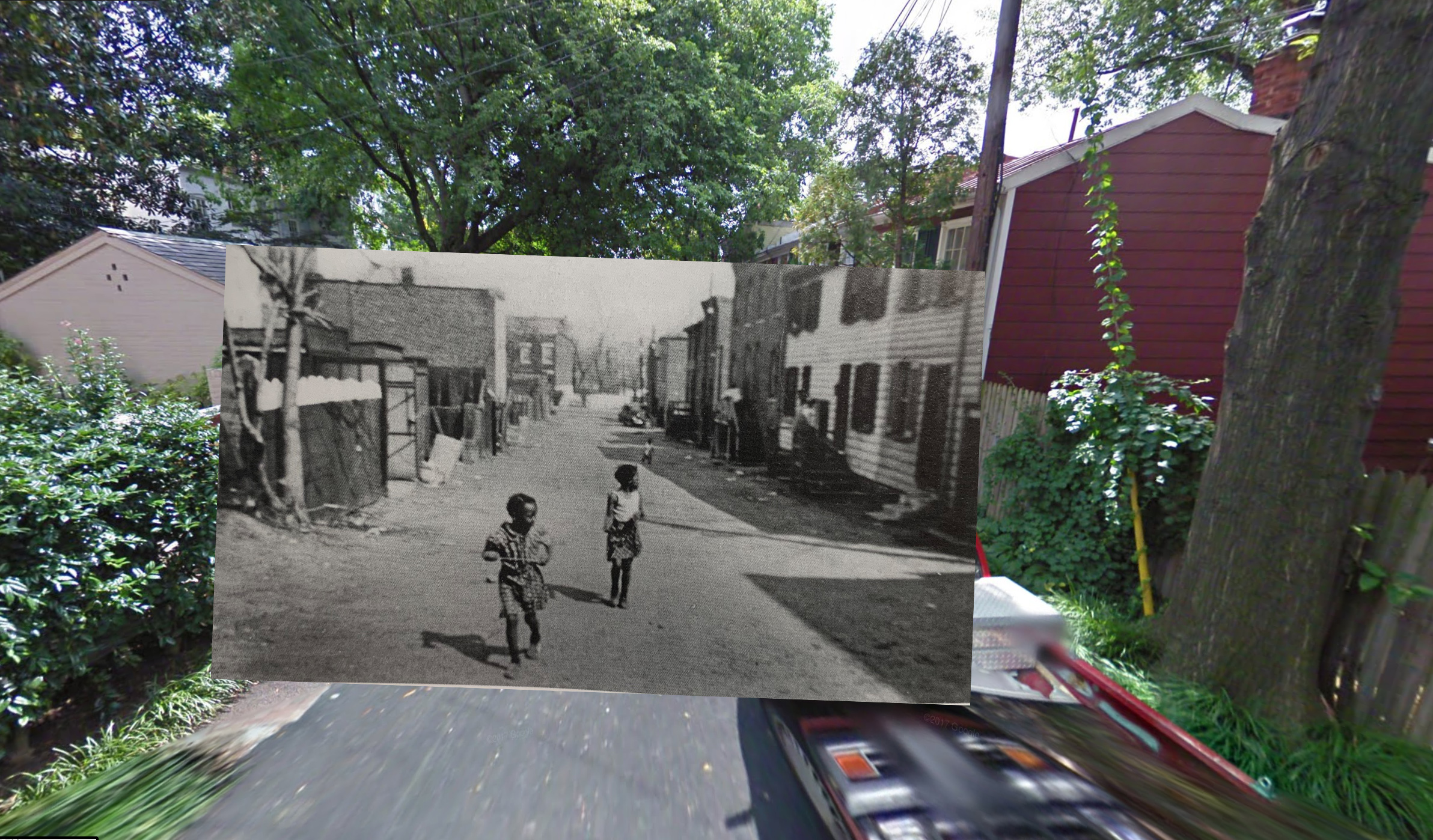
GM’s bringing back an old series this week. It’s Now and a Long Time Ago. And he’s visiting what is now called Poplar St. It’s a tiny, one block street that was once called Poplar Alley, and it was at the center of Georgetown’s historic African American population.
The old photo, courtesy of the DC Public Library, is from the 1920s. At this time, Poplar Alley was one of many alleys lined with small houses around Georgetown (and most of them are still around).
Alleys and alley dwellings were hardly idyllic, and were often filled with scenes of poverty. But they were home to many. Around the time of the photo, Poplar Alley housed thirty-two Black Georgetown residents in eleven homes.
The poverty of alley dwellings inspired the Alley Dwelling Act, a New Deal effort that targeted alley housing across the District. This ostensibly well-meaning act created the Alley Dwelling Authority, which scoured the city’s alleys to identify unsuitable housing. If a house was determined to be unlivable, it would be condemned and the residents ordered to leave. The building owner would be mandated to improve and modernize the home, and provided funding to do so. Once the homes were improved, the former tenants theoretically could move back in, but they often encountered much higher rents to do so.
It was, in effect, one of the first manifestations of gentrification in DC. And it had predictable impacts on the resident population. African Americans continued to live in large numbers in Georgetown for decades after this action, but the numbers began to decrease. And this decrease picked up speed as the gentrification moved from the alleys to the streets.
Now Poplar Alley is Poplar Street. And while the homes are just as small as they were back then, they sell for as high as a million dollars. What a world.
Filed under Uncategorized











 The Georgetown Metropolitan
You must be logged in to post a comment.