
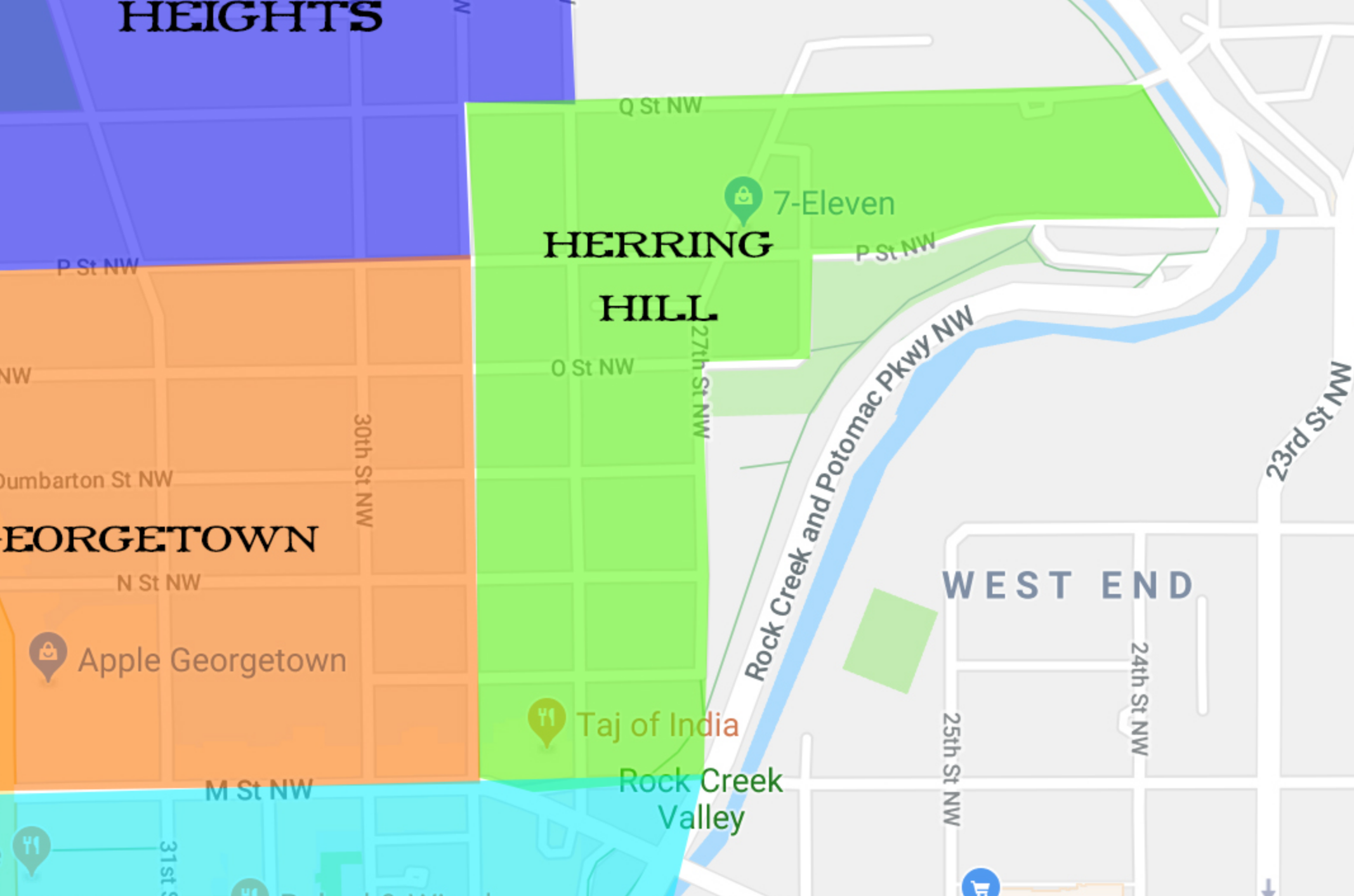
This week for Seven Georgetowns, GM explores the historic district of Herring Hill.
Herring Hill is far eastern Georgetown, basically 29th St. to Rock Creek. Cultural DC has a nice explanation of the name and the history of this quarter:
Tradition has it that the name came from the fish that neighborhood families caught in nearby Rock Creek. According to historian Mary Mitchell, by 1860 Herring Hill was a self-sustaining, even village-like community with a population of 951. Interspersed among the residences by the 1920s were candy stores, “mom and pop groceries,” coal and ice sellers, barbershops and beauty shops, cleaners, movers, feed stores, and everything else necessary to life. Most were black-owned businesses. Laborers lived alongside physicians, lawyers, and other professionals.
Herring Hill’s simple frame dwellings survived the gentrification of the 1930s to become prized, well-located townhouses in the 1960s and beyond.
In choosing this name for Seven Georgetowns (other than, say, Rose Park, or whatever) GM wanted to really emphasize the African American history and how closely it is tied to the homes and shops of this area. Some people occasionally say that all of Georgetown was a “Black ghetto” in the early 20th century. This is wrong on two accounts. The African American population was concentrated in eastern Georgetown, not spread out across the whole neighborhood. And Herring Hill was anything but a ghetto. It was a thriving, healthy neighborhood of families, businesses, churches and schools.
To get a sense for the neighborhood, you should read Black Georgetown Remembered. But for a shorter version, consider this excerpt from a letter sent to the ANC about the 7-11 back in 2011:
The block that housed P Street Pictures and 7-11 had a barber shop, shoe shine parlor and Reed’s Electric Company before Reed’s moved to Wisconsin Avenue. Around the corner on Twenty- Seventh Street, The Diamond Cab Company operated its taxi cabs. In days past, Georgetown housed the Ledo and Dumbarton movie houses, Murphy’s Five & Dime, Galliher & Huguely Lumber Yard, Ladd Mills Esso and the original Georgetown Boys Club…
The churches (most of them at least) still remain. The schools are closed. Phillips, the black school, was turned into condos after the Washington International School sold it in 2002. Corcoran, the white school, was turned into offices in 1982. It’s currently used by the Qatar Defense Ministry. Continue reading








 The Georgetown Metropolitan
You must be logged in to post a comment.