If you are like me, and you have a teenage girl, I present to you breaking news: Garage is coming to M St.
That is a meaningless message to me. And it may be meaningless to you too. But to many a teenage girl, this is a coveted clothing shop. And with its arrival, trips out to Tyson’s Corner become all that less necessary (by “necessary” I mean necessary by the standards of a teenager, not a normal human being.)
According to the Washington Business Journal, the store will be taking over the former Club Monaco space at M and 33rd (which is the former Rhino Bar, to somewhat old-timers, and the former Winston’s to genuine old-timers.) No word when it will open.
Breakfast with Santa will be returning to Volta Park this December 6th. Here are the details!:
One of our favorite events will be returning on December 6th to the Volta Basketball Courts. Join us between 10am-12pm and enjoy the holiday cheer with friends and neighbors. Bring the whole family, including your four-legged fur babies, for the Santa Experience ($20) which includes: sitting with Santa (*parents will take their own photo), festive crafts, doughnuts, coffee/hot chocolate and new this year – live DJ music and face painting!
On behalf of Georgetown Ministry, we will also be collecting gently used adult coats, hats, mitts and scarves. *Please do not bring any children’s coats or clothing for donation.
Come join us for the festivities, sure to bring laughter and smiles for the whole family.
Two new stores are on the horizon for Georgetown, at least according to this month’s Old Georgetown Board submissions.
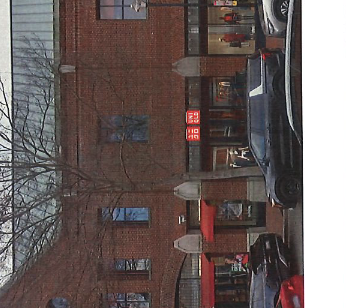
The first is the international brand Uniqlo. They have long been rumored to be looking for a location in Georgetown, and it appears they have found one. The sign application indicates that they are aiming to take over the recently vacated J Crew location on M St. (J. Crew moved to the other end of M St., opening recently at M and 30th).
(In case you’re wondering, in English the name of the store is pronounced like Unah-Klow. For what it’s worth, in its original Japanese it’s pronounced more like Unick-Cah-Lo.)
The other new store is probably a less familiar name to you. It’s called Nuts Factory, and it’s coming to the former Town Liquors location at Wisconsin south of O St. This appears to be pretty much what it says: a store that sells nuts. But it appears the main product that they sell is something called Dubai Chocolate. They have about a dozen existing store locations, all of which are in the northeast.
Last month, a Swedish company gave a demonstration of a boat they make designed with a hydrofoil hull. The company says it hopes to one day use this technology for a water ferry on the Potomac to Georgetown. While this is an impressive display, there are reasons to remain skeptical that we’ll see hydrofoil ferries anytime soon pulling up on the dock.
Hydrofoil hulls work by essentially bolting on a set of wings to the bottom of a normal boat. As the boat picks up speed, the “wings” (i.e. the foils) provide lift enough that the whole boat (minus the foils of course) rises up and out of the water. This has several advantages. For one, it significantly reduces the drag caused by the boat going through water, so higher speeds can be achieved with less energy spent. Additionally, (and more relevantly for Georgetown) the boat produces a far smaller wake because it is no longer having to push so much water out of the way. The video above demonstrates how small the wake is, despite the boat traveling over 18 knots (about 20 mph).
This would have the potential to dramatically reduce the travel times for a ferry to Georgetown. That’s because there is a “no wake zone” above Memorial Bridge. So any boat traveling from, say, Alexandria, has to spend the last mile creeping along at a very slow rate. If a ferry could cruise in to Washington Harbour at 20+ mph, it could significantly reduce travel times and possibly make it a more viable option for some.
But there are plenty of reasons to doubt this will actually happen.
First, we’ve been here before. Starting around 2010, a water taxi company operated a few routes to Georgetown (not the one that operates now). After a few seasons they closed down but promised to return with hovercrafts that would allow them to travel faster. They even had a demonstration of the hovercraft in 2013 at the exact same spot the hydrofoil was just shown. You’ll not be surprised to hear that the Potomac hovercraft never came to pass. (It’s probably telling that as I searched for a news report of the 2013 hovercraft demonstration, Google instead kept giving me news reports of this 2025 hydrofoil demonstration.)
Another concern is that it’s not quite right to say that there is a “no wake zone” above Memorial Bridge. There’s a speed limit, full stop. No boats are permitted to go over 6 mph. And this is not just pedantry. This part of the river is designed to host slow recreation boating, like kayaking, paddleboarding and canoeing. Throwing off a huge wake is bad and dangerous for these activities and is prohibited. But a boat going 20+ mph through here is also bad and dangerous for these activities even without a wake because a big fast boat can still injure or kill someone.
Maybe there could be remedial measures put in place to prevent that from happening, but I’m skeptical they’d be sufficient to limit the risk.
On top of everything, ferry-sized versions of these hydrofoil boats cost about $1.3 million. Is there enough demand from riders to justify that expenditure? We’ll see.
The public high school designated for Georgetown is in the process of receiving its official name, one that will be familiar to many in the neighborhood: John Thompson Jr. High School.
The high school, which was established by DC in the fall of 2023 and occupies the former Georgetown Day School on MacArthur Blvd. in the Palisades, is the in-boundary high school for Georgetown students. The school was created to address overcrowding issues at Jackson Reed (the former Wilson High School). Now students who attend Hardy Middle School will have the right to continue on to the new high school.
For its first years, the new school has been named MacArthur High School, after the street it’s on (which itself was named after Gen. Douglas MacArthur). It was always intended to be a placeholder name as the city considered a proper permanent name. Earlier this year, after support for the idea of naming the school after the legendary GU basketball coach gained traction, the decision was made to go with that idea. Legislation putting that decision into action was recently approved. I am not sure when the official renaming will take place, but I would guess it will be before the end of the school year.
The sports teams were previously known as the MacArthur Mammoths, but I understand that the new mascot will be the Jaguars.
Georgetown is down to two Starbucks again. The location at M and 34th has closed. This leaves just the location at Washington Harbour and the long standing location on Wisconsin by S St.
A note in the window of the recently closed location stated that it was closed after an “incredibly difficult decision”:
Starbucks has had a bit of a hot-and-cold relationship with Georgetown over the years. They once had a location at 33rd and M St. that was closed around 15 years ago as part of a similar downsizing. Then they opened this location just a block away in 2018, just for it to get axed by downsizing again. So perhaps in a few years they’ll try again yet another block to the west?
And also there was the other location at M and 31st that lasted until around 2020. So with this recent closure, there will now be no Starbucks on M St. for the first time in decades.
Which leaves the question of what will happen to the 34th and M building itself. It is one of the most storied buildings in Georgetown, as it was the location of the famous Cellar Door club. This was the location of the debut of “Country Roads Take Me Home”, written the night before in an apartment at 31st and Q St. And of course, it was the location of several legendary live recordings, including ones by Miles Davis and Neil Young.
Any rich and nostalgic investors out there interested in bringing the Cellar Door back? Here may be your chance…
Several aspects of our supremely screwed up national politics are likely to result in some gummed up construction projects around Georgetown in the near future. Some delays have already taken hold, and more are possible depending on how things move in the near future.
Here’s why:
Every construction project in Georgetown is required to be sent to the Old Georgetown Board for review and approval prior to the permit being issued. The Old Georgetown Board is a federal body and is currently out of action due to the ongoing federal shutdown. Under normal times, the OGB would meet tomorrow for its monthly session to consider the dozens of applications that came in since the October session.
But they didn’t have an October session due to the shutdown. And they won’t have one tomorrow either, barring some unforeseen breakthrough. That means we will have at least two months worth of projects delayed waiting for review by the time it does come back.
One month delay is not unusual. It happens twice a year because the OGB doesn’t meet in January or August. But two months is not normal. And any more months would be even less so.
But that’s not the end of the possible complications.
Last week, Trump fired the entire Commission of Fine Arts (CFA). This is the parent body of the OGB and appoints all its members. As far as I can tell, the OGB members are still in place. But they too could be replaced by the new CFA. But the new CFA has to be actually appointed, which they have not been yet. (They do not, however, need to be confirmed by the Senate, which would likely add yet another delay.)
And here’s another possible wrinkle: I said above that all projects in Georgetown need to be approved by the OGB, but that’s not quite right. They need to be approved by the CFA. For the vast majority of cases in Georgetown, projects approved by the OGB are rubber stamped by the CFA two weeks later via a summary calendar. But they don’t always work that way. For instance, the West Heating Plant project was rejected by the OGB but approved by the CFA.
So we will need a CFA actually appointed to get the approvals Georgetown projects needs. And any major changes the new board introduce could trickle down to Georgetown projects as well.
In summary: at the very least, we will be looking at projects getting delayed. And I would not rule out a brand new Trumpified CFA dramatically changing how things are reviewed and approved in the neighborhood going forward.
Hello, and welcome to your November Northwest Georgetown ANC update!
Book Hill Construction Proposal
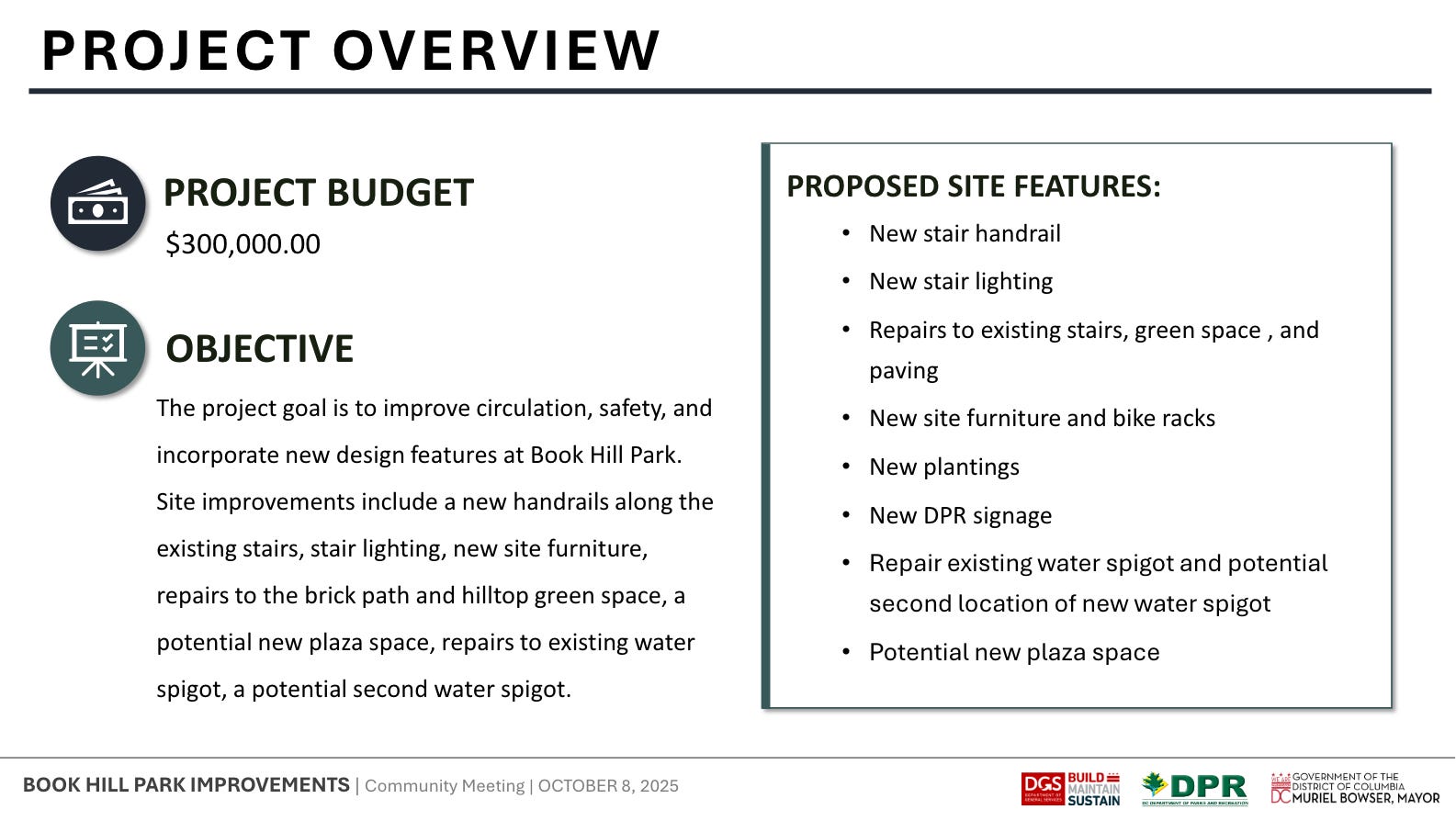
This month, the city finally presented some conceptual proposals for the improvements budgeted for Book Hill Park. Here are the broad details:
As you can see, the budget for the total project is just $300,000, which is really not a great deal of money, as far as these things go. But the proposal laid out seems to squeeze a decent amount of juice out of this amount. The elements would include:
Repairs to the stairs
Construction of a stair handrail
Installation of lights on the stairs
New seating and bike parking up by the library
New landscaping
The possible installation of a water spigot at the bottom of the park
The possible construction of a new plaza space
The repairs and proposed additions to the stairs are fairly straightforward. At the public meeting for the proposal, the residents attending (who largely represented immediate neighbors and the Friends of Book Hill Park) were receptive to the repairs and lighting proposals. There was some pushback to the railing idea, due to visual concerns, but openness to some sort of a safety improvement on that front.
The introduction of a water spigot is a long requested item from the Friends of Book Hill. This would make it significantly easier to water the plants and shrubbery towards the bottom of the hill. The project planners assured the attendees that they were looking into the feasibility of installing a new spigot. It sounds fairly straight forward, but it may be quite complicated. To the extent that the water spigot attaches into the library’s water supply, it would have to take into account the dramatic grade difference between the library and the bottom of the park.
The cost of such a feature could possibly swallow up a substantial portion of the budget fairly quickly. In light of that, the Department of Parks and Recs representative mentioned that if the cost for this feature does come back too high, the better route may be for the Friends of Book Hill to fundraise for it themselves. But we’ll have a better sense of the challenge as the planning proceeds.
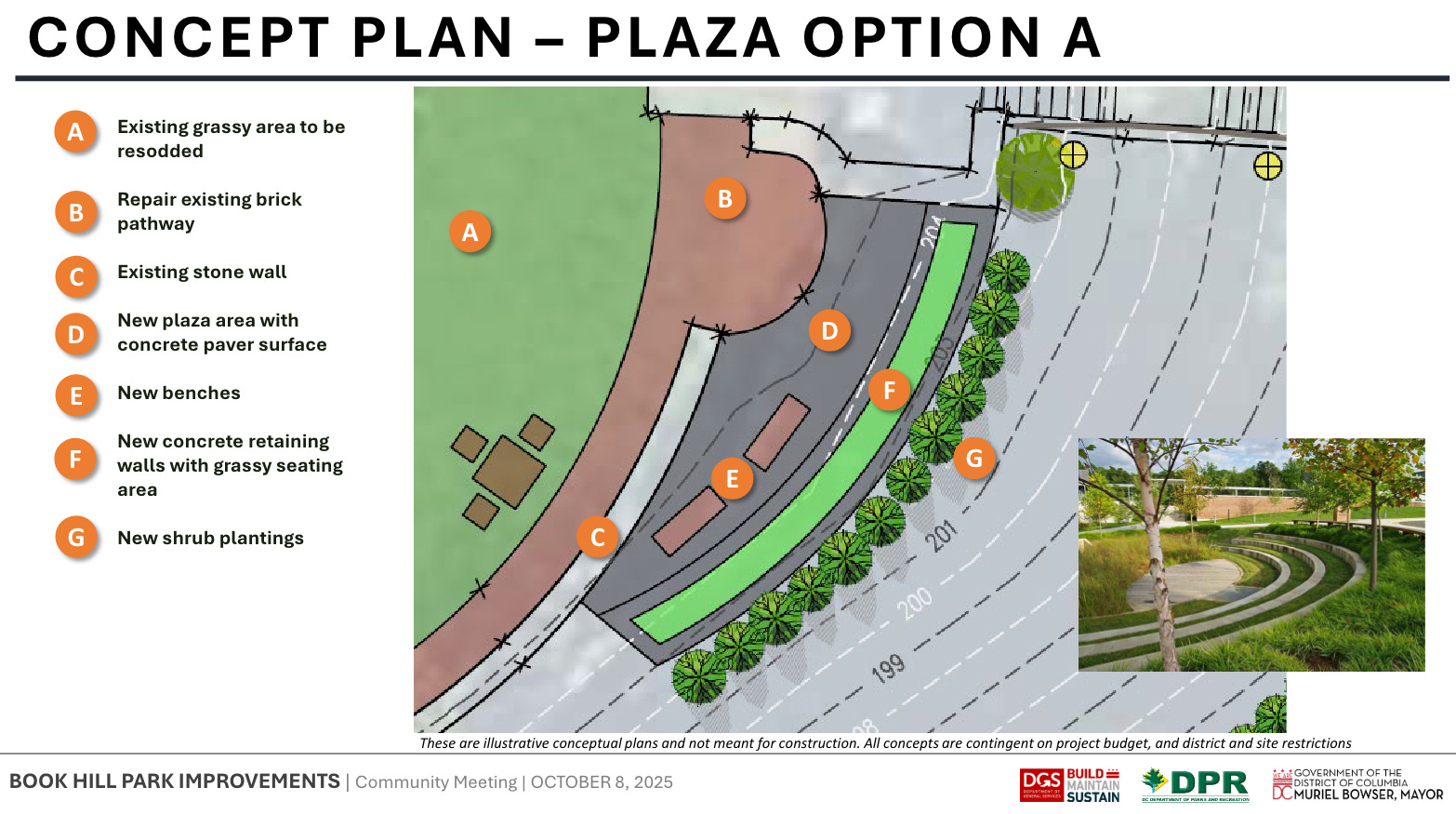
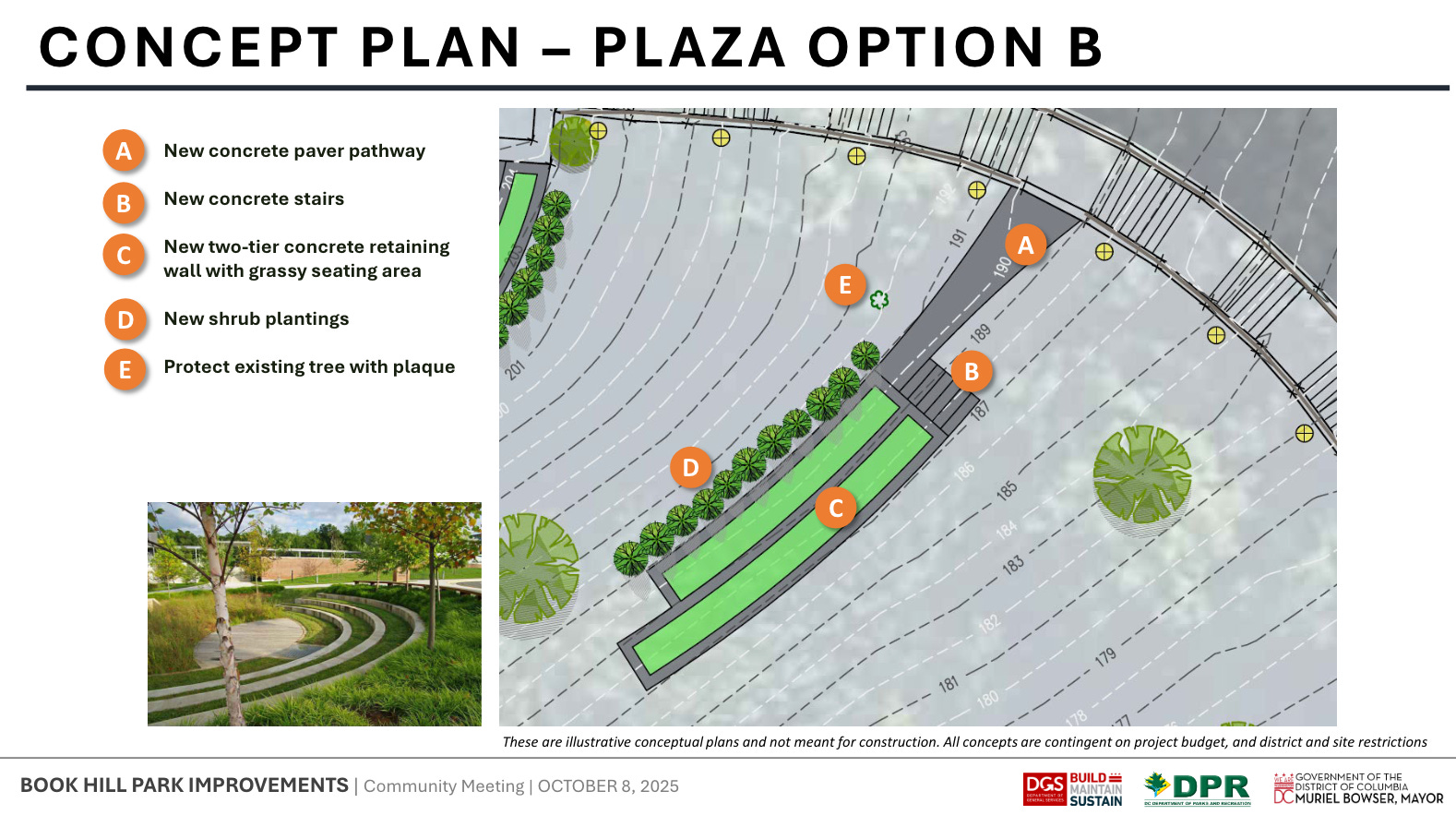
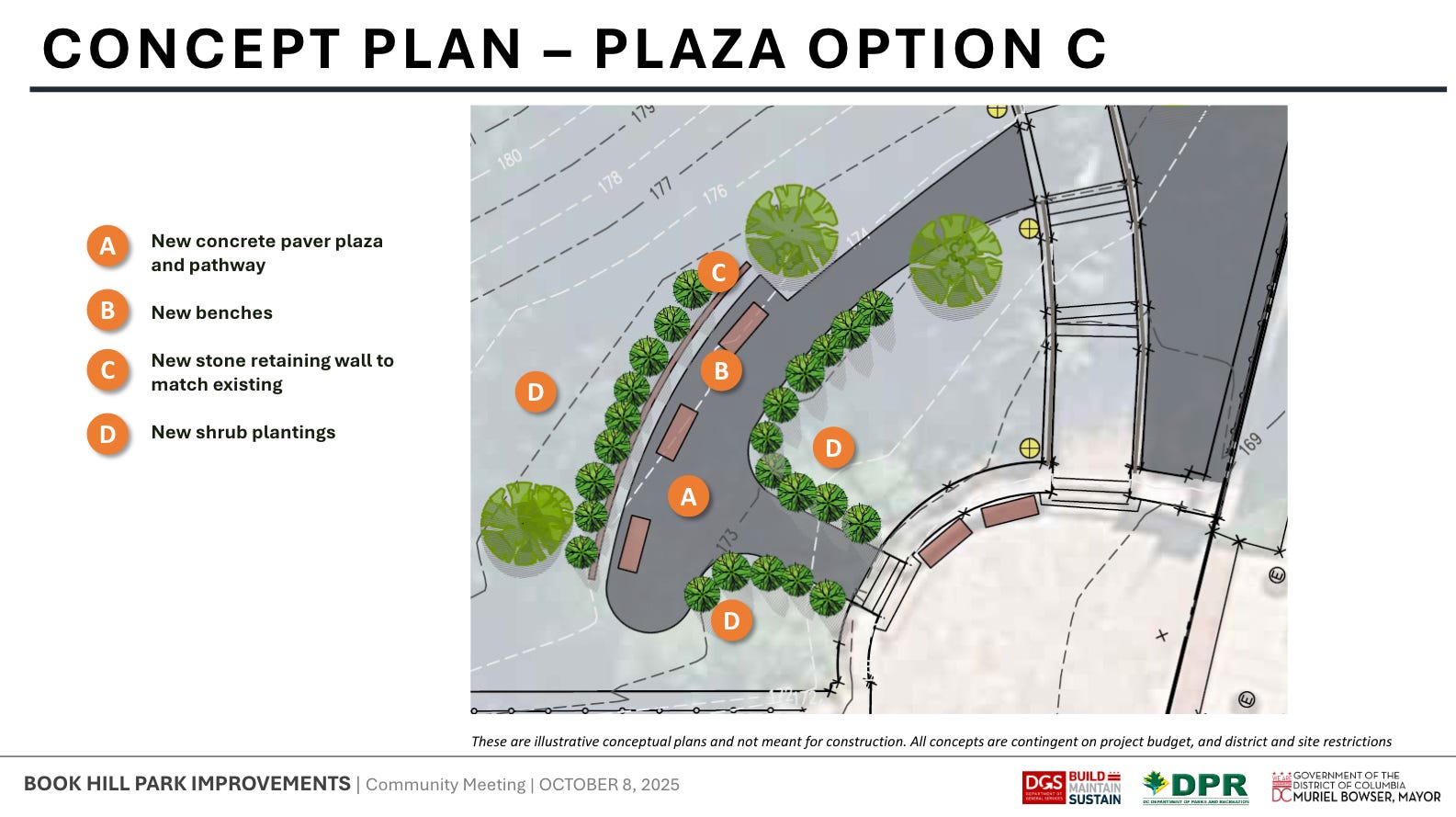
Which brings me to the plaza element of the proposal. The general idea with this is to create a space somewhere on the hill that enables people to experience the hill without stepping out on to a steep grassy grade. The concept proposes three possible locations for the plaza: at the top, at the middle, and (you guessed it) at the bottom. Only one of them would be chosen if the plan goes forward.
Here are some images of the concepts:
This is the “top” concept. The plaza would be just below the brick wall. It would provide new seating and some new planting.
This is the “middle” concept. It would create a two-tiered elongated terrace. This was the least popular of the three at the meeting as it would interrupt the hill’s appearance dramatically.
The “bottom” proposal would put the terrace just above the circular plaza at the intersection of Reservoir and Wisconsin. This would create a space just off the more busy plaza below without interrupting the hill’s overall appearance dramatically. This added terrace space would give more room for programming from orgs like Georgetown Main Streets, which has hosted a Christmas tree at this location for several years.
Of the three, the “bottom” proposal seemed to be the best received by the crowd at the meeting. But the general sense of the attendees was to prioritize the other improvements first. If the other items can be done and there still money left for the plaza, then great, but only if the other items get funded first.
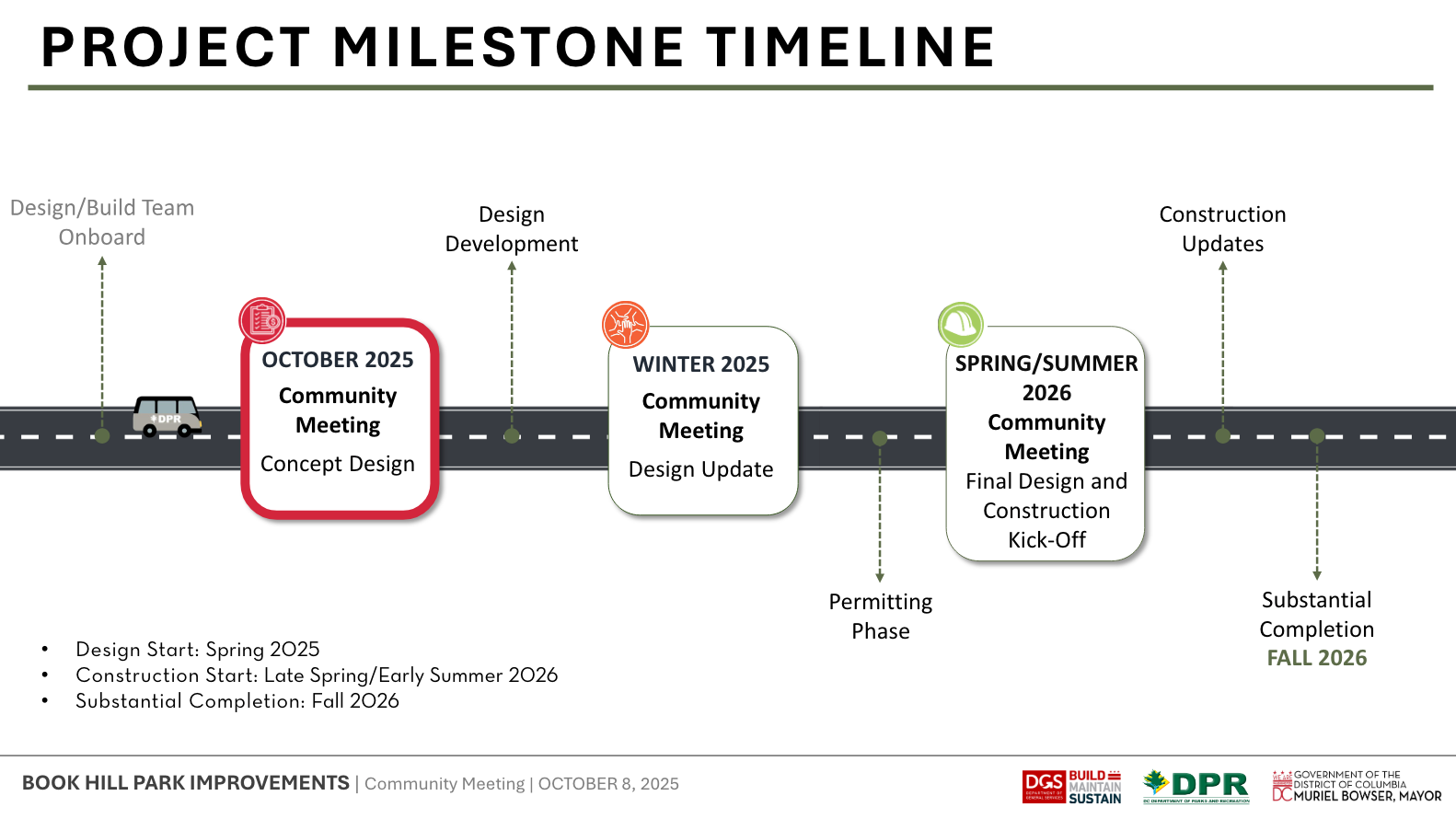
As for timeline, here is what the city laid out:
According to this, the city will return this winter with a design update, incorporating the feedback it’s getting. Then in the spring, a final design will be presented with construction beginning. The aim is to complete construction by next fall.
Based on my experience with the city in terms of getting projects like this actually moving forward, I would take this timeline with a grain of salt. But I’m always happy to be proven wrong on this account!
Leaf Collection
Speaking of pessimism born of experience, the Fall leaf collection is starting now!
The basic outline of this program is supposed to work this way:
You wait until the city notifies you that leaf collection crews are about to come to your neighborhood
You then rake your leaves into street tree boxes or bag them and leave them on the sidewalk
The crews them come by with a massive leaf vacuum cleaner and take all the leaves, in piles or in bags
The whole cycle repeats later in the fall season
This is how it has actually played out in recent years:
The city issues a notification about leaf collection crews coming, but many residents don’t get the notification
The crews don’t come when they say they will
Sometime later, they do come but they don’t pick up the bagged leafs
They also just completely skip many blocks
The leafs that weren’t collected get blown around, wet and eventually frozen. The bags tear open and same thing happens to those leafs.
The whole cycle repeats later in the season
As to the question of whether to bag leafs, the city gave mixed messages last year. Some sources said it was permitted, others that it was not. This year the message directly from the Mayor herself is that you are permitted to bag the leafs and leave them on the sidewalk and they will take them without the resident needing to place a specific 311 request. We’ll see, I guess.
As to skipped blocks, I have been in touch with the Mayor’s Ward Two rep, identifying which blocks in my district that were skipped last year. Hopefully that won’t repeat this year. But if you do notice that your block has been skipped, please let me know. It’s hard to know right away if your block has been skipped, but if a week goes by during the period that they said they’re coming (and perhaps you notice the crews around on other blocks) that’s a good time to reach out.
Many have noticed that the construction around the Volta Park fields has ground to a halt over the past month or so. I have reached out to DPR repeatedly inquiring abbout the stoppage and have been assured the delay is due to the crews waiting for a pipe to be delivered. Some residents have expressed a skepticism about this response, and I have to say I share it but I can only pass along what I’ve been told.
There have been some rumors about whether the crews found human remains, and that’s why there have been delays. This would not be at all surprising since the park was a cemetery in the 19th century and many of the remains were not removed when it stopped being one in the early 20th century. Added to the confusion, I think, is that apparently a human skull was recently found in the park. But it was in connection with a new drain pipe for the recreation center, not the ball field.
This, of course, highlights a truism that most residents around the park know: it’s probably better not to dig around there. But, again, as far as I’m being told, this is not the reason for the delay with the field restoration. In either event, I have been strongly encouraging the city to get on with the work asap, as the arrival of winter will significantly complicate the job.
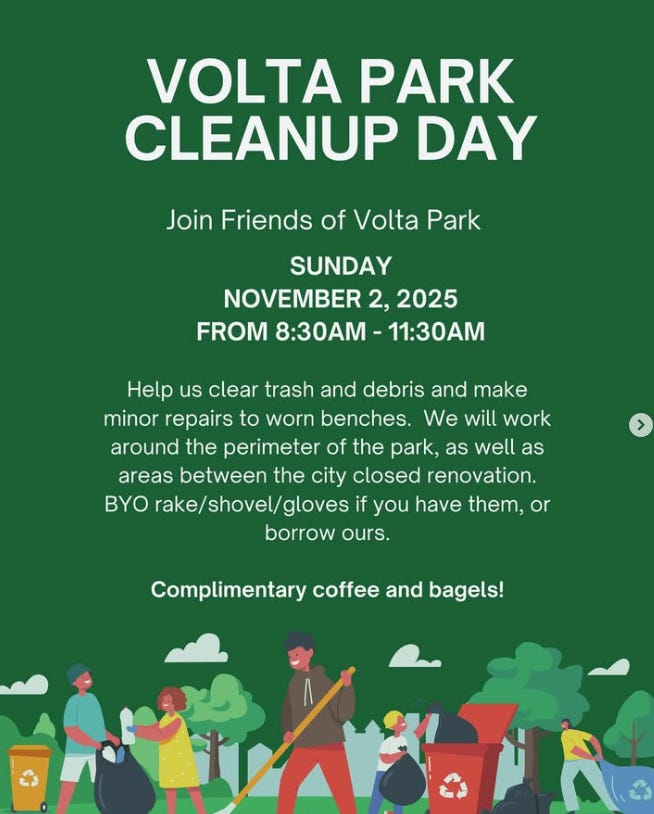
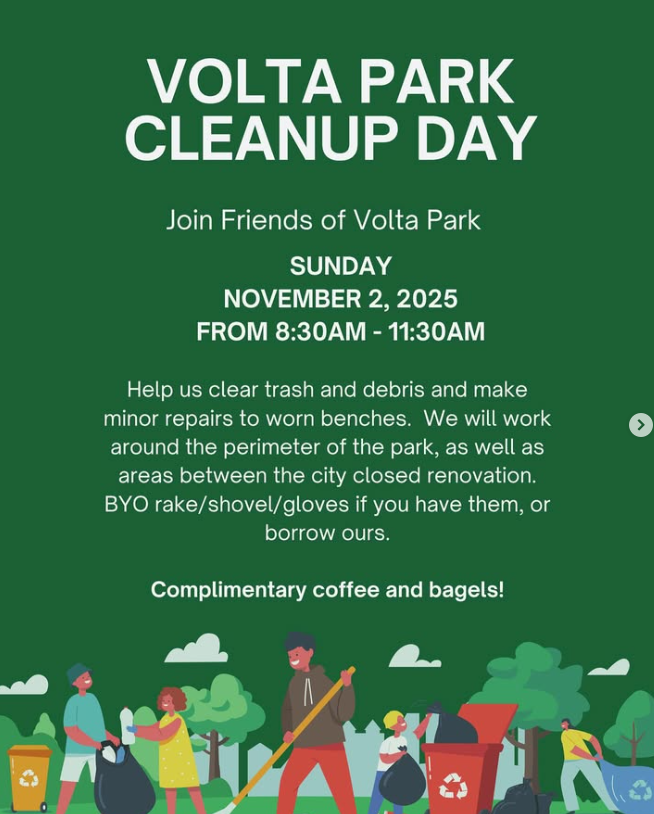
But on a happier Volta Park note: tomorrow several events will take place. This includes a park clean up and several kiddie events. Coffee and bagels will be provided! Come on out!













 The Georgetown Metropolitan
You must be logged in to post a comment.