Perhaps you’ve heard, but if not: there was a massive sewer main break up along the C&O Canal near the DC and Maryland border. Millions of gallons of raw sewage poured out and into the river. It was really bad.
Well it’s still really bad. All that incredibly harmful material is still working its way downstream. And as a consequence, the river has exceedingly high levels of dangerous materials like E. Coli and Staph. Councilmember Pinto put out a warning yesterday to tell people to stay away from the river right now:
As DC Water continues to work to address the recent sewage spill into the Potomac River, my primary focus remains protecting public health and our ecosystem, and I want to provide you with important updates you need to know:
Your drinking water is treated and remains safe. The overflow occurred downstream from the Washington Aqueduct’s intakes at Great Falls.
It’s now estimated to take 4-6 weeks of additional time for cleaning and repairs after a recent inspection of the Potomac Interceptor revealed a blockage inside the sewer line.
Keep distance between the riverbank, river water and you and your pets. Do not have any contact with the river water, including fishing and boating. Clean yourself or your clothing as soon as possible if you touch water or land along the riverbank.
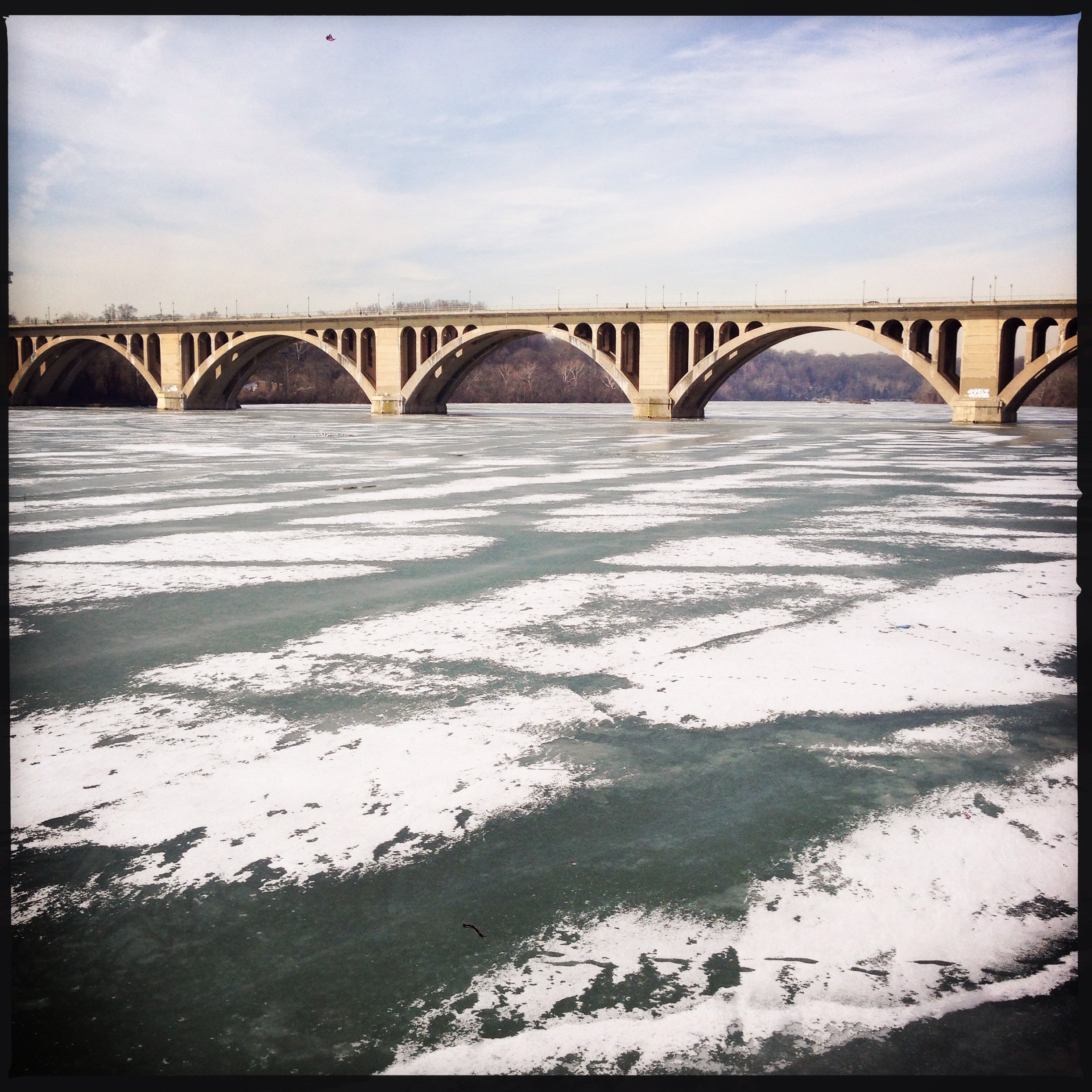
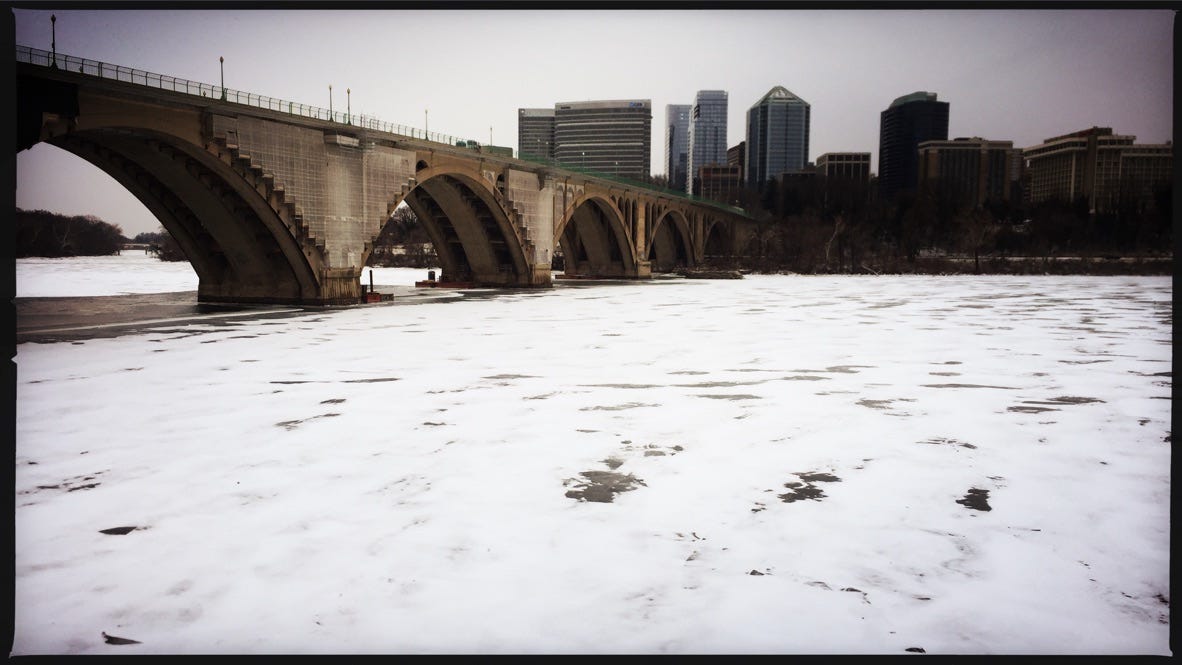
Remember it is never safe to walk on frozen ice over the river.
Freezing may preserve the bacteria, which can be released later when the ice melts again.
We will continue to share what we know and work towards long-term remediation plans.
So stay away from the river until you hear the all clear!
Last year I reported on the sad news that despite what I previously thought, deep cold stretches in the winter do not reduce the amount of mosquitos in the following summer. I don’t mean to be a Debbie Downer, but here’s what I wrote last yeat:
One consolation I have long taken from intense cold snaps Iike the one we are experiencing now is that it would kill off more mosquitos and lead to a less buggy season next summer. If you have also had this understanding, I am sorry to inform you that we’ve been wrong.
It is true that mosquitoes become less active when the temperature drops below 50 degrees. And many do die with the onset of freezing temperatures. But they long ago evolved as a species to handle cold winters. Depending on the species, they either enter hibernation or lay eggs. And in both cases the creatures are able to withstand much colder weather than we’re dealing with right now.
And really, that makes a lot of sense, seeing as places like Alaska or northern Canada have huge swarms of mosquitos, despite also having bitterly cold winters.
The good news? There is one climate phenomenon that actually can reduce the mosquito levels. As insect expert Dr. Daniel Markowski told WUSA a few years ago: “consistent cold isn’t as bad for mosquitos as cycles of warm and cold days that keep waking them up throughout the winter. Waking up burns energy, and if it happens often enough, it can be deadly for the insects.”
So if we get a nice midwinter thaw, followed by another freeze-up, not only will that give us a respite from the cold, it may actually make our summer gardens a bit more pleasant!
Georgetown is more than simply another neighborhood in DC. It’s even more than simply another old neighborhood in DC. It is a neighborhood that was uniquely a former independent municipality that is not only older than DC itself, but older than the United States. Founded in 1751 as a town in the colony of Maryland, Georgetown is celebrating its 275th year in 2026. And a few proud locals are proposing an idea to mark the occasion.
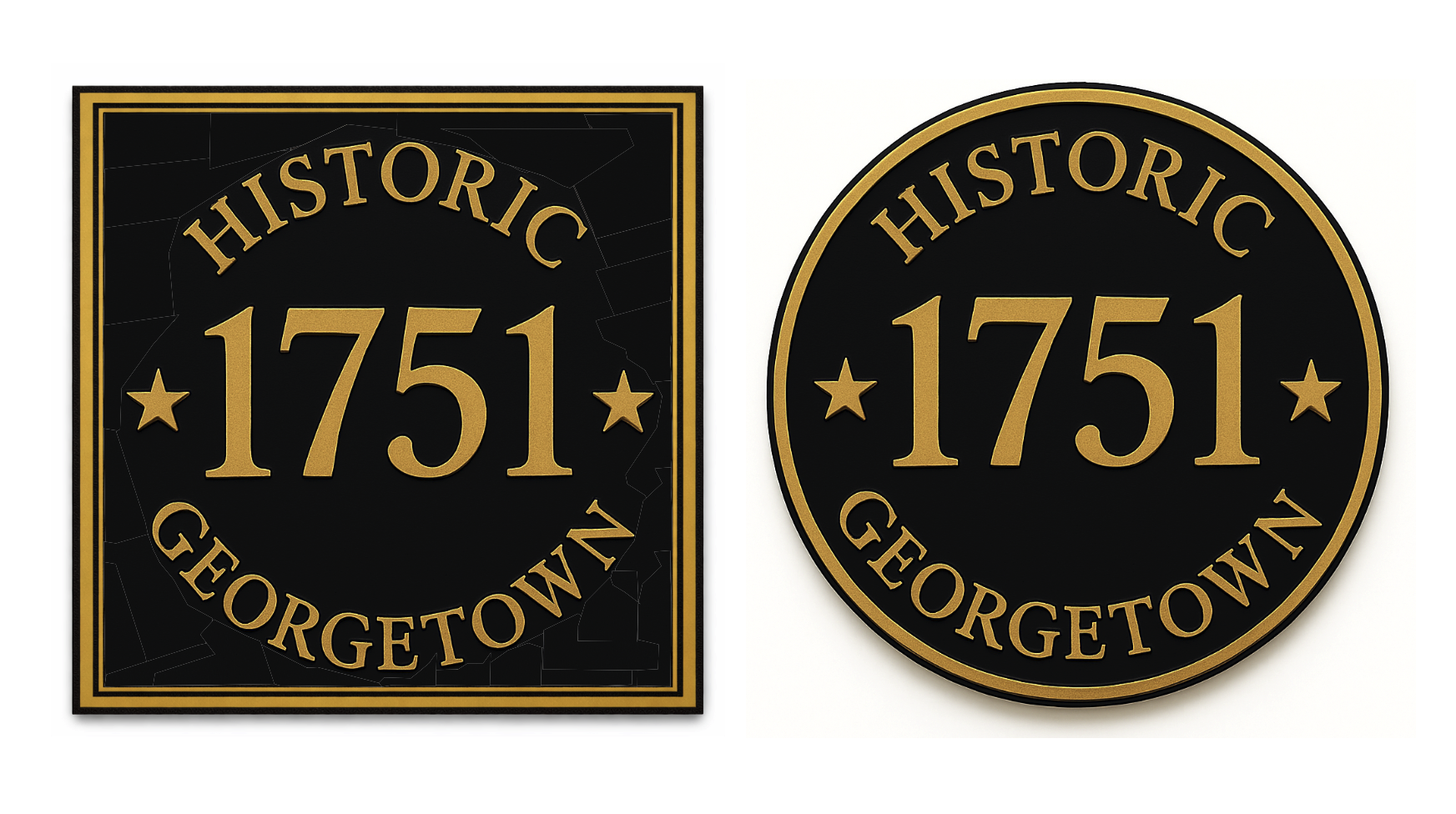
Outerbridge Horsey and Eileen McGrath have proposed the installation of signs around the entries to Georgetown to mark both the boundaries of the neighborhood and the age. The first versions of the signs are above, and were presented to the ANC last week to a warm reception. The design has shifted slightly since then, and will now read “Historic Georgetown – Estab. 1751” (in order to avoid any confusion over what the number means).
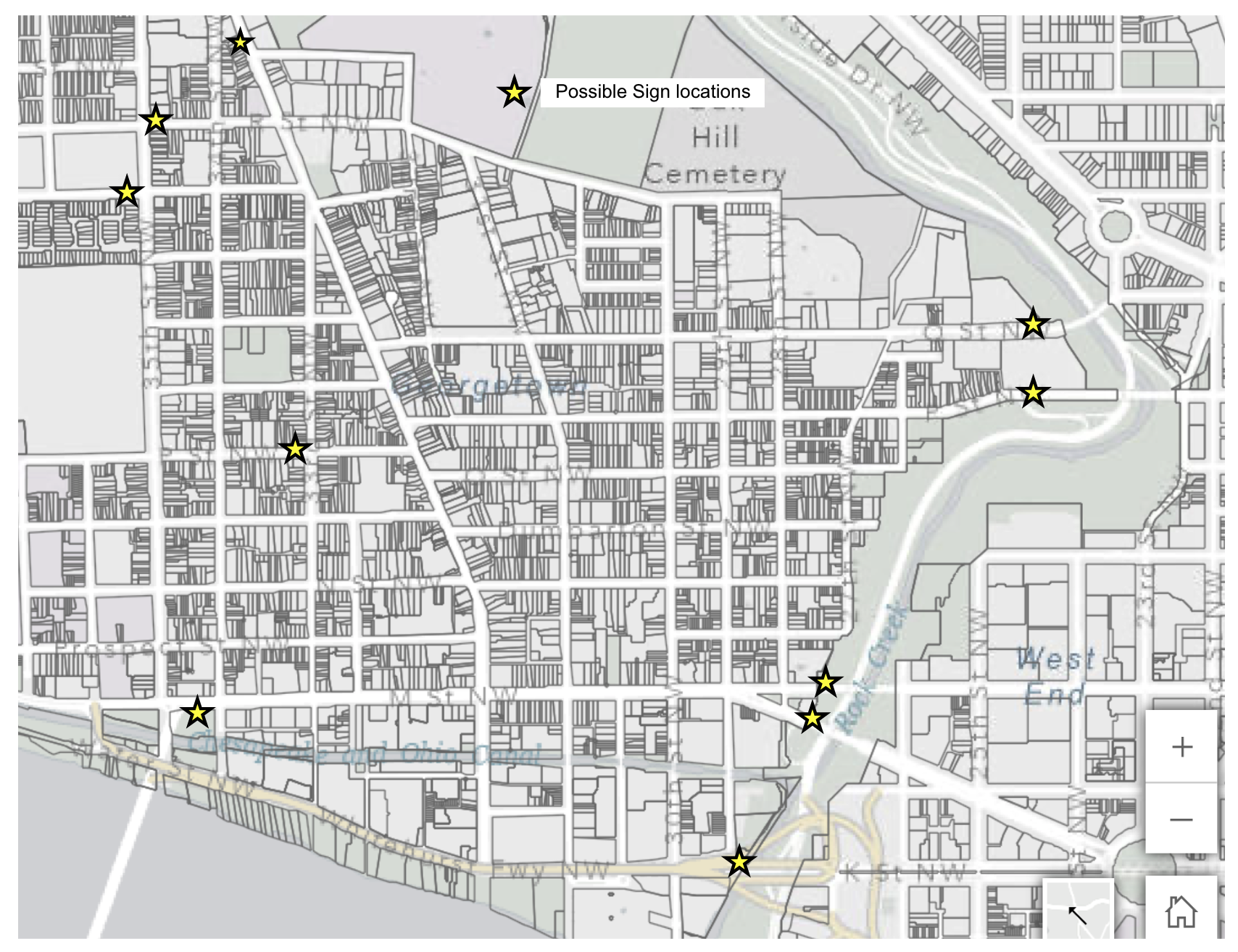
Here is a map of where they hope to install the signs. They have targeted most of the entry points of the neighborhood:
The design still needs to get approval from the Old Georgetown Board and then DDOT. If approved, identifying a funding source will be the next step. At the ANC meeting, Horsey estimated that the cost for all the signs would be about $50,000, which seems like a doable number from a fund-raising perspective.
Here’s hoping it can all come together in time to help mark our neighborhood’s 275th year!
Over the weekend, someone suggested to me that it would be helpful to remind people of all the changes to the Metrobuses that happened last summer. Here is a reprint of my article outlining all those changes:
Over the past year I have been trying to pass along the dramatic changes that WMATA is planning for the Metrobus network. Literally every bus line will be different in name and (mostly) route by the end of this year. I recently learned that some tweaks have been made to the plans I’ve circulated, so I wanted to pass those along to you as well.
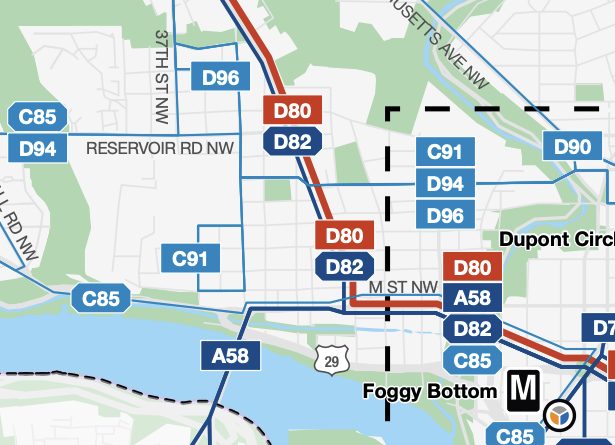
For the benefit of those who have not been following these changes, I’ll try to sum them up here. A good place to start is from the map above, which shows how the various bus routes will pass through Georgetown. It’s probably best to group them in a couple baskets:
Wisconsin Ave.
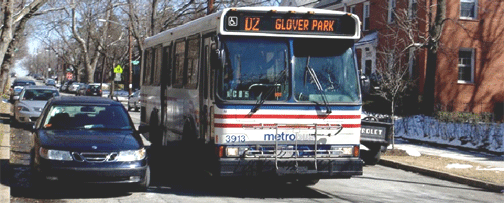
Since the days of the streetcars, Wisconsin Ave. and M St. have been serviced by the 30 Series. What particular routes ran has changed a lot over the years, but right now we have two routes remaining: the 31 (which goes only to Foggy Bottom) and the 33 (which now goes to Union Station as a substitute for the defunct Circulator). The Better Bus network will maintain similar service, but the names will change. Now it will be the D80 and the D82.
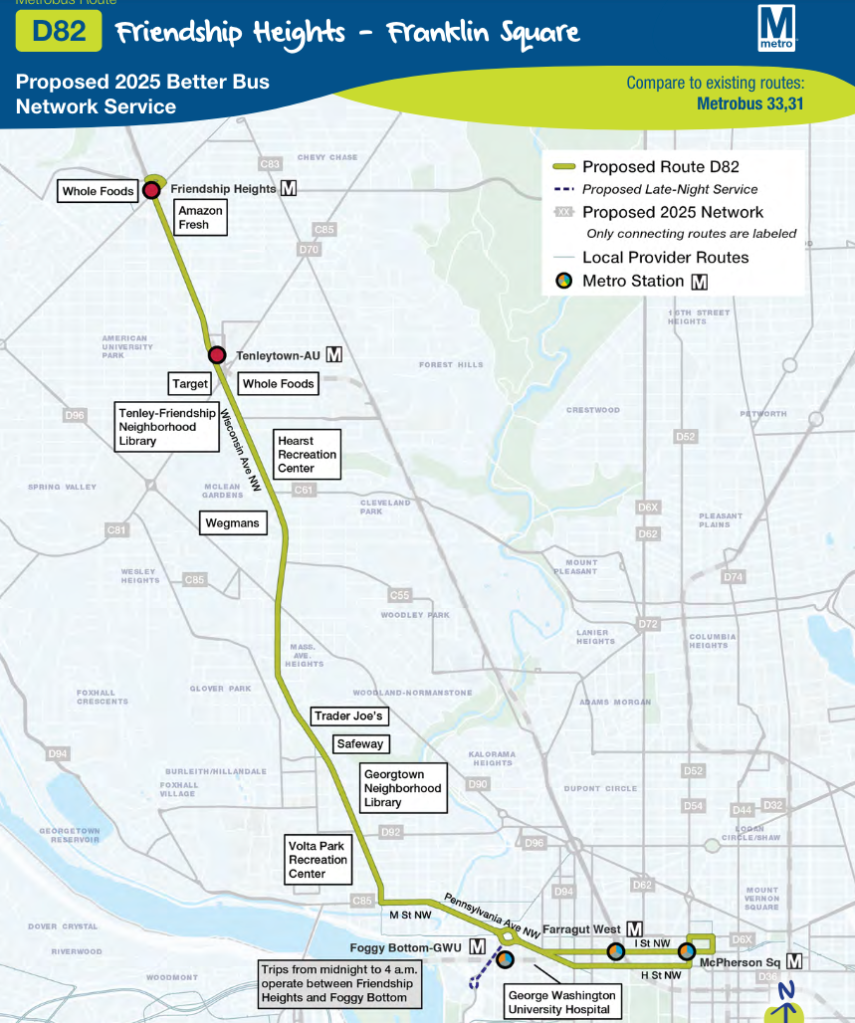
The last time I discussed the possible changes, the only route I discussed was the D82 (if WMATA had proposed the D80 at that point, I must have missed it). This was that previous D82 route:
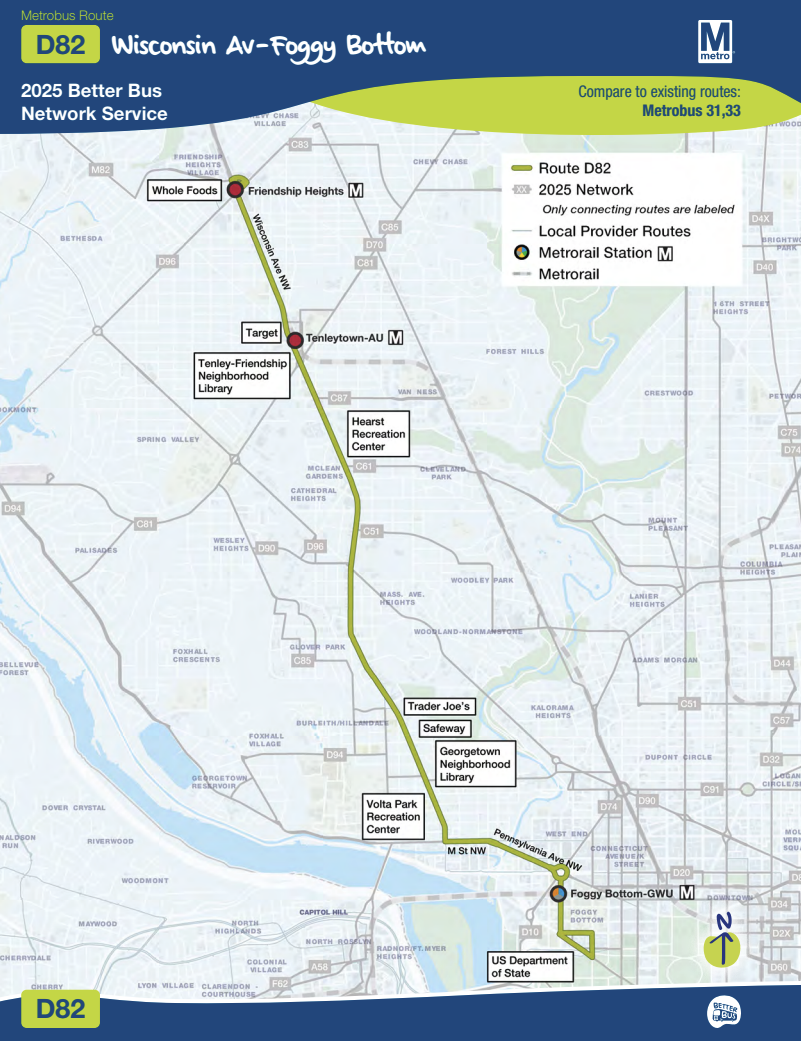
The D82 Route now only goes to Foggy Bottom, and is basically the same as the current 31:
The D80, on the other hand, would now travel all the way to Union Station, much like the 33 does now:
So in short: the 31 becomes the D82 and the 33 becomes the D80. Travelers along the Wisconsin Ave.-> M St. routes will likely just have to memorize new bus route names. The service will otherwise be fairly similar (although I am working with my ANC colleagues and the BID to make sure that WMATA keeps the frequency to what we’re used to).
East-West Lines
The second basket of routes I think it’s helpful to consider are the primarily east-west routes through the heart of Georgetown. This currently includes the D2, D6 and the G2. The D2 and the D6 cross Georgetown mostly on Q St., with the D6 traveling from Sibley to the west and RFK stadium to the east, and the D2 running between Glover Park and Dupont. The G2 starts next to Georgetown University and snakes through Georgetown on a couple different streets before heading east to Dupont along P St.
Each of these routes will be mostly replicated in the new system, however they will all travel primarily on Q St. as they travel east-west.
Here is the D94, which is the D6 replacement:
As you can see, it will no longer travel all the way to RFK Stadium. This is unchanged from earlier proposals.
Here is the D96, which is the D2 replacement:
This obviously doesn’t look terribly like the current D2 route, but between Glover Park and Dupont, it is basically the same. But now it will continue westward all the way to Bethesda (and on weekdays it will travel beyond Dupont to Foggy Bottom).
This is basically the same as earlier proposal but for one tweak. The route around Dupont appears to be more like the current D2 route than in the prior iteration:
Here is the previous proposal:
It’s hard to make out exactly what’s going on, but it appears to be using Mass Ave. and Sheridan Circle in one direction (probably westbound). The newer proposal is cleaner:
That appears to match the current D2 route which takes Q St. eastward all the way to the Dupont northern escalator and takes P St. westward to 20th St. at which point it heads back up to Q St. westward to Georgetown again. This is a much better plan, if you ask me.
Finally, here is the G2 replacement, the C91:
This is a big change from the previous iteration. Previously this proposed route was called the D92, and it went to Union Station:
The C91 will now instead more closely match the G2 by going to Howard University/Le Droit Park (but with a somewhat more circuitous route on the eastern end.)
The western end is also going to change from the current G2 route, but it is consistent with the earlier proposals: to whit, rather than snaking through the middle of Georgetown, it will travel up 35th St. to Q St. and go eastward from there. This will be a big loss of transit access to those in the middle of the east village, who will now have to walk all the way up to Q St. But it will be an improvement for those closer to Q St., who can now have even more options at the same stop versus before. Sadly, as with many changes to transit networks, it often ends up with zero sum games like this.
M Street Lines
The last bucket to consider are the bus lines that are primarily on M St. through Georgetown. Right now that only includes the 38B, which goes from downtown, along M St., to the Key Bridge and ultimately Ballston. Two new routes will be in this bucket: the A58 and the C85.
(Before I go on, just a quick note on the naming conventions: WMATA is giving the new routes different prefixes depending on where they mostly go. Arlington/Alexandria routes start with an A; Fairfax/Falls Church routes start with F; Montgomery County routes start with an M; Prince Georges County routes start with a P; and DC routes start with a D or a C. The D routes are more likely to go downtown and the C routes are mostly between residential neighborhoods. I think that is why the G2 replacement was changed from D92 to C85 once it no longer travelled to Union Station.)
Here is the A58, which is the 38B replacement:
This is identical to earlier proposals.
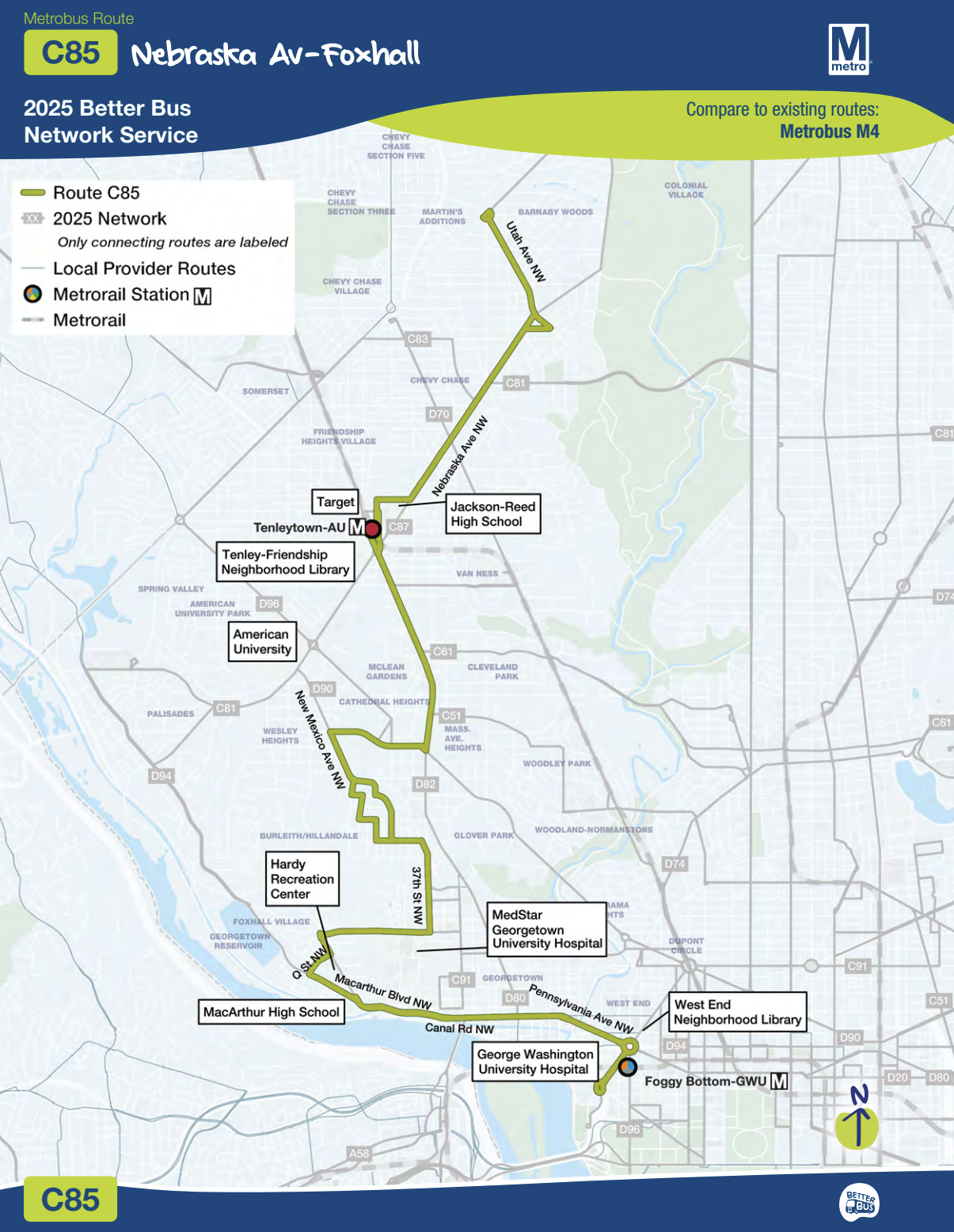
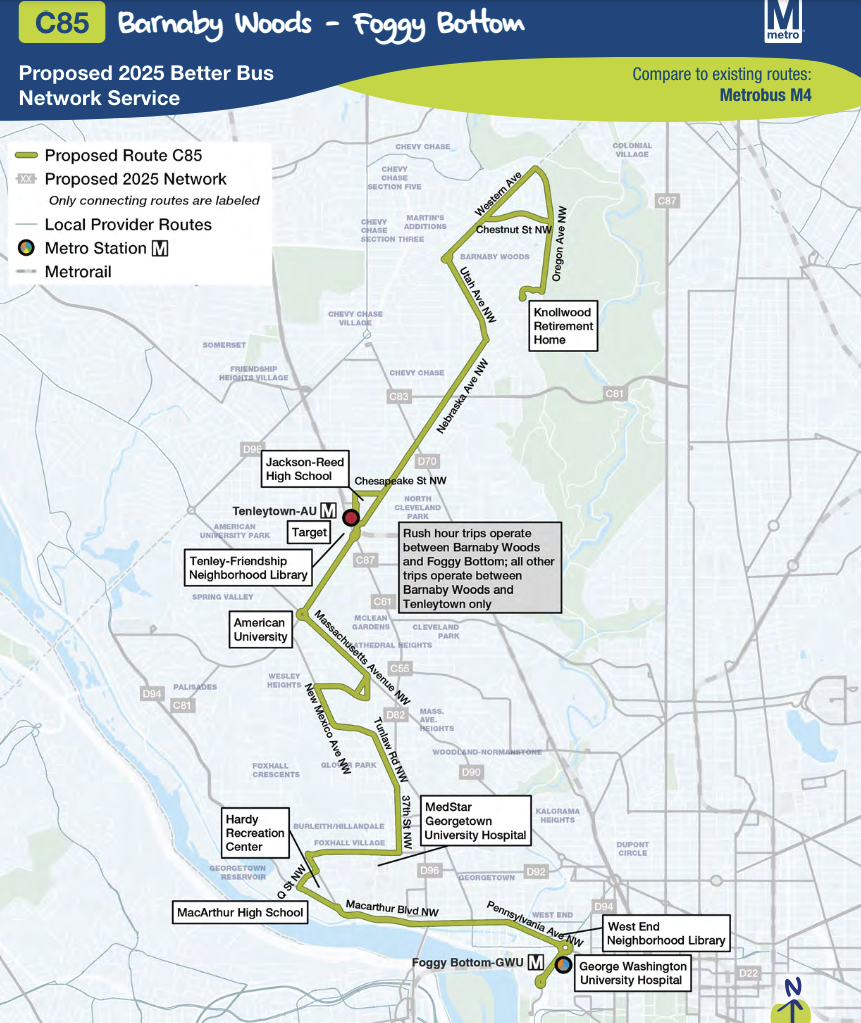
Here is the C85, which is a genuinely novel route that has no obvious precedent in Georgetown (except perhaps the former D5 route):
It travels from Foggy Bottom, through Georgetown on M St. to Canal Rd. Then after going through the eastern part of the Palisades, it turns back through Burleith and Glover Park upwards through Ward 3.
This route is mostly the same as earlier iterations, but they’ve modified the route substantially north of Burleith, as you can see from the earlier design:
In total, these tweaks are mostly that: tweaks. But the totality of the oncoming change is nonetheless monumental. Not since the (in my opinion) tragic demise of the streetcars and the “bustitution” that followed has such a radical change come to Washington’s surface transit
Good morning Georgetown, here’s your weekly news round-up:
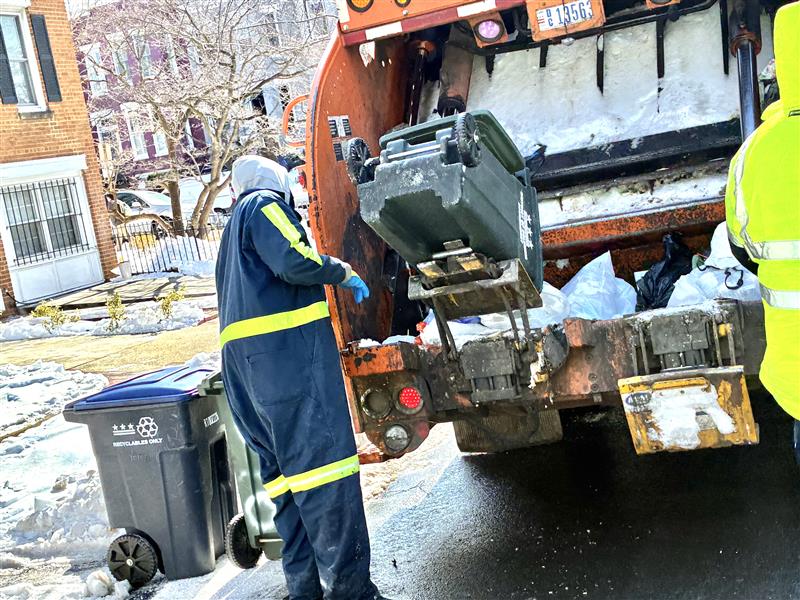
First off, obviously the city has failed once again to pick up the trash they said they would. That’s now three days this week when DPW said they were about to finally take away trash and they simply didn’t show up. I have sent increasingly upset messages to DPW and the Mayor’s office demanding that they come back as soon as possible. Please call 311 yourself to let them know how unacceptable this performance is. We haven’t had any trash picked up at all in 12 days in west Georgetown. This cannot go on any longer.
I am the first to cut the city a little slack in terms of dealing with this unprecedented snow-ice-freeze weather we’ve experienced over the last ten days. But the trash situation is getting absolutely out of control. Residents have been pleading for some, any pick up to take place, and we keep on being let down.
The fist message of false hope came Saturday night when DPW stated that we would have our trash picked up on Sunday.
It wasn’t.
Then last night reps from the Mayor’s office told the ANC that regular trash service would resume today, so you should put (or frankly, keep) your trash out on the curb. In fact they also told us to put recycling out too.
As of writing (early Tuesday night) nothing has been picked up on the blocks near me.
I was given a false bit of hope when I heard the tell-tale sound of a trash truck rumbling up 33rd St. But they just drove by without stopping. I haven’t heard the slightest hint of another truck around Georgetown since.
As the risk of sounding like a broken record, I will tell you what DPW is telling us:
Trash, recycling, and food waste collections have resumed, and Tuesday collections will continue on schedule.
Residents are encouraged to place trash and recycling bins at their normal collection point. Food waste bins should be set out at the front curb to support safe and efficient service while crews continue working through weather-related impacts.
If your trash or recycling is not collected on your scheduled day, please leave your bins out, as missed collections will be prioritized the following day. If materials have not been collected within two days, residents should report the issue to 311.
So the only advice I can offer is to just keep the trash out until its picked up. And if it happens to be picked up before Friday, go ahead and put it out again Thursday night. And call 311 to complain.
Listen, this is a hard job. And I respect the staff that do this immensely. But it’s still a job, a job that has to actually be done. Lets keep the pressure on to make sure it actually gets done.
Welcome to your February update for northwest Georgetown!
Snow and Ice
The storm that hit us last week was genuinely a freak confluence of conditions. In the 26 plus years I’ve been in DC, I can’t remember a time when we had such a significant snow become so suddenly encased in such a thick crust of concrete-like ice. Honestly, I don’t remember a storm result like that from my New England youth or upstate New York college days. This really is a freak outcome.
I say that as backdrop to a discussion of how the city has handled the storm clean up so far. It has obviously been very disappointing to see roads and sidewalks continue to be partially or fully uncleared. And it feels to many that after the city made reasonably good progress on clearing the main roads that they largely gave up on the side streets. (In 9 DC storms out of 10, this would probably work out fine, as the snow often melts by the time the city even gets to the secondary and tertiary streets). But there is an explanation for this. Only the city’s big trucks with hug plows can blast through the icy crust. And these large trucks simply don’t fit on the smaller streets, let alone the alleys. The city’s smaller trucks simply can’t do much to make an impact on the chunky ice. They’re trying but it takes time. This Post article is a fair report on the challenges.
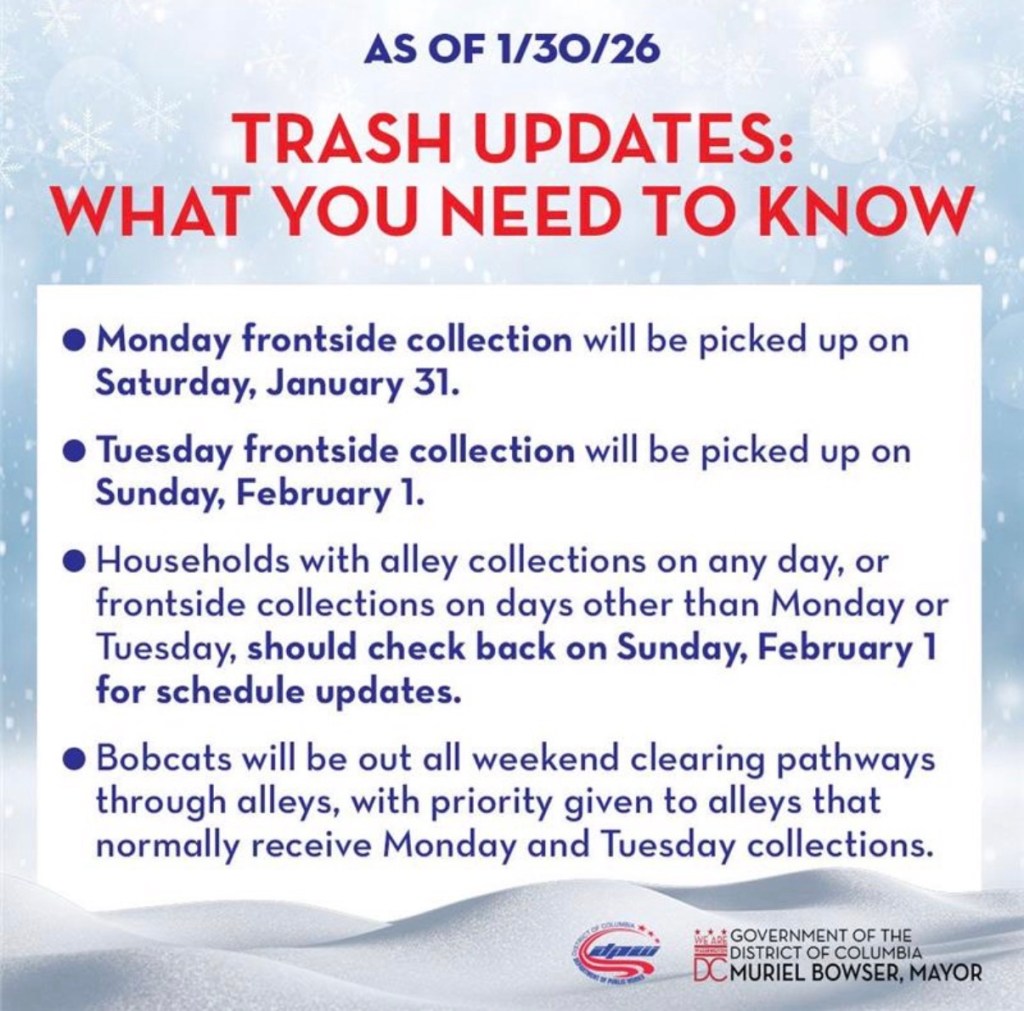
So please be patient. This includes trash. DPW has stated that they will pick up our trash tomorrow (i.e. Sunday). So put it out asap.
I am hopeful that a second trash pickup and a first recycling pick up will also happen this coming week. But keep an eye on DPW updates to keep informed on that progress.
My last plea: This ice is not kidding around. And that includes the sheets of ice on house and building roofs. As it starts to finally melt, those ice sheets on slanted roofs will threaten to become guillotines. I would be careful walking near building eaves once the temperatures start to rise! Keep your eyes up!
Resident Ony Parking
Just a quick update this month on this effort. In March, the ANC is likely to formally consider filing a request to the city to implement resident only parking in Georgetown. We wanted to give people one more month to get informed, consider the proposal and reach out to their ANC commissioner with their thoughts. So please read my summary of the proposal from last month, take the survey if you haven’t already, and let me know what you think!
Volta Park Human Remains
As many have heard, some human remains were left exposed to the elements at the suspended construction site at Volta several weeks ago. It is disturbing that that happened. And this came after a long period of poor communication from the Department of Parks and Rec concerning the project.
I was able to finally get a full understanding of the project, which I recounted in detail here. But in short, this is what I learned: While digging a trench across the baseball diamond outfield last year, the construction crews encountered a completely intact grave that was only 3-4 feet deep. On the one hand this was not surprising since it is well known that a great number of graves remained on site after a cemetery was closed here in the 1890s. But on the other hand, it was a surprise since it was so shallow. The work stopped in order to assess the grave and plan around it. During this work stoppage, a pile of dirt that had been dug up became eroded by the rain at which point bone fragments became exposed. These were found by nearby residents.
Finding bone fragments is also not a surprise for the site. And there is a protocol for that whereby the bones are reburied deep enough, in the park. That protocol was not followed due to the work stoppage, which is unfortunate. However, since becoming aware the archeologists have collected the bone fragments and the dirt piles have been covered with a tarp.
The work will continue and hopefully be completed by April or May. This will be followed by a month or two where the park will remain off-limits while the new sod is given a chance to get established. By mid-summer the park should be finally done and fully open.
Update on the Lobby Bar
In 2024, a new bar sought to open at 1660 33rd St. in a former bookshop space. Originally it was going to be called Créme, but ultimately called itself the Lobby. Part of the plan was the creation of a back patio (or “summer garden” in regulatory speak) that opens up to a group of private residences.
This obviously alarmed the nearby residents and property owners. The ANC, along with some neighbors and the Citizens Association of Georgetown, protested. I negotiated a settlement agreement with the applicant that allowed for the patio but set strict rules about how and when it could be used. Like all good settlements, neither side was terribly thrilled with it, but so it goes.
Despite the fact that the agreement was reached in September 2024 and the applicant was eager to get it signed in order to let him open as soon as possible, the bar didn’t actually open until August 2025. Unfortunately the bar immediately and consistently broke the settlement agreement on multiple fronts, most egregiously concerning the patio hours. Despite multiple polite reminders to the bar owner about the terms of the agreement, the violations persisted.
Coincidentally, the license came up for renewal last fall. The parties to the agreement decided to protest the renewal. We now anticipate going to a full protest hearing on the license this month. If you are a nearby neighbor impacted by the operations of the Lobby, please reach out to me at 2e02@anc.dc.gov.
I will give an update next month to let you know how it went!
Good morning Georgetown, here’s your weekly update:
The city is obviously not doing a good job dealing with this snow. For particularly unpassable streets, please call in to 311. I was told informally not to expect any trash pick up until next week, but check DPW’s notices for confirmation.
The ANC will be meeting for our February session next Monday night. During this meeting Councilmember Brooke Pinto will be with us to give her annual update and answer questions from the Commission and public. So please come prepared with questions for her! See you there.











 The Georgetown Metropolitan
You must be logged in to post a comment.