After an initial burst of activity for the Volta Park ballpark renovations, many residents have noticed that the construction has been on pause for weeks. This has led to a bunch of speculation and rumor. The most frequent thing I have heard from residents is suspicions that they uncovered some human remains. Since the park was once a cemetery, and many remains are estimated to remain, I have not heard anything to substantiate that.
What I have heard from DPR, and confirmed once again last night, is that the construction is on pause while they wait for a pipe. At least one resident has expressed a great deal of skepticism of this explanation to me. And honestly, I can’t blame them for their doubt. But as far as I have been told, the delay is related to the pipe. Not skeletons. Not anything else.
As a result of the delay, no estimate is available for when the construction will end. I fear that if the delay lasts too much longer, the arrival of winter will delay the project even more. So lets hope it is the pipe, and lets hope it gets here soon.
A lot of times when I search for news or photos of Georgetown, I often end up with stories or pictures of other Georgetowns, like Georgetown, Delaware or Georgetown, Guyana. So when I saw that Ikea is planning on opening a store in Georgetown, I assumed it was another case of mistaken Georgetown.
Hold your meatballs, though. The plan is not to open a normal ginormous Ikea store. Rather, the plan is more like a design studio featuring Ikea cabinetry and furniture. You won’t be able to walk out of the store with the items, like you do at their normal stores. You will instead be able to order them and have them delivered to your house. Ikea is actually moving the store to Georgetown, from Pentagon City. So if you’re familiar with that location (which will close on Nov. 30th) then you know what to expect here.
The announcement states that it will be moving to 3307 M St., which is just next to the similarly out-of-place Tesla store.
This week for Georgetown Time Machine, I’m exploring another photo from the DC Historical Society. This one is a a shot looking westward along the canal between what we now call 31st St. and Wisconsin Ave.
I say “what we now call” because the information for the photo identifies the location as “C&O Canal at 32nd St.” That is what Wisconsin Ave. was called from 1895 to 1905. Before then, it was called High Street. It was changed to 32nd St. in 1895 as part of the wider Georgetown street renaming. This was done in order to synchronize Georgetown’s streets with the rest of the District. (If you’re wondering: what we now call 32nd St. was called Valley Road during this period).
The date of the photo lists 1911-1915, i.e. after the street was officially renamed Wisconsin Ave. But many of the streets of Georgetown continued to be referred by both names over this period, as this 1919 map demonstrates:
What really caught my eye from this photo is not the photo at all but rather the description of the bridge as the “Bridge of Sighs”. That is not a sobriquet I’ve ever heard applied to that bridge. The term is familiar, of course. It was first used to describe an especially ornate bridge in Venice:
Apparently Lord Byron coined the term to reflect the fact that a glimpse of this bridge was the last thing prisoners saw before being led to the Venetian jails (supposedly).
Other bridges around the world have also earned that nickname, likely due to their resemblance to the Venetian bridge rather than some other apocryphal feature. They include the Bridge of Sighs in Cambridge:
Not to be outdone, their rivals in Oxford have their own Bridge of Sighs:
Essentially, if it’s a fancy, enclosed bridge connecting two buildings with an arched bottom, you got yourself a potential Bridge of Sighs.
But why would the Georgetown bridge qualify? It’s got a similarly shaped bottom, I suppose. But that’s it. And plenty of bridges have a similarly arched bottom. That’s pretty much a routine bridge design. It’s not enclosed and doesn’t connect two buildings. It’s just a bridge.
Anyhow, the poetic-yet-not-really-accurate name distracts from the one thing that makes this bridge unique: it’s the oldest bridge in the District. It was built in 1831.
Last Wednesday, the Department of Parks and Recreation hosted a community meeting to discuss the next steps in the project to improve Book Hill Park. The meeting was attended by about twenty members of the public, most of whom are either involved with the Friends of Book Hill Park or live nearby. The presentation, included below, described some of the elements that the planners are considering for the project. Here is the slide with the big picture:
The project as proposed includes both repairs to the existing infrastructure and the addition of new features. The most eye-catching of the proposed additions was the idea of a new terrace. The proposed new terrace would be in one of three locations:
At the top of the hill:
In the middle of the hill:
Or at the bottom of the hill:
The idea was generally to create a new space for people to enter into the park and enjoy the hillside view without having to tramp across a steep grassy lawn. The audience in the room was not terribly enthusiastic for this idea, especially the middle of the hill option. Option C, the plaza right above the bottom plaza, received the most support of the three. But the audience was much more interested in other additions instead.
Most of all, the Friends of Book Hill Park wants a new water spigot towards the bottom of the hill. The city reps explained that that could end up being hugely costly, which might require some sort of a public-private partnership to accomplish. But they will prioritize it and evaluate its feasibiiity.
A final element that many in the room felt strongly about was the addition of lighting to the stairs. The planners had suggested it, but stated that the lights would likely turn off around 9 pm daily. Some in the community requested that they be on all night. Curious, I took a walk down the (currently unlit) stairs after the meeting, and I have to agree. They are basically unusable at night without lights. I could hardly make each step out, even with plenty of nearby streetlights.
As for the timeline, this is what the DPR reps estimate:
According to this timeline, construction would begin next spring or summer and end by the fall. Based on my past experiences with DPR’s promised construction timelines, I would not bet even assorted Monopoly money on that. But I’m always happy to be pleasantly surprised.
Here is the full presentation. If you have any comments on the proposal, email Christopher Dyer at Christopher.Dyer@dc.gov and copy me if you don’t mind (2e02@anc.dc.gov):
A lot of Georgetowners want to learn more about the history of their homes. Assuming the house is actually old, there are several places you can look to find that history. Many know that the Peabody Room at the library maintains a separate file on each house in the neighborhood. Some also know that with a library card, you can access the digital archives of the Post and the defunct Evening Star to see if your address has popped up on their pages. But another source many likely overlook may be staring them in the face every time they come home. And that source is the conservation easement that is literally applied to the front of a great number of homes in Georgetown.
Two organizations maintain most if not all the conservation easements in Georgetown: the L’Enfant Trust and the Foundation for the Preservation of Historic Georgetown. The orgs acquire the easements over the homes by way of a donation from the owners at some point. (Beyond a general sense of philanthropy, the donors get a nice tax write-off for the donation). Once the easement has been granted, approval is now required from the organization in perpetuity in order for the homeowner to make certain changes to the exterior of the house. This is, of course, on top of the normal approvals the homeowners would need to seek from the Old Georgetown Board.
You can tell if you have an easement from the badges that affixed to the front of your house, like the one above. (It’s certainly possible that an easement exists without the presence of the badge. You would probably have learned of its existence when you bought your house.)
So besides just preserving history, how can this help you research your house? Because when the easement is granted, the orgs may have performed their own historical research on your house. And you can reach out to the org and ask for a copy. I did just that and received some fascinating info.
First of all, I received a photo of my block from the time the easement was granted: 1983.
Obviously this is not that old a photo, but it’s great to see it nonetheless.
Sadly there were no “Washington Slept Here” moments in my house’s past, but it’s still illuminating to see its whole history (including owners and renters) up to the mid-1980s.
So if you have an easement, it’s worth reaching out to the org to see if they have similar records on your own house!
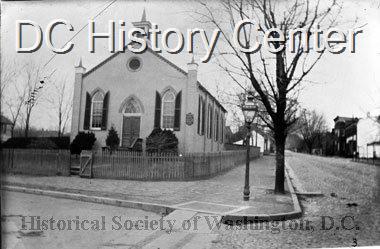
This week for Georgetown Time Machine, I’m exploring another photo from the DC Historical Society. It is of an unidentified church at an unknown location. The only thing the record can say is that it’s in Georgetown and from between 1895 to 1905.
I love a challenge like this, so I jumped right into trying to figure out which church this is and where. I checked a couple existing spots that could match the photo in terms of location near a corner like this, most notably St. John’s. I knew the church looked different in some if its earlier iterations, but unfortunately that wasn’t it. Here’s what St. John’s used to look like around the time of the photo above:
I checked out a couple of the other smaller churches, but none were near a corner like this.
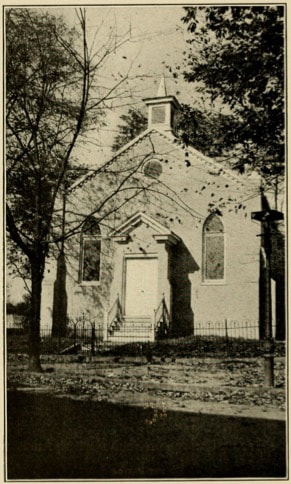
But then I think I found the answer: Georgetown Lutheran. Here is a photo from the church’s website showing an earlier version of its santuary:
Here is more information about the building:
In 1867, a third sanctuary was built, this time a one-story brick building. The church was larger than the previous ones, and housed a school until 1870. School was taught in German, but in 1870 the congregation decided to end the use of German language and close the school. Georgetown Lutheran Church was re-incorporated as an English-speaking church, and the congregation set out to renovate the sanctuary, install gas lighting, and repaint the building. A rededication ceremony took place in June 1870.
The facade is not exactly the same in the two pictures, but the church’s history describes the construction of an outside vestibule, which could explain the different entrances.
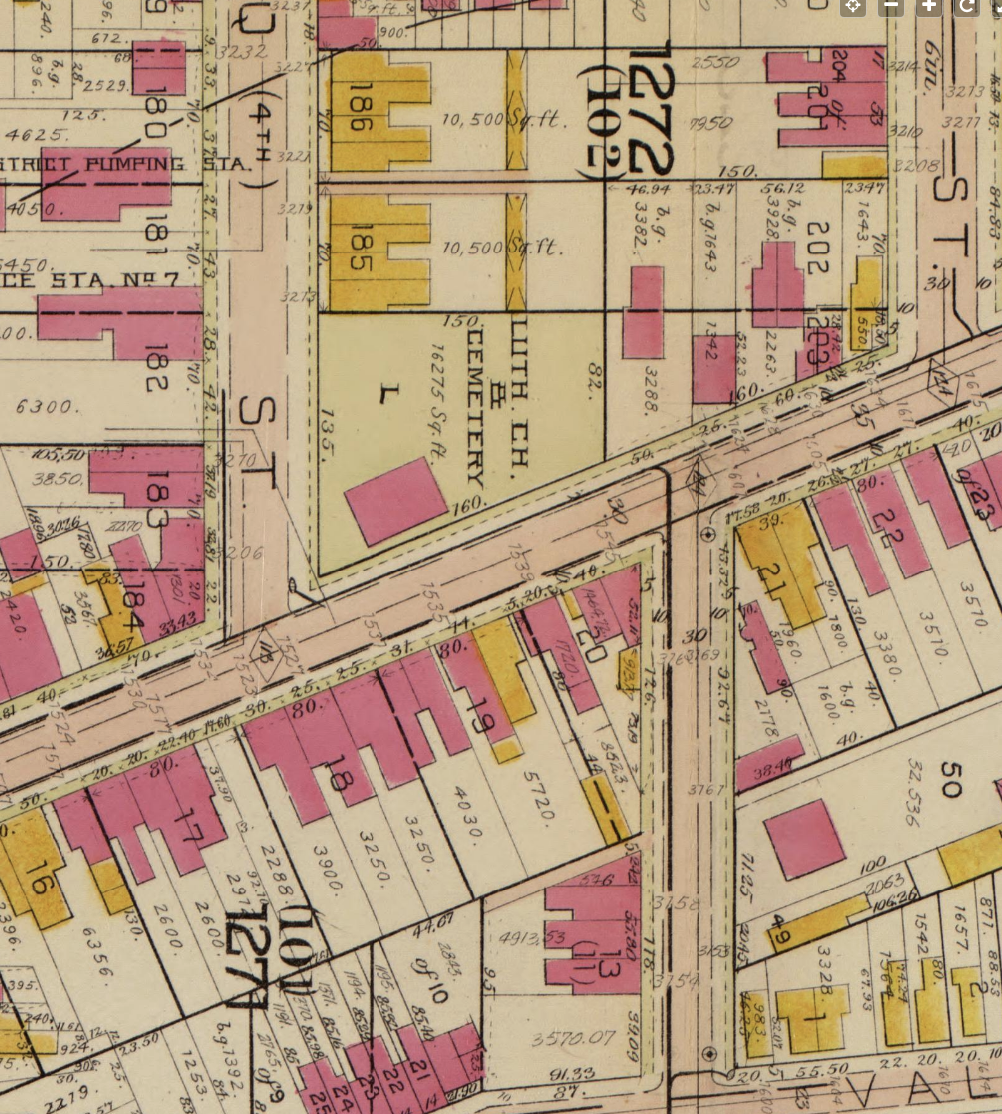
So if I’m correct, the photo on the top was taken from the intersection of Volta Place looking north, with Wisconsin Ave. on the right. A map from the time supports that alignment:
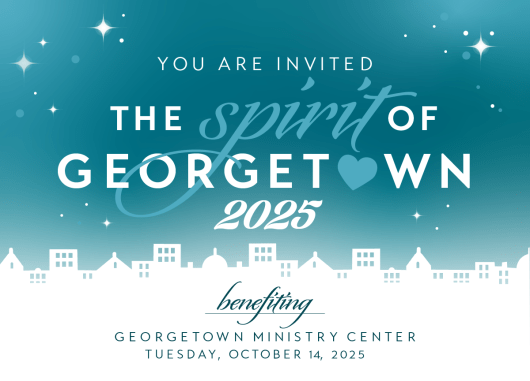
Next Tuesday night, the City Tavern will be hosting a Spirit of Georgetown party to benefit the Georgetown Ministry Center. It will be an absolutely fun way to support a critically important community asset. Please come out! Buy your tickets here and here are more details:
On October 14, 2025, The Spirit of Georgetown annual celebration will be held in the heart of Georgetown at the historic City Tavern. This year’s event will be co-chaired by Kristin Cecchi, Amanda Klingler, Leslie Maysak and Claire Wilder. The evening will raise awareness about homelessness in Washington, D.C., and build support for Georgetown Ministry Center’s Drop-In Center, which serves chronically homeless individuals with dignity and care. This much-anticipated gathering is the perfect way to kick off the fall social season.
We are proud to honor longtime GMC volunteer Sue Massimiano, whose extraordinary commitment to our guests reflects the heart of our mission. A regular presence in our Drop-In Center, Sue once walked over during a snowstorm just to see if our team could use an extra set of hands. Her dedication embodies the compassion and reliability that our volunteers bring every day.
Georgetown Ministry Center is the only entirely privately funded homeless services agency in the greater Georgetown area. That independence gives our team the flexibility to respond quickly and meaningfully to the evolving needs of the people we serve. We rely entirely on our hyper-local community of care to support our critical work ensuring that every guest who enters the Drop-In Center can get their needs met with dignity and compassion.
We seek lasting solutions to homelessness one person at a time.









 The Georgetown Metropolitan
You must be logged in to post a comment.