
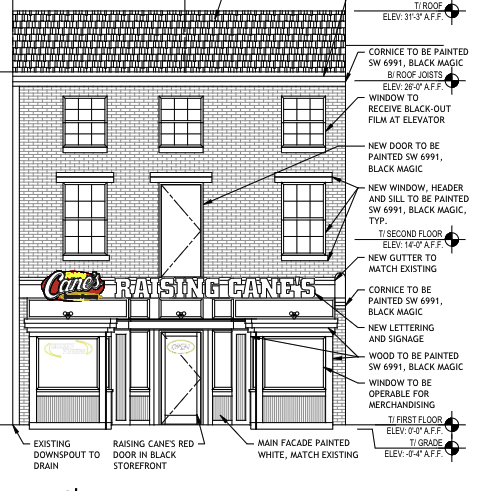
A Louisiana-based fast food chain is seeking to open at 3249 M St., according to a signage application filed with the Old Georgetown Board. The restaurant, Raising Cane’s, sells chicken fingers. That’s not from the children’s menu. That’s literally the entire menu.
The chain, created in Baton Rouge in the 90s, has expanded to over 700 stores. This would be the second location in the District, after a Union Station location opened recently.
The thing is, though, that the zoning rules in Georgetown don’t actually allow fast food restaurants to open. This is what the zoning code says:

M St. is in the MU-4 zone. But what’s “fast food” you might ask? Well the zoning code has that covered too:

I think it’s fairly clear that Raising Cane’s fits this definition. The tricky part is, don’t other restaurants also fit in to this definition? Most chain restaurants that have grown a lot over the last decade or so often fall into the “fast casual” definition. That category name comes from the merger of “casual dining” and “fast food”. Casual dining is the category of restaurants that provide cheaper food in less formal environments, but with the traditional table service model. Think Olive Garden or Pizza Hut. Fast casual emerged by taking the heightened cuisine (at least as compared with traditional fast food) and combining it with the faster pay-at-the-cashier model of fast food.
Restaurants that clearly fall into the fast casual model have opened in Georgetown without obtaining a zoning waiver since that category emerged. In fact, one of the quintessential fast casual restaurants (Sweet Green) was founded in Georgetown. But I think it would be a stretch to call Raising Cane’s a fast casual restaurant. Put it this way, while you could argue that restaurants like Greco or Good Stuff Eatery fall under the fast food definition of the zoning code, if Raising Cane’s doesn’t fall into the definition then nothing counts as fast food anymore.
The prohibition against fast food restaurants has not been entirely ignored in recent history, it should be noted. Tai Chi Bubble Tea successfuly obtained a special exception from the fast food prohibition in 2022. Further back, Capriotti’s Sandwich’s also obtained zoning relief in 2016. And the infamous Philly P’s on Potomac Street was shut down in 2010 for operating as a fast food restaurant without zoning relief. But that action only came after significant complaints piled up for years. That fight was so high profile that Mayor Fenty even held a press conference on Potomac St. to announce the closure.
Tai Chi’s more recent experience suggests that even if the city requires a zoning waiver, it will not be hard to obtain. The analysis is in line with other special exceptions: i.e., will the use be objectionable from noise, trash, parking, etc. But the prohibition on fast food restaurants stems from objections above and beyond those concerns. This exact issue has come up before. In 2016, Smoked and Stacked, a local fast casual BBQ restaurant, was initially blocked from opening by the convention center due to it being considered a fast food restaurant. Tim Carman wrote in the Post:
The D.C. Zoning Commission levied its first restrictions on fast-food eateries in 1985, when the major chains were spreading to parts of the District where residents and Advisory Neighborhood Commissions did not welcome them . Locals and ANC commissioners didn’t want the car traffic, the pedestrians, the litter, the late-night hours or the “gaudy signs” associated with fast-food joints, according to the original 1983 petition from two ANC commissioners representing Columbia Heights, Shaw and other neighborhoods.
Before the restrictions went into effect, the District had no limitations on where fast-food restaurants could locate, which accelerated their spread. The Washington Post reported in May 1985, when the zoning commission first passed emergency regulations, that the District had 130 fast-food restaurants, 35 more than the previous year. The number of fast-food outlets, in short, had jumped 37 percent in one year.
Carmen also noted that that year the city was updating its definition of what counts as a fast food restaurant in order to be more flexible for fast casual. Previously the definition was fairly clear: does it have a drive-through, do you pay first or does it use disposable utensils? A yes to any of those meant it was a fast food. in 2016 the current guidelines were issued and, in the words of Carmen:
The new zoning regulations, more than eight years in the making, will kick in Sept. 6. Among the many changes is a new definition of a fast-food restaurant. The city has relaxed the language: There are now five characteristics that define such a place, but no single one automatically places a restaurant in fast-food land. The D.C. Office of Planning, the lead agency in drafting the revised regulations, notes that the new definition gives DCRA more flexibility.
In other words, the DCRA zoning administrator will be able to look at the totality of a restaurant, not at any single element, to determine whether it falls into the fast-food category.
So perhaps the smooth sailing that Tai Chi had reflects the fact that it really doesn’t look like a McDonalds. But Raising Cane’s is something quite different. Whether the city sees it that way is yet to be seen.






 The Georgetown Metropolitan
Seems silly that the city would allow Good Stuff, but not Cane’s. It’ll be interesting to see how this one plays out.
How did the Roy Rogers exist way back when?
The rules didn’t come into effect until the mid 80s, the Roy Rogers was already open by then. Also, they took over the space from a Hot Shoppes, so they could possibly argue that they are just continuing a non-conforming use grandfathering.
Moreover, as this whole issue demonstrates, the rules are not applied in a remotely uniform way.