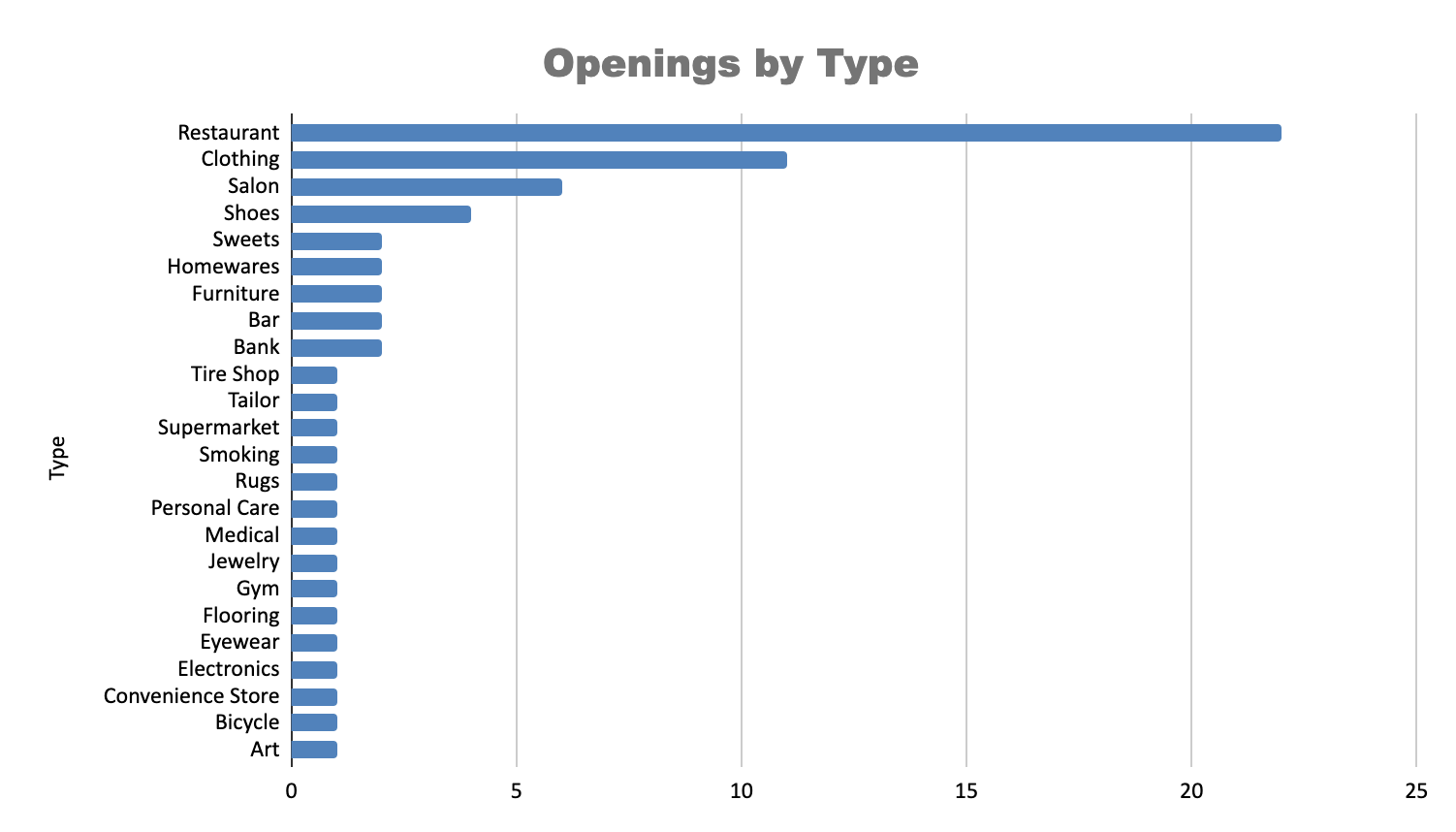
Some more data from GM’s retail survey! Today GM will drill down a little on the openings and closings that took place between November 2019 and now. As mentioned last week, GM counted 68 openings and 123 closings. Here’s where they were:
As you can see, by far the largest category of openings was in restaurants, where there were 22. Clothing stores came in a distant second at 11, and salons trailing at 6. The rest were scattered across a bunch of different categories.
(GM should note here that he did not capture stores that opened and then closed during the gap. There were some, for instance Harper Macaw briefly had a store on M St. But for consistency’s sake, GM did not attempt to capture them.)
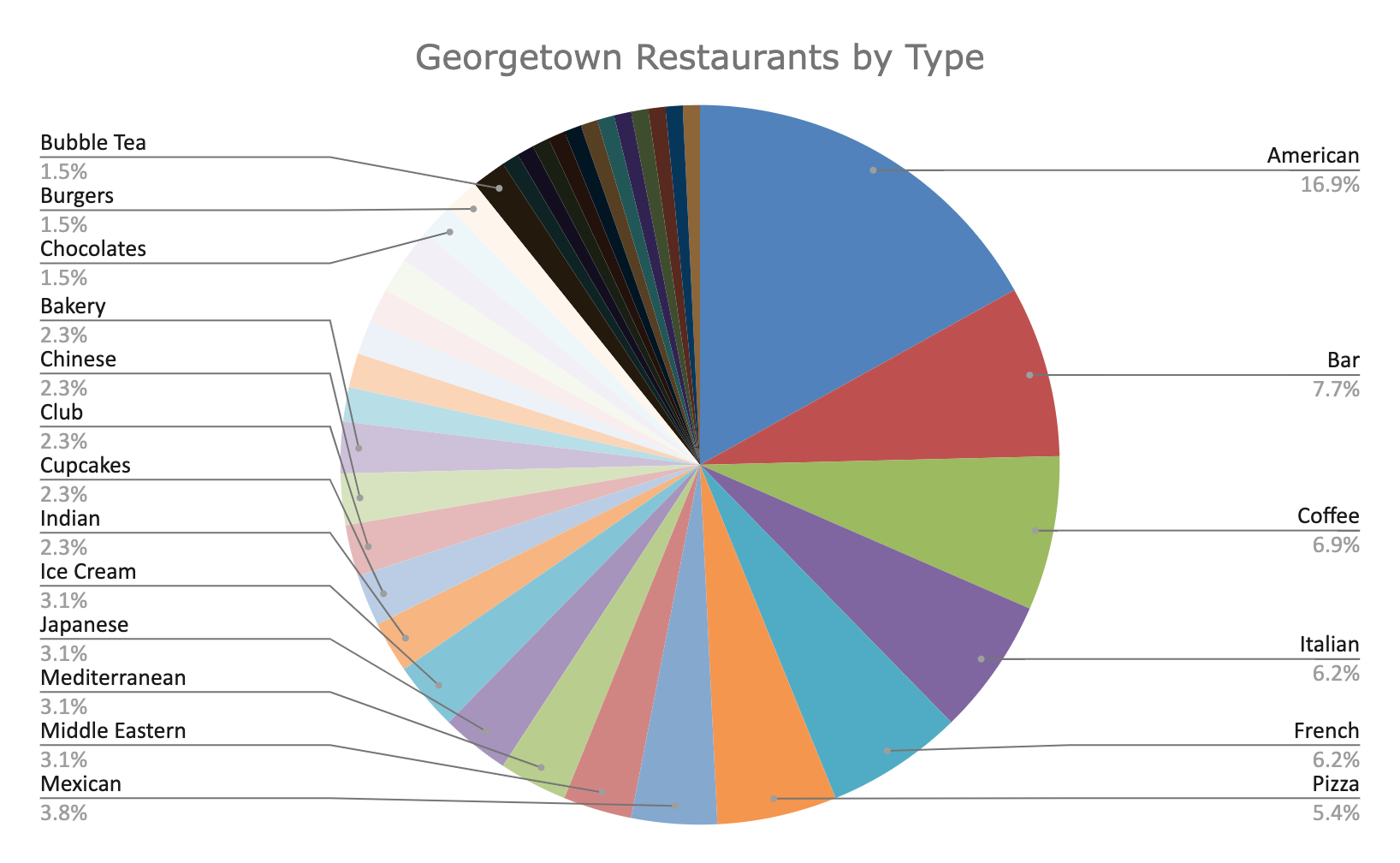
As part of GM’s store survey, he always loves to put all the restaurants and such into a pie graph and chart out what variety of cuisine the neighborhood offers. Above is this year’s chart.
As in previous years, generic American leads the way, with “bar” now coming in behind. This is partially a change in counting (GM has excluded them in previous years) and partially a reflection of the rise of fancy cocktail bars in Georgetown, with the Fountain Inn and Donahue being two recent additions.
Coffee shops still are well represented, although their numbers are down to 8 from the 12 they had before Covid hit.
Italian is the largest non-American cuisine represented, with French close behind. From there it’s a long list of different cuisines each with a handful of representatives. All in all, if you’re hungry in Georgetown, you’ve got a plethora of cuisine options.
As promised, today GM presents his compiled numbers for his survey of Georgetown. In the course of cleaning up the data, he revised (yet again) some of the preliminary numbers he shared earlier this week. So without further ado, the results:
Well, sorry, some more ado. GM would like to insert his normal caveats here. First, it’s important to know that it’s more of an art than a science. The term “shop” as used here refers to just about all commercial establishments: retail stores, restaurants, salons, gyms, etc. GM doesn’t count pure office space. The rule of thumb GM uses is if you can walk in without an appointment, it’s a shop. But again, sometimes it’s a close call (for instance, he counts realtors but not lawyers). ¯\_(ツ)_/¯.
Overall Picture
GM counted 451 shops this year. That is a sharp drop from the historic numbers. It was 509 when GM counted in 2019 right before Covid. It hasn’t been below 500 since GM counted 498 in 2016. The last time GM counted so few shops was back in 2010 when he counted 443, but that was one of the first couple years GM did the survey and was missing a ton of shops from his count.
There’s always a bit of an error rate. GM missing some shops that opened or closed each time he goes out (sometimes is genuinely hard to tell whether a business is still in business or not!) But that would only account for a handful of shops in either direction. The drop from 2019 to 2022 was 58, or over 11%. This was a genuinely sharp decline.
Yesterday GM published his initial top level numbers of his retail survey of Georgetown. One of the numbers that really jumped out was the vacancy number.
The total was 169. This was way above the recent tallies of vacancies for the neighborhood. But it occurred to GM that he may be over-counting that number a bit. That’s because over the years as he’s built up his database, he’s included some spaces that formerly contained a retail use but no longer do. This could be as simple as a space being converted to residential or office use (which GM doesn’t count as a retail use). Also, some “vacancies” were spaces like the old Smith and Hawken, which became the second floor of the Brooks Brothers. That should never really have been included as a vacancy. Other spaces were simply lost to time and GM can’t even figure out what address he was even talking about or they were torn down, like La Madeleine.













 The Georgetown Metropolitan
You must be logged in to post a comment.