
Anyone who wants to make physical changes to a building in Georgetown quickly gets to know what the Old Georgetown Board is, and how its whims can dramatically affect (or squash) the changes. Created in 1950 by the adoption by Congress of the Old Georgetown Act, the board is a group of three architects who give recommendations to the Commission of Fine Arts on any project that is forwarded to the CFA by the city due to it being within the boundaries of Old Georgetown. While the recommendations are not absolutely binding–and occasionally an applicant successfully wins an appeal from the Mayor’s Agent–they are virtually so.
But for a short period soon after the Old Georgetown Act was adopted, the breadth of the act was fiercely challenged. And for some time, the power of the Old Georgetown Board was effectively reduced to a significant degree. Only after the U.S. Attorney General weighed in was the power of the board restored to what it is today.
Beginnings
The Old Georgetown Act was passed by Congress in 1950 in order to preserve the historic nature of Georgetown. The former city celebrated its bicentennial in 1951, and the push to preserve the physical shape of the old buildings had been rising significantly since at least the 1930s. (There are other less noble reasons behind that drive that you can read about here.)
The act gives authority to the U.S. Commission of Fine Arts to issue advisory opinions to the District government on building permits in Georgetown. And the Old Georgetown Board was set up as a junior organ of the CFA to specialize on the Georgetown applications. Generally the CFA simply rubber stamps what the OGB recommends (but not always).
The District Government Pushes Back
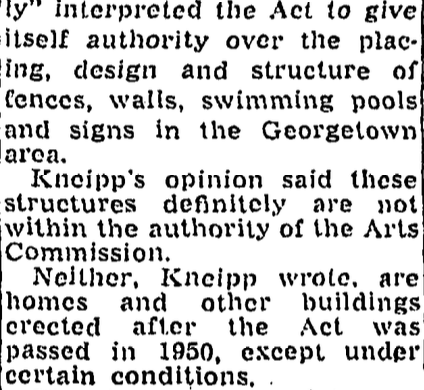
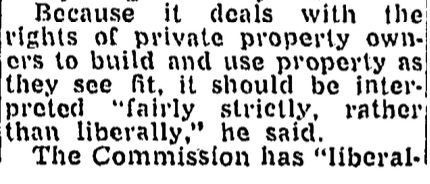
In 1957, an Assistant Corporation Counsel of the District government wrote an opinion that shocked Georgetown, and the greater preservation world. The opinion, written by Robert F. Kniepp and approved by the Corporation Counsel, Chester Gray, concluded that the CFA exceeded the authority granted to it by the act whenever it attempted to weigh in on non-historic structures. As the Post reported June 20, 1957:

 Continue reading →














 The Georgetown Metropolitan
You must be logged in to post a comment.