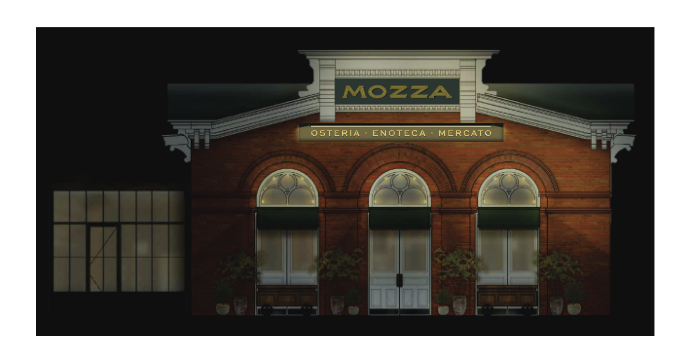
One of the most common questions I get about Georgetown recently is: When will that Italian restaurant open in the old Dean and Deluca?
Well, I don’t have a definitive date for you, but it is definitely inching forward.
The restaurant’s name will be Osteria Mozza. It will share the name with its sister restaurant in LA. Although the restauranteur behind the Georgetown project is Stephen Starr (who was behind Le Diplomate, among other ventures) the Osteria Mozza name comes from his partner in the Georgetown project: Nancy Silverton. The LA location has received a Michelin star, by the way. So if the Georgetown one matches the other’s quality, another star may be coming.
The Friends of Volta Park will be hosting their annual cocktail party on June 1st at the George Town Club. It’s always a great event and is one of the most important fundraising efforts for the park all year. Here are the details:
Buy Your Tickets: Volta Park’s Cocktail Party is June 1
Join us on Saturday, June 1, 2024, from 4:30 p.m. to 6:30 p.m. at the GeorgeTown Club for everyone’s favorite way to kickoff the summer: the Friends of Volta Park Annual Cocktail Party and Fundraiser.
Sip on signature cocktails and nibble delicious hors d’oeuvres while you catch up with neighbors, enjoy live music and get a chance to win one of our famous luxury raffle baskets, all while supporting Volta Park.
Click here to buy Cocktail Party & Luxury Raffle tickets!
As the source for the majority of our contributed donations and funding each year, this event is a must-attend for all of our Volta Park supporters.
Pillar and Post on list of best home decor shops “in the south”. (Not sure I agree with that geographic description, but I agree with the “best” part!)
The Georgetown Garden Club is celebrating its 100th year in 2024, and the highlight of the year is, of course, their annual garden tour. It returns on May 11th (and marks the 94th year it has been held).
The ANC adopted a resolution honoring the organization last month. It reads:
ANC 2E commends the Georgetown Garden Club (GGC) on its celebration of 100 years. The GGC is part of the heart and soul of Georgetown – working collaboratively on community beautification while strengthening our sense of community.
The GGC’s focus on civic engagement has benefited all parts of our community. Through its annual Garden Tour, the GGC raises funds for local green spaces, parks, public gardens, and our tree-lined streets. The tour has become a highly respected event known throughout the Mid Atlantic. The GTC has strategically provided funds for new planting in addition to funds that maintain our community’s existing green spaces. The GGC’s beneficiaries have included Book Hill Park, Trees for Georgetown, Tudor Place’s gardens, the rose garden at Montrose Park, Rose Park, Volta Park, the Dumbarton Oaks Park Conservancy and Georgetown Waterfront Park.
ANC 2E wishes the GGC another 100 years of success in enhancing the beauty and unity of our community.
The bill that would remove the exception to the rule against pot shops opening near schools and rec. centers was rejected by the council. Now whether your child is shielded from having a pot shop open next to her school boils down to what zoning the school happens to occupy. Direct any complaints to Chair Mendelson and Councilmembers McDuffie, White, Bonds, the other White, and Nadeau who all voted that it’s ok for pot shops to open right next to schools and rec. centers.
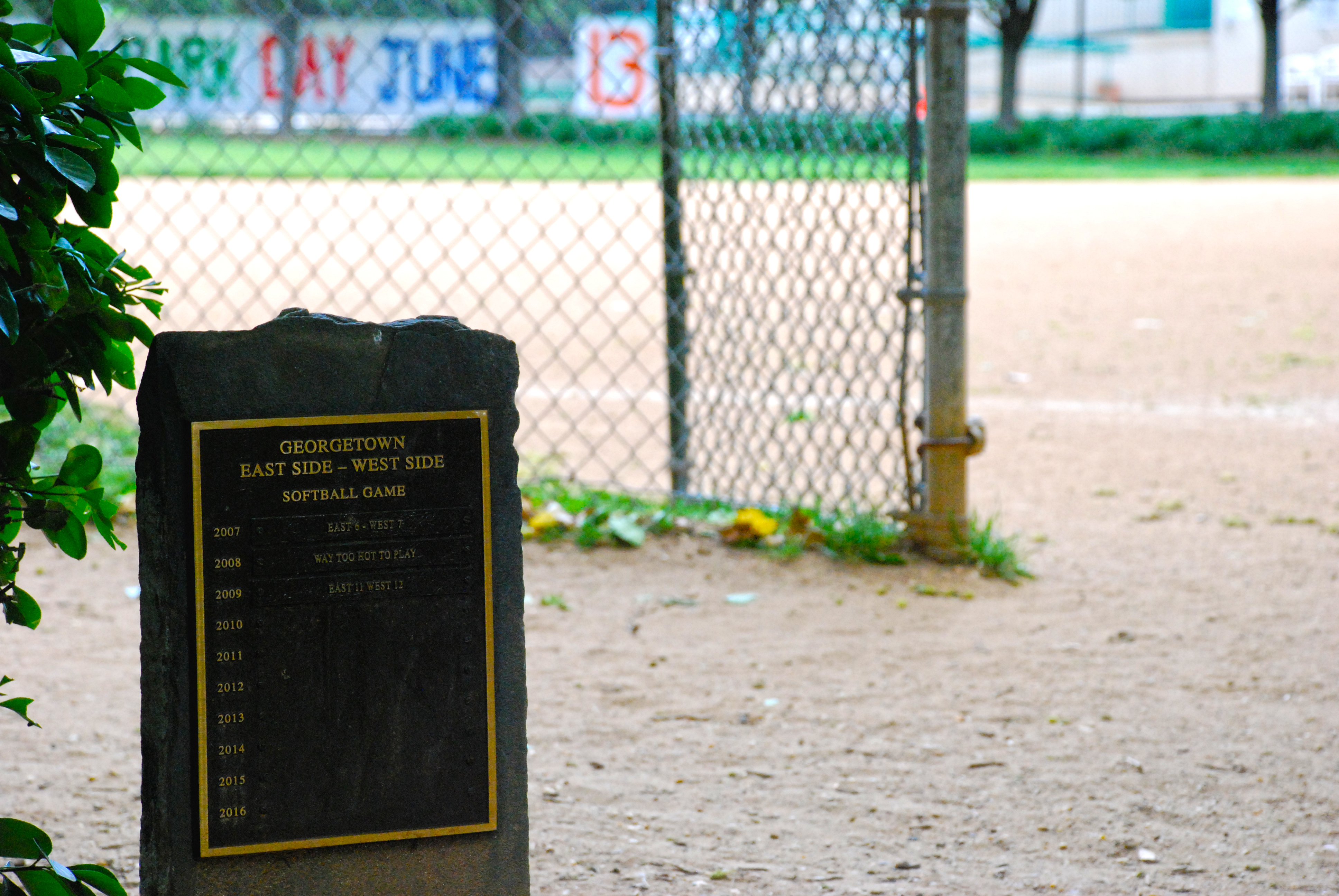
The Friends of Volta Park are hosting several events in the park this weekend. The first is a volunteer cleanup on Sunday from 8:30 AM to 10:30 AM. Come help get the park in shape for the season. At the same time, there will be crafts and music for the kiddos. So make it a whole family outing! See you there!
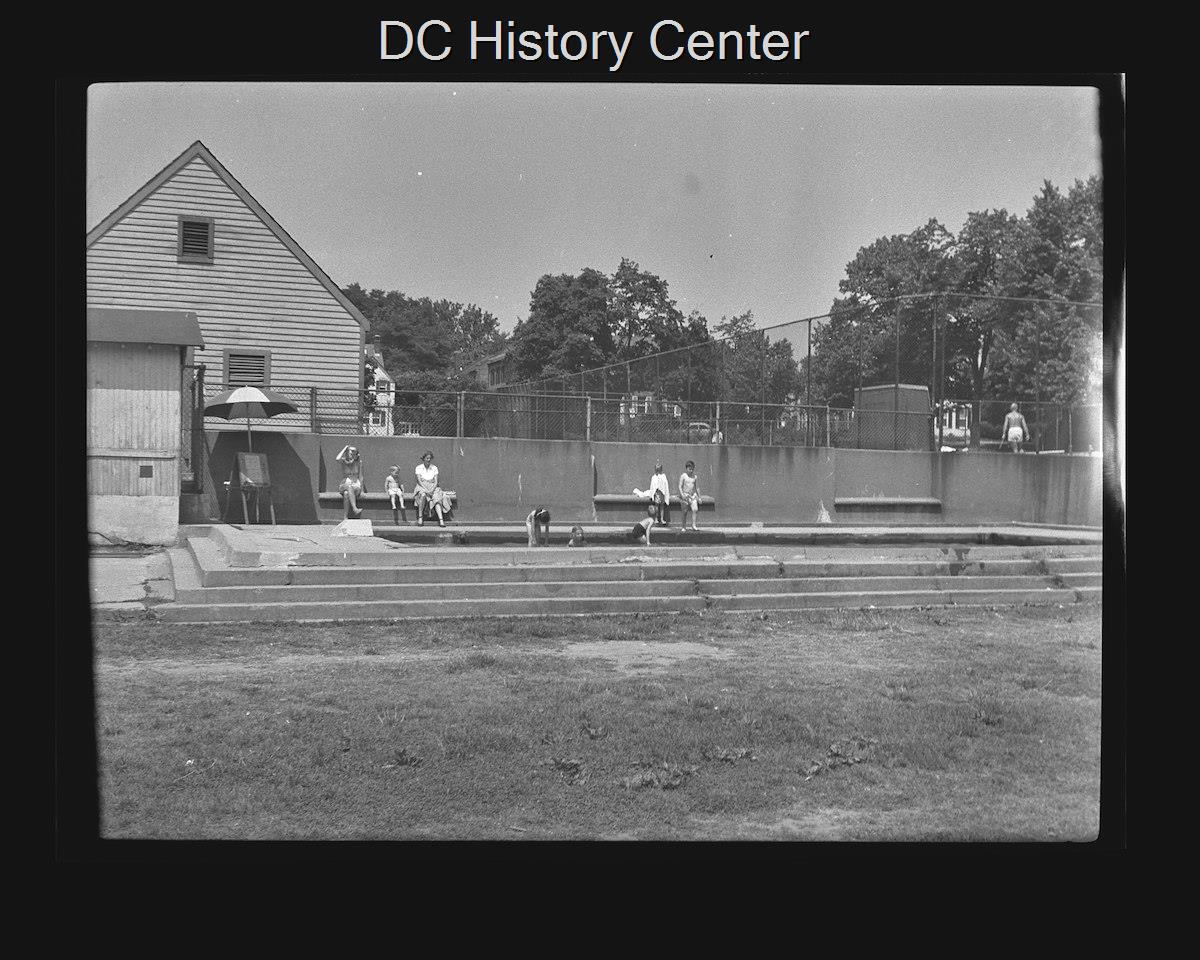
This week for Georgetown Time Machine, I’m dipping back into the wonderful DC Historical Society archives. In particular, I’ve found a snapshot from the Wymer collection, which is a priceless trove of photos taken around the city circa 1950 by Bill Wymer. This photo is of a pool and playground in Georgetown.
Wymer describes the scene as “Wading pool, Georgetown Playground, 32nd Street and Volta Place NW. July 1, 1950.” The problem, of course, with that description is that there is no playground at 32nd St. and Volta Place. In fact, there is no 32nd and Volta. The streets don’t intersect.
Wymer likely got his streets mixed up and meant to say 33rd or 34th. The photo appears to show what is now called Volta Park. It also seems to show a wading pool, which I personally had no idea was ever there. Which makes me slightly suspicious that this isn’t really Volta Park after all?
Here is an aerial photo of Volta Park from 1951, I’m not sure it correctly lines up with the photo above:
If the top photo is to make any sense, it would appear that we’re standing just southwest of the tennis courts looking north towards Q St. But in the aerial photo, there’s nothing but a grass field southwest of the tennis courts. Moreover, the homes in the back of the picture don’t line up with Q St.
I was ready to write this off as not being in Volta Park at all, but then I realized that the white house in the background actually lines up fairly well with 1558 34th St. That would mean the photo was taken from the southeast of the courts looking west. There still does not appear to be corresponding structures in the aerial shot, but it is hardly a high resolution shot. So perhaps the wading pool and the house next to it are hard to pick up.
In either event, a wonderful summer shot nonetheless!
38 years ago yesterday, the B&O Railroad official abandoned its rail line that ran from Silver Spring to K St. It later became the Capital Crescent Trail.












You must be logged in to post a comment.