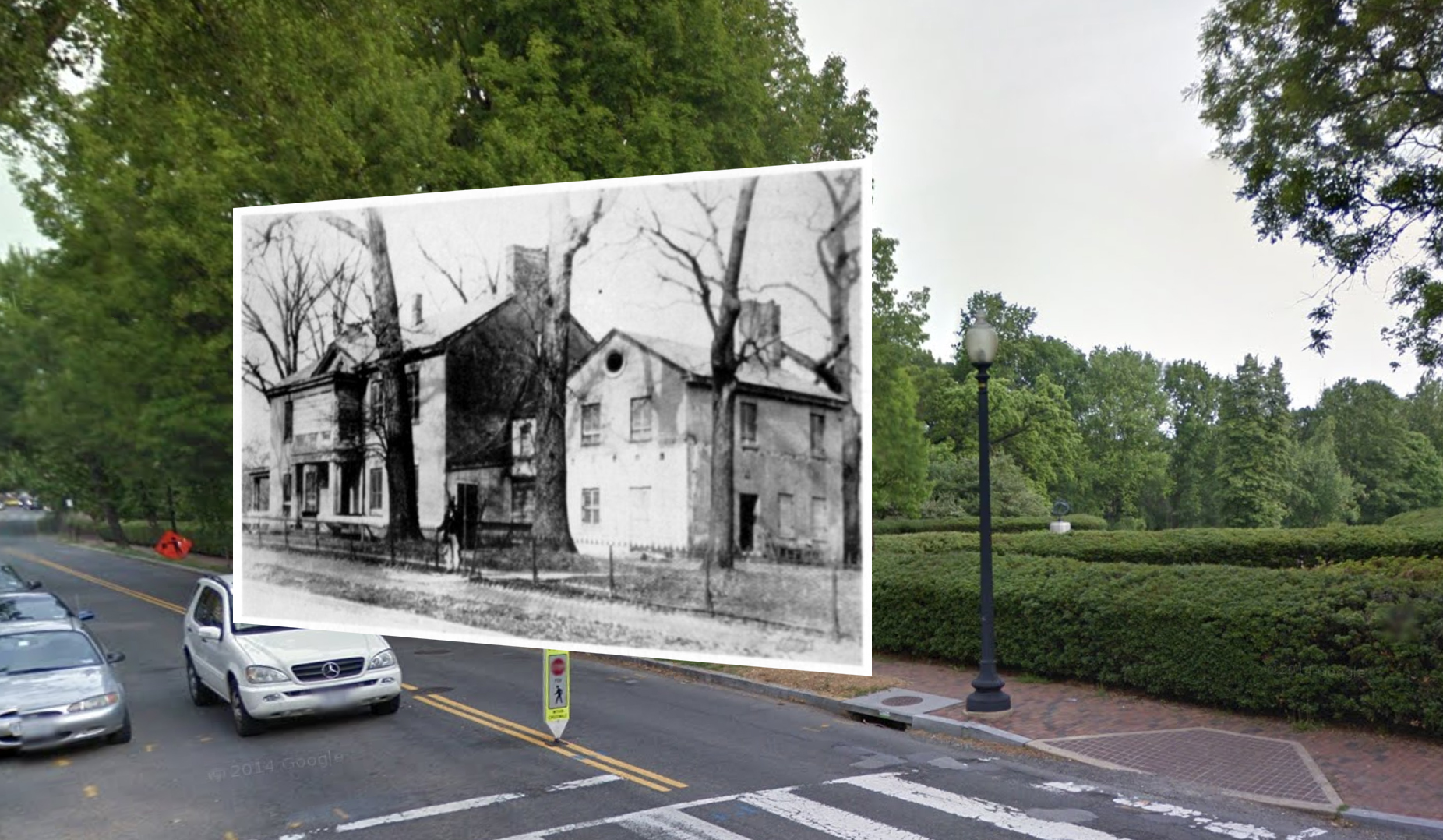
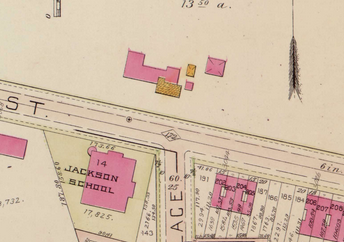
Before Montrose was a park, it was a house. On the south side of the park, just across R St. from Avon, once stood a stately home that was originally called the Montrose. It would later be renamed Elderslie, although the park always kept the original name. You can see the house on this 1903 map:
Our first knowledge of the present Montrose Park was as Parrott’s Woods. Richard Parrott conducted there a “rope walk.” It seems that when they made rope it was necessary to have a long, even stretch where the rope-makers walked up and down manufacturing the hemp into rope. And, of course, in this town with all its ships, the making of rope was a lucrative business.
Mr. Parrott evidently was kind in loaning his property for picnics too, for again Mr. Gordon gives us vivid pictures of the Fourth of July annual picnic of all the Protestant Sunday schools. It seems to have been a huge affair, with flags and banners and rosettes of various colors adorning the scholars of the different schools.
In 1822 the property was bought by Clement Smith, of[Pg 306] whom I have spoken before as being the first cashier of the Farmers and Mechanics Bank, afterwards becoming its president. He called the place Elderslie. In 1837 he sold it to Mrs. Mary McEwen Boyce, whose daughter, Jane, married George Washington Peter, son of Thomas Peter of Tudor Place. In a railroad accident, both Captain Boyce and another daughter were killed. Mrs. Boyce continued to live here the rest of her life.
It was a very sweet, homelike house, but not a particularly handsome one. There was a conservatory opening off of one of the rooms, for Mrs. Boyce seems to have been especially fond of flowers. A sweet little story was told me the other day about her. A friend paused one day to admire the roses blooming in front of the house, saying, “How lovely your roses are, Mrs. Boyce!” “They are not my roses,” said she. At the surprised look on her friend’s face she continued, “I plant them there for the public.” And still, today, there are lovely roses blooming at Montrose for “the public,” for after many, many years a movement was set on foot to buy this place with its marvelous old trees of numerous varieties for a park for the people of Georgetown.
Two historic events have taken place in Montrose Park. The first was long ago, on September 1, 1812, when the funeral services were held here for General James Maccubbin Lingan, after his tragic death in Baltimore. No church could be found large enough to accommodate the crowds which wished to attend. There were representatives from three cities and five counties, in those days of travel by foot, by saddle, by rowboat and by coach. General Washington’s tent was spread over the stand on which were four clergymen, other dignitaries, and George[Pg 307]Washington Parke Custis of Arlington, who delivered the oration.
The funeral cortege was escorted by Major George Peter’s company. The General’s horse was led behind the hearse, where his son walked as chief mourner, followed by two heroes of the Revolution, Major Benjamin Stoddert and Colonel Philip Stuart. Light Horse Harry Lee, who had been wounded at the time General Lingan was killed, was still too ill to be present.
General Lingan’s widow was not able to be present because of a very unfortunate occurrence. While she was sitting by her window waiting for her carriage, a rough man, carrying a pike, stopped under her window and, thrusting up the weapon covered either with blood or rust, which had the same appearance, he let forth a torrent of brutal words. She was so overcome with an agony of shock and grief that she was obliged to remain at home.
The other historic event took place on the fifth of June, 1918, the day on which was inaugurated the draft for the soldiers of the World War I. All over this land that evening speeches were delivered on the subject, but I think none could have been more effective or impressive than the one staged in Montrose Park at sunset. Then Newton D. Baker, as Secretary of War, in charge of the whole operation, “elected to speak to his neighbors.” A wonderful speech it was, and I shall never forget the sight as he stood outlined against the glow of the western sky.











 The Georgetown Metropolitan
You must be logged in to post a comment.