The French Market returns this weekend to Book Hill. The festivities start Friday and they run all the way till Sunday. Friday and Saturday it is from 10 am to 5 pm, and on Sunday it’s noon to 5:00.
This is always a great time and looks like the weather should be very pleasant, with just a few stray rain clouds Saturday and Sunday. So come out early and often!
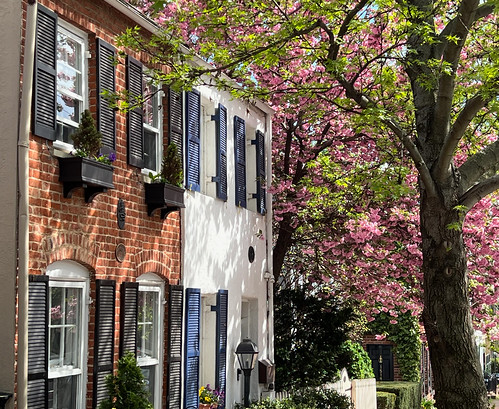
A home with quite a lot of history has just hit the market. It’s 3126 O St. and it was home to one of Georgetown’s earliest schools: the Lancaster School. It can be yours for a mere $5.2 million.
I wrote about the school history way back in 2009 as part of my series on various school buildings in Georgetown. Here it is reprinted:
Today for his survey of historic school buildings in Georgetown, GM sets his sights on the Lancaster School.
The Lancaster School
3126 O St.
Built: Cornerstone laid June, 1811, school opened November 18, 1811
Architect: Unknown
Current Use: Private Residence
Brief History:
The Lancaster school is both a proper name and a descriptive term. A “Lancasterian” school is a school that follows the principals of John Lancaster, who promoted a system of public education based on the one room school house model. In fact, the Lancaster School in Georgetown was the very first public school open to girls and African-Americans in the District.
Like many projects in early nineteenth century Georgetown, Francis Scott Key had his star spangled fingers in the creation of the Lancaster School. Under his encouragement, funds were raised to support the school and enable it to offer free education to poor children (if you could afford it, you paid $10 per year per student).
The first teacher of the Lancaster School was an Englishman named Robert Ould who came from the Borough School of London. The first year he taught a class of over 200 students. Apparently by 1812, the student body was nearly 300.
Unfortunately, GM was unable to track down much else about the Lancaster School after its first couple years. Regardless, being the first public school in D.C. open to girls and African Americans is probably enough of a history for any old school building to be proud of.
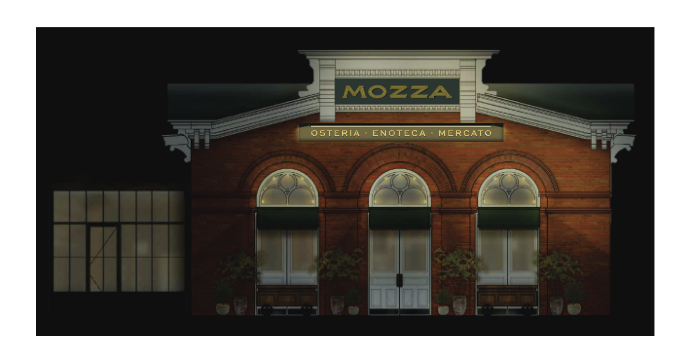
One of the most common questions I get about Georgetown recently is: When will that Italian restaurant open in the old Dean and Deluca?
Well, I don’t have a definitive date for you, but it is definitely inching forward.
The restaurant’s name will be Osteria Mozza. It will share the name with its sister restaurant in LA. Although the restauranteur behind the Georgetown project is Stephen Starr (who was behind Le Diplomate, among other ventures) the Osteria Mozza name comes from his partner in the Georgetown project: Nancy Silverton. The LA location has received a Michelin star, by the way. So if the Georgetown one matches the other’s quality, another star may be coming.
The Friends of Volta Park will be hosting their annual cocktail party on June 1st at the George Town Club. It’s always a great event and is one of the most important fundraising efforts for the park all year. Here are the details:
Buy Your Tickets: Volta Park’s Cocktail Party is June 1
Join us on Saturday, June 1, 2024, from 4:30 p.m. to 6:30 p.m. at the GeorgeTown Club for everyone’s favorite way to kickoff the summer: the Friends of Volta Park Annual Cocktail Party and Fundraiser.
Sip on signature cocktails and nibble delicious hors d’oeuvres while you catch up with neighbors, enjoy live music and get a chance to win one of our famous luxury raffle baskets, all while supporting Volta Park.
Click here to buy Cocktail Party & Luxury Raffle tickets!
As the source for the majority of our contributed donations and funding each year, this event is a must-attend for all of our Volta Park supporters.
Pillar and Post on list of best home decor shops “in the south”. (Not sure I agree with that geographic description, but I agree with the “best” part!)
The Georgetown Garden Club is celebrating its 100th year in 2024, and the highlight of the year is, of course, their annual garden tour. It returns on May 11th (and marks the 94th year it has been held).
The ANC adopted a resolution honoring the organization last month. It reads:
ANC 2E commends the Georgetown Garden Club (GGC) on its celebration of 100 years. The GGC is part of the heart and soul of Georgetown – working collaboratively on community beautification while strengthening our sense of community.
The GGC’s focus on civic engagement has benefited all parts of our community. Through its annual Garden Tour, the GGC raises funds for local green spaces, parks, public gardens, and our tree-lined streets. The tour has become a highly respected event known throughout the Mid Atlantic. The GTC has strategically provided funds for new planting in addition to funds that maintain our community’s existing green spaces. The GGC’s beneficiaries have included Book Hill Park, Trees for Georgetown, Tudor Place’s gardens, the rose garden at Montrose Park, Rose Park, Volta Park, the Dumbarton Oaks Park Conservancy and Georgetown Waterfront Park.
ANC 2E wishes the GGC another 100 years of success in enhancing the beauty and unity of our community.
The bill that would remove the exception to the rule against pot shops opening near schools and rec. centers was rejected by the council. Now whether your child is shielded from having a pot shop open next to her school boils down to what zoning the school happens to occupy. Direct any complaints to Chair Mendelson and Councilmembers McDuffie, White, Bonds, the other White, and Nadeau who all voted that it’s ok for pot shops to open right next to schools and rec. centers.











You must be logged in to post a comment.