
 Photo by Marc Andre.
Good morning Georgetown, here’s the latest:
- Should participation in an acappella group disqualify you for higher office? And how possibly could you not say yes?
- Drone delivery tank(?) seen around Georgetown.
Photo by Marc Andre.
Good morning Georgetown, here’s the latest:
Filed under Uncategorized

Anyone who wants to make physical changes to a building in Georgetown quickly gets to know what the Old Georgetown Board is, and how its whims can dramatically affect (or squash) the changes. Created in 1950 by the adoption by Congress of the Old Georgetown Act, the board is a group of three architects who give recommendations to the Commission of Fine Arts on any project that is forwarded to the CFA by the city due to it being within the boundaries of Old Georgetown. While the recommendations are not absolutely binding–and occasionally an applicant successfully wins an appeal from the Mayor’s Agent–they are virtually so.
But for a short period soon after the Old Georgetown Act was adopted, the breadth of the act was fiercely challenged. And for some time, the power of the Old Georgetown Board was effectively reduced to a significant degree. Only after the U.S. Attorney General weighed in was the power of the board restored to what it is today.
Beginnings
The Old Georgetown Act was passed by Congress in 1950 in order to preserve the historic nature of Georgetown. The former city celebrated its bicentennial in 1951, and the push to preserve the physical shape of the old buildings had been rising significantly since at least the 1930s. (There are other less noble reasons behind that drive that you can read about here.)
The act gives authority to the U.S. Commission of Fine Arts to issue advisory opinions to the District government on building permits in Georgetown. And the Old Georgetown Board was set up as a junior organ of the CFA to specialize on the Georgetown applications. Generally the CFA simply rubber stamps what the OGB recommends (but not always).
The District Government Pushes Back
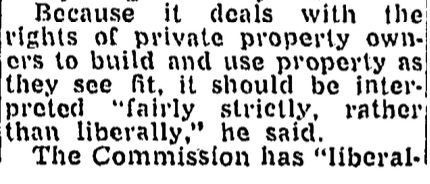
In 1957, an Assistant Corporation Counsel of the District government wrote an opinion that shocked Georgetown, and the greater preservation world. The opinion, written by Robert F. Kniepp and approved by the Corporation Counsel, Chester Gray, concluded that the CFA exceeded the authority granted to it by the act whenever it attempted to weigh in on non-historic structures. As the Post reported June 20, 1957:
Filed under Uncategorized
 Photo by Marc Andre.
Good morning Georgetown, here’s the latest:
Filed under Uncategorized

Last night at the ANC meeting, the commission considered the BID’s proposal to construct a gondola between Rosslyn and Georgetown. Following an abbreviated presentation by Joe Sternlieb, the BID CEO, the ANC passed a resolution in favor of the project moving forward, with certain reservations.
Much of the talk regarding the gondola over the last couple weeks has been about the fact that the Arlington County Board wrote a letter stating that they did not intend to provide any money for the project. The reticence on the part of the board has much to do with the fact that the board has recently been taken over by Tea Party-like members who are intent of stopping, or significantly diminishing, all significant capital projects in the county. Most central to their effort was the plan to kill the Columbia Pike Streetcar project, which they did once elected. They also promised a replacement plan that would provide improved transit to the corridor. Spoiler alert: they didn’t.
This Tea Party-like spasm will likely subside long before the gondola project would be constructed, and a future Arlington board may be more willing to chip in. But it may not really be necessary, as some sort of private funding may be able to take care of the Virginia side. Continue reading
Filed under Uncategorized
 Photo by Marc Andre.
Good morning Georgetown, here’s the latest:
Filed under Uncategorized

Way back in 2009, GM expressed a healthy dose of skepticism for a Georgetown startup called LivingSocial. Why that skepticism seems ill-placed for a little while, the inevitable came about: last week it was revealed that Living Social was sold to its ostensible rival, Groupon, for $0.
So although there was some rather eye-catching valuations between GM’s original skepticism and the zero dollar valuation, GM still feels justified. And for that reason (and because he doesn’t have any other article ideas at hand) GM will re-run his 2009 article below:
What are your five favorite bands? How about your five favorite movies? How about your five favorite fast food restaurants? If you’re a Facebook user, these inane questions probably sound awfully familiar. That’s because the ubiquitous social networking site has been lousy recently with people announcing to the world their top five favorite-things-that-nobody-else-cares-about. The application that enables this pointless ranking system is called LivingSocial, and surprisingly enough it was developed by a start-up company based right here in Georgetown.
And as of this week, LivingSocial became the number one Facebook application, registering 20 million active users. In doing so, it knocked out of the top spot another application called Causes that helps charities raise money.
Filed under Uncategorized
 Photo by Ehpien.
Good morning Georgetown, here’s the latest:
Filed under Uncategorized












 The Georgetown Metropolitan
You must be logged in to post a comment.