
Dumbarton Oaks Park

In what’s becoming an annual tradition, GM forgot to mark his seventh anniversary doing whatever this website is. That’s easily at least five more years than he ever figured he would do this. Maybe he should hire a editor in chief so that he can get fired and finally take a break?
Anyway, GM likes to review his most popular articles from the last year. Here it goes:
#5 – Loads of New Stores on the Horizon
This article was the first to announce the coming of Boulangerie Christoph, Lauderee, and Kit & Ace. The news of Lauderee caught the most attention, although it has yet to be confirmed. We’ll see.
#4 – Why do the Exorcist Steps Exist in the First Place?
In all the excitement over the designation of the Exorcist steps as a historic landmark, GM looked into why they exist at all. He didn’t get a terribly satisfying answer, but then again, they’re just stairs. Not all stairs have a dark secret. Continue reading
Filed under Uncategorized
 Photo by Joe Flood.
Good morning Georgetown, here’s the latest:
Filed under Uncategorized
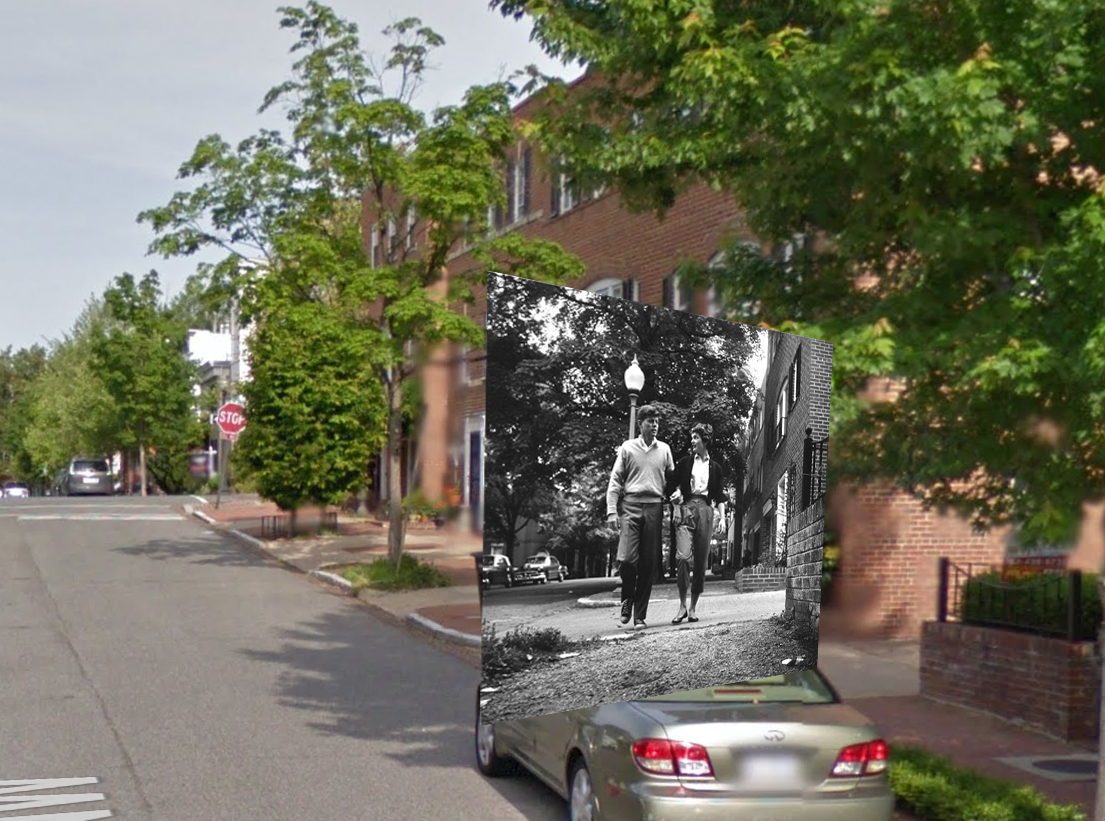
Today on now and a long GM takes a swing by Dent Pl in May 1954. Walking down the street here is the new Massachusetts senator and his wife. JFK and Jackie lived at 3321 Dent Pl. on this block from 1953 to 1957.
The photo was taken by Orlando Suero. Of this series of photos, Jackie had to say:
They are the only pictures I’ve ever seen of me where I don’t look like something out of a horror movie.
As always, though, these old shots of Georgetown from the fifties keep reminding GM how much better the tree canopy was back then…
Filed under Uncategorized
 Photo by Joe Flood.
Good morning Georgetown, here’s the latest:
Filed under Uncategorized

Most people with even just a passing knowledge of Georgetown history are aware that at some point in the neighborhood’s past there was once a significant African American population that is for the most part not around anymore. Those with a slightly deeper knowledge will attest to the fact that Georgetown was in the 1930s the first neighborhood in DC to undergo a process that was later to be called gentrification. But what most people don’t realize is how much the current state of Georgetown was intentionally built upon that process.
Among the first qualities of Georgetown cited by people extolling its charms is the historic architecture of the neighborhood. And it’s true that Georgetown as a neighborhood is a virtual ark of American architecture from the late 18th to the early 20th centuries. One of the reasons the building stock has survived is that Georgetown entered a long economic lull in the late 19th century. It was an age of benign neglect which spared Georgetown from dramatic demolition and expansion that a more prosperous time would have inevitably brought. By the time interest grew again for living in Georgetown in the 1930s, the fog of nostalgia had descended. The first flickers of a wider preservationist movement (Colonial Williamsburg was formed in the 1920s to wide acclaim) sparked a drive to save Georgetown as it stood.
That, at least, is the sanitized version of how Georgetown became Georgetown.
A more accurate picture of how the depressed neighborhood with pockets of poverty and racial diversity transformed is less rosy. Two significant Congressional acts can be credited with the change. The first was the Alley Dwelling Act of 1934. This act created the Alley Dwelling Authority, a city agency that was granted the power to condemn and demolish cramped alley dwellings. While the act had an air of a progressive policy–one that refused to allow people to live in squalor in the nation’s capital–the act also had an implicit (if not entirely explicit) goal to evict black residents specifically.
Preservation in places and time like Georgetown in the 1930s is a decidedly double-edged sword. Regardless of the intentions behind the changes (and they were almost certainly not entirely pure), when existing housing stock is deemed substandard and the tenants forced out so that the home can either be demolished or modernized, the end result almost always meant the previous tenant was not welcome back afterwards. The conditions were ameliorated, yes, and in many cases in Georgetown the architecture was preserved, but the people who lived there were forced out. Continue reading
Filed under Uncategorized
 Photo by M.V. Jantzen.
Good morning Georgetown, here’s the latest:
Filed under Uncategorized











You must be logged in to post a comment.